

Kinetics and Energetics of Photosynthetic Micro-Organisms in Photobioreactors
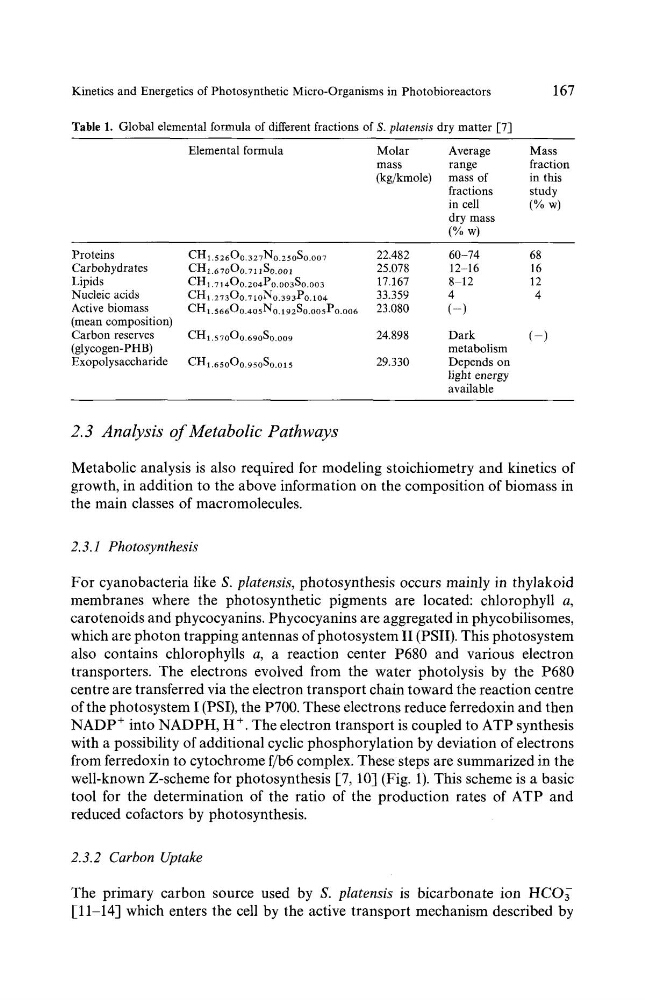
Table 1. Global elemental formula of different fractions of S. platensis dry matter [7]
167
Elemental formula
Molar
Average
Mass
mass
range
fraction
(kg/kmole) mass of
in this
fractions
study
in cell
(% w)
dry mass
(% w)
Proteins
Carbohydrates
Lipids
Nucleic acids
Active biomass
(mean composition)
Carbon reserves
(glycogen-PHB)
Exopolysaccharide
CH1.52600.327N0.25 oSo.o07
22.482
CH1.67o0o.71 l So.oo l
25.078
CH1.7140o.eo4Po.oo3So.oo 3
17.167
CH t.273Oo.71 oNo.393Po. 1 o4
33.359
CH1.56600.aosN0.192S0.0osPo.006 23.080
60-74
68
12-16
16
8 12
12
4
4
(-)
CH1.57000,690S0.009
24.898
Dark
(--)
metabolism
CH1.65oO0.95oS0.015
29.330
Depends on
light energy
available
2.3 Analysis of Metabolic Pathways
Metabolic analysis is also required for modeling stoichiometry and kinetics of
growth, in addition to the above information on the composition of biomass in
the main classes of macromolecules.
2.3.1 Photosynthesis
For cyanobacteria like S. platensis, photosynthesis occurs mainly in thylakoid
membranes where the photosynthetic pigments are located: chlorophyll a,
carotenoids and phycocyanins. Phycocyanins are aggregated in phycobilisomes,
which are photon trapping antennas of photosystem II (PSII). This photosystem
also contains chlorophylls a, a reaction center P680 and various electron
transporters. The electrons evolved from the water photolysis by the P680
centre are transferred via the electron transport chain toward the reaction centre
of the photosystem I (PSI), the P700. These electrons reduce ferredoxin and then
NADP + into NADPH, H +. The electron transport is coupled to ATP synthesis
with a possibility of additional cyclic phosphorylation by deviation of electrons
from ferredoxin to cytochrome f/b6 complex. These steps are summarized in the
well-known Z-scheme for photosynthesis [7, 10] (Fig. 1). This scheme is a basic
tool for the determination of the ratio of the production rates of ATP and
reduced cofactors by photosynthesis.
2.3.2 Carbon Uptake
The primary carbon source used by S. platensis is bicarbonate ion HCO3
[11-14] which enters the cell by the active transport mechanism described by
Table 1. Global elemental formula of different fractions of S. platensis dry matter [7]
167
Elemental formula
Molar
Average
Mass
mass
range
fraction
(kg/kmole) mass of
in this
fractions
study
in cell
(% w)
dry mass
(% w)
Proteins
Carbohydrates
Lipids
Nucleic acids
Active biomass
(mean composition)
Carbon reserves
(glycogen-PHB)
Exopolysaccharide
CH1.52600.327N0.25 oSo.o07
22.482
CH1.67o0o.71 l So.oo l
25.078
CH1.7140o.eo4Po.oo3So.oo 3
17.167
CH t.273Oo.71 oNo.393Po. 1 o4
33.359
CH1.56600.aosN0.192S0.0osPo.006 23.080
60-74
68
12-16
16
8 12
12
4
4
(-)
CH1.57000,690S0.009
24.898
Dark
(--)
metabolism
CH1.65oO0.95oS0.015
29.330
Depends on
light energy
available
2.3 Analysis of Metabolic Pathways
Metabolic analysis is also required for modeling stoichiometry and kinetics of
growth, in addition to the above information on the composition of biomass in
the main classes of macromolecules.
2.3.1 Photosynthesis
For cyanobacteria like S. platensis, photosynthesis occurs mainly in thylakoid
membranes where the photosynthetic pigments are located: chlorophyll a,
carotenoids and phycocyanins. Phycocyanins are aggregated in phycobilisomes,
which are photon trapping antennas of photosystem II (PSII). This photosystem
also contains chlorophylls a, a reaction center P680 and various electron
transporters. The electrons evolved from the water photolysis by the P680
centre are transferred via the electron transport chain toward the reaction centre
of the photosystem I (PSI), the P700. These electrons reduce ferredoxin and then
NADP + into NADPH, H +. The electron transport is coupled to ATP synthesis
with a possibility of additional cyclic phosphorylation by deviation of electrons
from ferredoxin to cytochrome f/b6 complex. These steps are summarized in the
well-known Z-scheme for photosynthesis [7, 10] (Fig. 1). This scheme is a basic
tool for the determination of the ratio of the production rates of ATP and
reduced cofactors by photosynthesis.
2.3.2 Carbon Uptake
The primary carbon source used by S. platensis is bicarbonate ion HCO3
[11-14] which enters the cell by the active transport mechanism described by