

Kinetics and Energetics of Photosynthetic Micro-Organisms in Photobioreactors
165
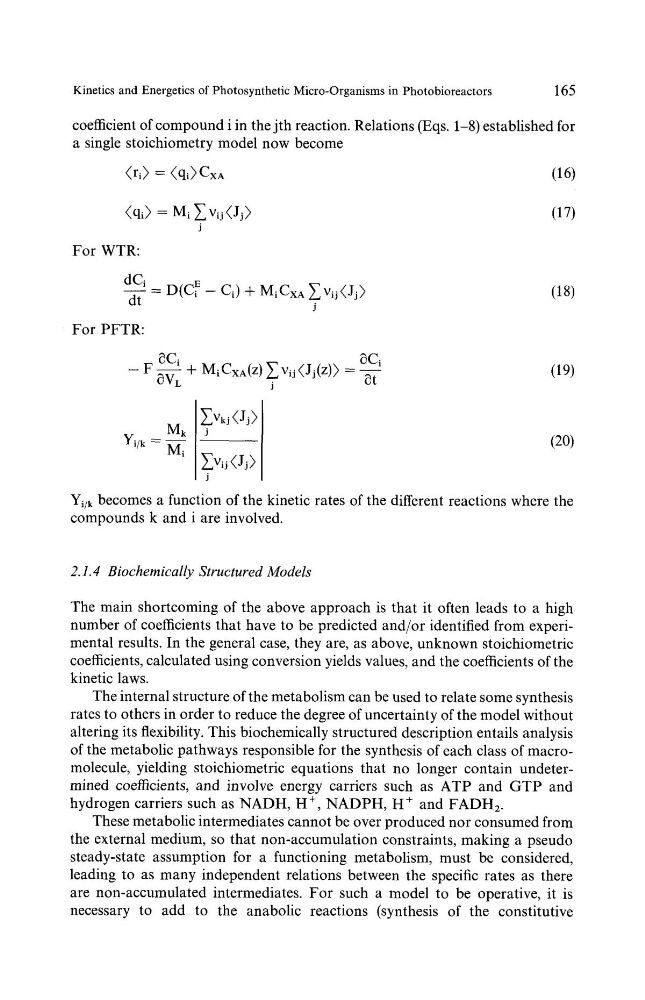
coefficient of compound i in the jth reaction. Relations (Eqs. 1-8) established for
a single stoichiometry model now become
(ri) = (qi)Cxa
(16)
(qi) = Mi y' v~j (Jj)
(17)
J
For WTR:
dCi = D(C~ - Ci) + MICxA Zvij
dt
j
For PFTR:
~VL + M i CxA(Z) Y' Vij (Jj (z)) - ~C~
(19)
j
~t
Mk j~. Vkj (Jj)
Yi/k ~ Nil [~vij(Jj)
(20)
IJ
Yi/k becomes a function of the kinetic rates of the different reactions where the
compounds k and i are involved.
2.1.4 Biochemically Structured Models
The main shortcoming of the above approach is that it often leads to a high
number of coefficients that have to be predicted and/or identified from experimental results. In the general case, they are, as above, unknown stoichiometric
coefficients, calculated using conversion yields values, and the coefficients of the
kinetic laws.
The internal structure of the metabolism can be used to relate some synthesis
rates to others in order to reduce the degree of uncertainty of the model without
altering its flexibility. This biochemically structured description entails analysis
of the metabolic pathways responsible for the synthesis of each class of macromolecule, yielding stoichiometric equations that no longer contain undetermined coefficients, and involve energy carriers such as ATP and GTP and
hydrogen carriers such as NADH, H +, NADPH, H § and FADH2.
These metabolic intermediates cannot be over produced nor consumed from
the external medium, so that non-accumulation constraints, making a pseudo
steady-state assumption for a functioning metabolism, must be considered,
leading to as many independent relations between the specific rates as there
are non-accumulated intermediates. For such a model to be operative, it is
necessary to add to the anabolic reactions (synthesis of the constitutive
165
coefficient of compound i in the jth reaction. Relations (Eqs. 1-8) established for
a single stoichiometry model now become
(ri) = (qi)Cxa
(16)
(qi) = Mi y' v~j (Jj)
(17)
J
For WTR:
dCi = D(C~ - Ci) + MICxA Zvij
dt
j
For PFTR:
~VL + M i CxA(Z) Y' Vij (Jj (z)) - ~C~
(19)
j
~t
Mk j~. Vkj (Jj)
Yi/k ~ Nil [~vij(Jj)
(20)
IJ
Yi/k becomes a function of the kinetic rates of the different reactions where the
compounds k and i are involved.
2.1.4 Biochemically Structured Models
The main shortcoming of the above approach is that it often leads to a high
number of coefficients that have to be predicted and/or identified from experimental results. In the general case, they are, as above, unknown stoichiometric
coefficients, calculated using conversion yields values, and the coefficients of the
kinetic laws.
The internal structure of the metabolism can be used to relate some synthesis
rates to others in order to reduce the degree of uncertainty of the model without
altering its flexibility. This biochemically structured description entails analysis
of the metabolic pathways responsible for the synthesis of each class of macromolecule, yielding stoichiometric equations that no longer contain undetermined coefficients, and involve energy carriers such as ATP and GTP and
hydrogen carriers such as NADH, H +, NADPH, H § and FADH2.
These metabolic intermediates cannot be over produced nor consumed from
the external medium, so that non-accumulation constraints, making a pseudo
steady-state assumption for a functioning metabolism, must be considered,
leading to as many independent relations between the specific rates as there
are non-accumulated intermediates. For such a model to be operative, it is
necessary to add to the anabolic reactions (synthesis of the constitutive