

96
D.C. Hill et al.
4.1 Inflammatory Disease
4.1.1 Sugar Metabolism lnhibitors
Glycoconjugates on mammalian cell surfaces have an important functional role,
not least in inflammatory disease where cell adhesion is a key process in
leukocyte rolling and, ultimately, extravasation. Cell adhesion is also important
in cancer metastasis and viral infection. A plethora of enzymes are involved in
the metabolism of sugars presented at cell surfaces. One such enzyme which has
been used in a microbial screening programme is 0t-D-mannosidase.
Rat epididymis 0t-D-mannosidase activity was determined colorimetrically
by measuring the amount of p-nitrophenol released from p-nitrophenyl mannose. A screening programme based on this assay resulted in the discovery of the
at-D-mannosidase inhibitors, mannostatins A and B, from the culture broth of
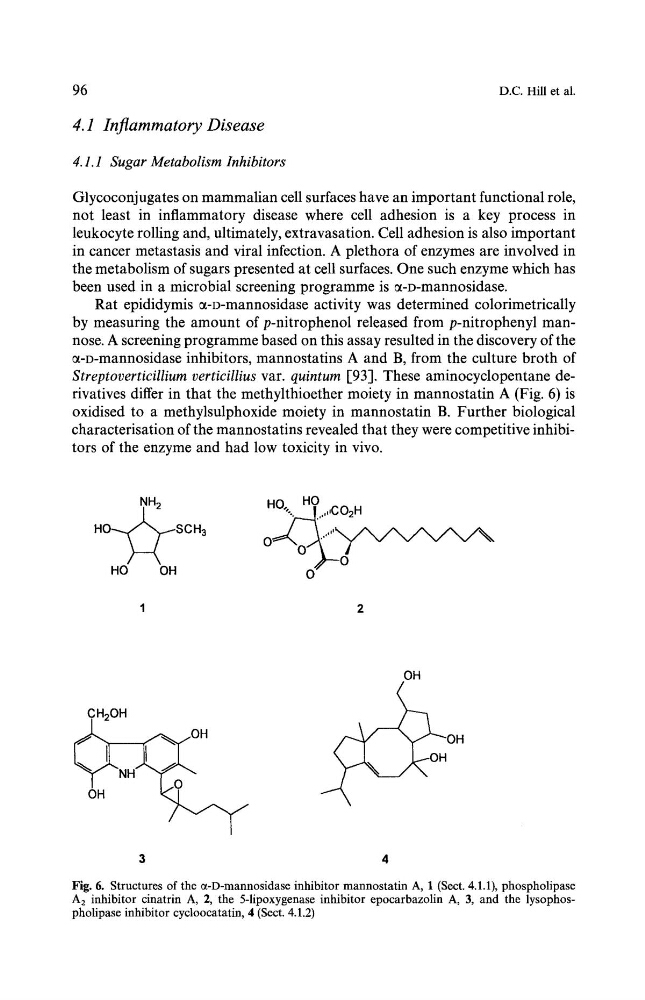
Streptoverticillium verticillius var. quintum [-93]. These aminocyclopentane derivatives differ in that the methylthioether moiety in mannostatin A (Fig. 6) is
oxidised to a methylsulphoxide moiety in mannostatin B. Further biological
characterisation of the mannostatins revealed that they were competitive inhibitors of the enzyme and had low toxicity in vivo.
NH2
HO HO ,
HO
SCH 3
O~ O
HO
OH
1
2
CH20H
OH
3
4
Fig. 6. Structures of the at-D-mannosidase inhibitor mannostatin A, 1 (Sect. 4.1.1), phospholipase
A2 inhibitor cinatrin A, 2, the 5-1ipoxygenase inhibitor epocarbazolin A, 3, and the lysophospholipase inhibitor cycloocatatin, 4 (Sect. 4.1.2)
D.C. Hill et al.
4.1 Inflammatory Disease
4.1.1 Sugar Metabolism lnhibitors
Glycoconjugates on mammalian cell surfaces have an important functional role,
not least in inflammatory disease where cell adhesion is a key process in
leukocyte rolling and, ultimately, extravasation. Cell adhesion is also important
in cancer metastasis and viral infection. A plethora of enzymes are involved in
the metabolism of sugars presented at cell surfaces. One such enzyme which has
been used in a microbial screening programme is 0t-D-mannosidase.
Rat epididymis 0t-D-mannosidase activity was determined colorimetrically
by measuring the amount of p-nitrophenol released from p-nitrophenyl mannose. A screening programme based on this assay resulted in the discovery of the
at-D-mannosidase inhibitors, mannostatins A and B, from the culture broth of
Streptoverticillium verticillius var. quintum [-93]. These aminocyclopentane derivatives differ in that the methylthioether moiety in mannostatin A (Fig. 6) is
oxidised to a methylsulphoxide moiety in mannostatin B. Further biological
characterisation of the mannostatins revealed that they were competitive inhibitors of the enzyme and had low toxicity in vivo.
NH2
HO HO ,
HO
SCH 3
O~ O
HO
OH
1
2
CH20H
OH
3
4
Fig. 6. Structures of the at-D-mannosidase inhibitor mannostatin A, 1 (Sect. 4.1.1), phospholipase
A2 inhibitor cinatrin A, 2, the 5-1ipoxygenase inhibitor epocarbazolin A, 3, and the lysophospholipase inhibitor cycloocatatin, 4 (Sect. 4.1.2)