

94
D.C. Hill et al.
HO HO 0 OH 0
H3CO O~
NH2
OH
W
0
0
N 0
0
OH
0
H
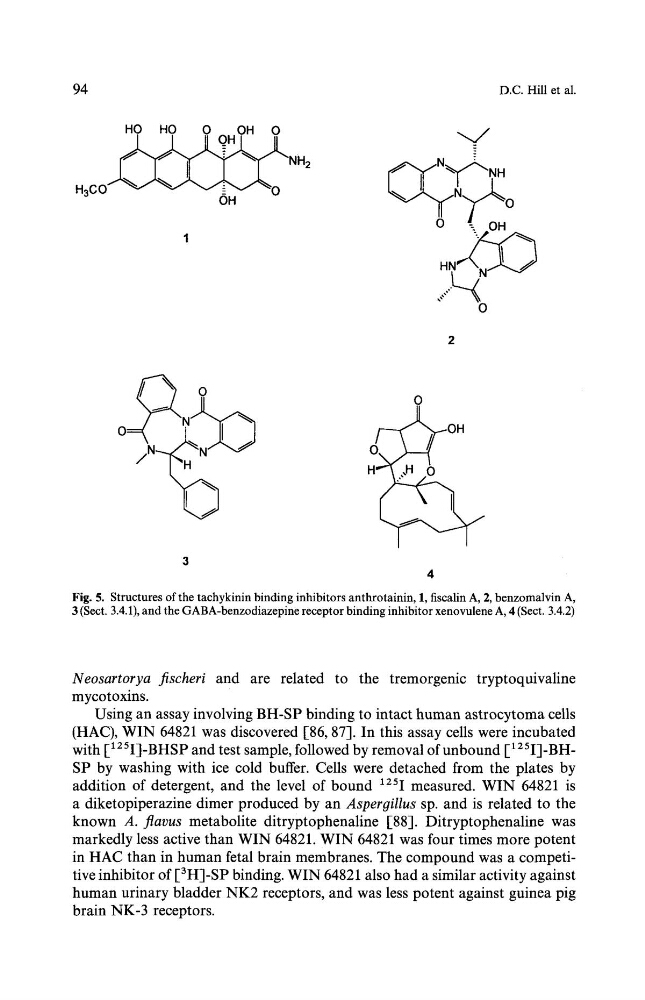
Fig. 5. Structures of the tachykinin binding inhibitors anthrotainin, 1, fiscalin A, 2, benzomalvin A,
3 (Sect. 3.4.1), and the GABA-benzodiazepine receptor binding inhibitor xenovulene A, 4 (Sect. 3.4.2)
Neosartorya fischeri and are related to the tremorgenic tryptoquivaline
mycotoxins.
Using an assay involving BH-SP binding to intact human astrocytoma cells
(HAC), WIN 64821 was discovered [86, 87]. In this assay cells were incubated
with [12 sI]_BHS P and test sample, followed by removal of unbound [125I]_BH_
SP by washing with ice cold buffer. Cells were detached from the plates by
addition of detergent, and the level of bound 125I measured. WIN 64821 is
a diketopiperazine dimer produced by an Aspergillus sp. and is related to the
known A. flavus metabolite ditryptophenaline [88]. Ditryptophenaline was
markedly less active than WIN 64821. WIN 64821 was four times more potent
in HAC than in human fetal brain membranes. The compound was a competitive inhibitor of [3H]-SP binding. WIN 64821 also had a similar activity against
human urinary bladder NK2 receptors, and was less potent against guinea pig
brain NK-3 receptors.
D.C. Hill et al.
HO HO 0 OH 0
H3CO O~
NH2
OH
W
0
0
N 0
0
OH
0
H
Fig. 5. Structures of the tachykinin binding inhibitors anthrotainin, 1, fiscalin A, 2, benzomalvin A,
3 (Sect. 3.4.1), and the GABA-benzodiazepine receptor binding inhibitor xenovulene A, 4 (Sect. 3.4.2)
Neosartorya fischeri and are related to the tremorgenic tryptoquivaline
mycotoxins.
Using an assay involving BH-SP binding to intact human astrocytoma cells
(HAC), WIN 64821 was discovered [86, 87]. In this assay cells were incubated
with [12 sI]_BHS P and test sample, followed by removal of unbound [125I]_BH_
SP by washing with ice cold buffer. Cells were detached from the plates by
addition of detergent, and the level of bound 125I measured. WIN 64821 is
a diketopiperazine dimer produced by an Aspergillus sp. and is related to the
known A. flavus metabolite ditryptophenaline [88]. Ditryptophenaline was
markedly less active than WIN 64821. WIN 64821 was four times more potent
in HAC than in human fetal brain membranes. The compound was a competitive inhibitor of [3H]-SP binding. WIN 64821 also had a similar activity against
human urinary bladder NK2 receptors, and was less potent against guinea pig
brain NK-3 receptors.