

92
D.C. Hill et al.
Some of the first natural product ET binding inhibitors to be reported were
two cyclic pentapeptides produced by Streptornyces misakiensis. A binding assay
of the same type as that used to discover anantin, in this case using [125i] ET-1
binding to ETA receptors on porcine aortic smooth muscle, was used in the
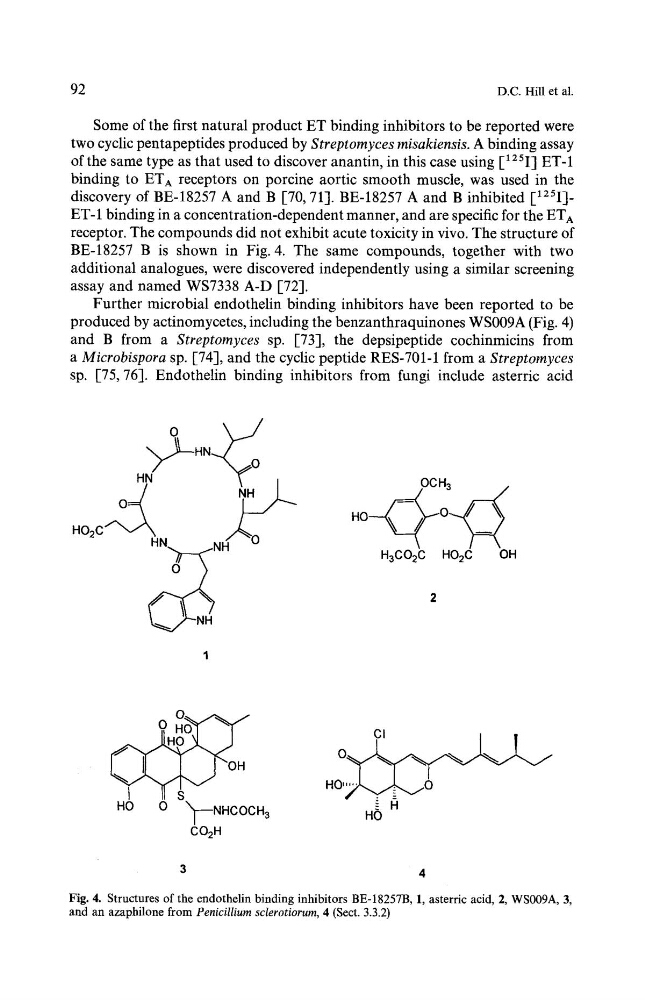
discovery of BE-18257 A and B [70, 71]. BE-18257 A and B inhibited [125I]ET-1 binding in a concentration-dependent manner, and are specific for the ETA
receptor. The compounds did not exhibit acute toxicity in vivo. The structure of
BE-18257 B is shown in Fig. 4. The same compounds, together with two
additional analogues, were discovered independently using a similar screening
assay and named WS7338 A-D [72].
Further microbial endothelin binding inhibitors have been reported to be
produced by actinomycetes, including the benzanthraquinones WS009A (Fig. 4)
and B from a Streptomyces sp. [-73], the depsipeptide cochinmicins from
a Microbispora sp. [74], and the cyclic peptide RES-701-1 from a Streptomyces
sp. [75, 76]. Endothelin binding inhibitors from fungi include asterric acid
H
/
,OC H 3
/
H3CO2C HO2C OH
HO,~O
HO
O "~NHCOCH3
HO H
CO2H
Fig. 4. Structures of the endothelin binding inhibitors BE-18257B, 1, asterric acid, 2, WS009A, 3,
and an azaphilone from Penicillium sclerotiorum, 4 (Sect. 3.3.2)
D.C. Hill et al.
Some of the first natural product ET binding inhibitors to be reported were
two cyclic pentapeptides produced by Streptornyces misakiensis. A binding assay
of the same type as that used to discover anantin, in this case using [125i] ET-1
binding to ETA receptors on porcine aortic smooth muscle, was used in the
discovery of BE-18257 A and B [70, 71]. BE-18257 A and B inhibited [125I]ET-1 binding in a concentration-dependent manner, and are specific for the ETA
receptor. The compounds did not exhibit acute toxicity in vivo. The structure of
BE-18257 B is shown in Fig. 4. The same compounds, together with two
additional analogues, were discovered independently using a similar screening
assay and named WS7338 A-D [72].
Further microbial endothelin binding inhibitors have been reported to be
produced by actinomycetes, including the benzanthraquinones WS009A (Fig. 4)
and B from a Streptomyces sp. [-73], the depsipeptide cochinmicins from
a Microbispora sp. [74], and the cyclic peptide RES-701-1 from a Streptomyces
sp. [75, 76]. Endothelin binding inhibitors from fungi include asterric acid
H
/
,OC H 3
/
H3CO2C HO2C OH
HO,~O
HO
O "~NHCOCH3
HO H
CO2H
Fig. 4. Structures of the endothelin binding inhibitors BE-18257B, 1, asterric acid, 2, WS009A, 3,
and an azaphilone from Penicillium sclerotiorum, 4 (Sect. 3.3.2)