

4.5
Destruction of the Particle Due to Growth
If the carbon source used by the microorganism contributes to giving the
particle its solid structure, then the structure of the particle will be degraded
during growth. This can lead to a reduction in the size of the substrate particle
during the fermentation. Note, however, that as the substrate particle itself is
shrinking the biomass layer at its surface tends to expand outwards. Depending
on the relative rates of these two phenomena, the overall particle (i.e., including
both biomass and residual substrate) may either increase or decrease in size.
Decreases in particle size have been characterized experimentally.
Nandakumar et al. [115] used perchloric acid to remove the fungal mycelium
from wheat bran particles. During the fermentation the average size of the
residual substrate particles decreased: At zero time 98% of the total substrate
mass was composed of particles of greater than 1 mm. After 72 h this had fallen
to 75%. Gumbira-Sa¢id et al. [127] measured overall particle diameters (i.e., the
particle plus the biomass film) for growth of Rhizopus oligosporus on spherical
sago beads. With an initial particle diameter of 4.8 mm, the particle size increased to 5.4 mm at 24 h, but then decreased to 4.5 mm by the end of the
fermentation at 54 h. With an initial particle size of 3.8 mm the diameter increased to 4.1 mm at 35 h and then decreased to 3.2 mm. With an initial particle
diameter of 3.0 mm the diameter increased to 3.5 mm at 44 h and then decreased to 3.1 mm. In this last case, given that some of the diameter of the final
particle was comprised of biomass, the substrate particle itself had probably
shrunk.
Some modeling attention has been given to this phenomenon. Nandakumar
et al. [115] assumed that the overall particle size was constant, meaning that
biomass occupied the space liberated by the shrinking particle. The substrate
consumption reaction was assumed to take place at the biomass-substrate
interface and to be controlled by the availability of oxygen, the supply of which
was restricted by diffusion through the biomass film. Note that since the oxygen
consumption reaction occurred only at the interface, simultaneous diffusion
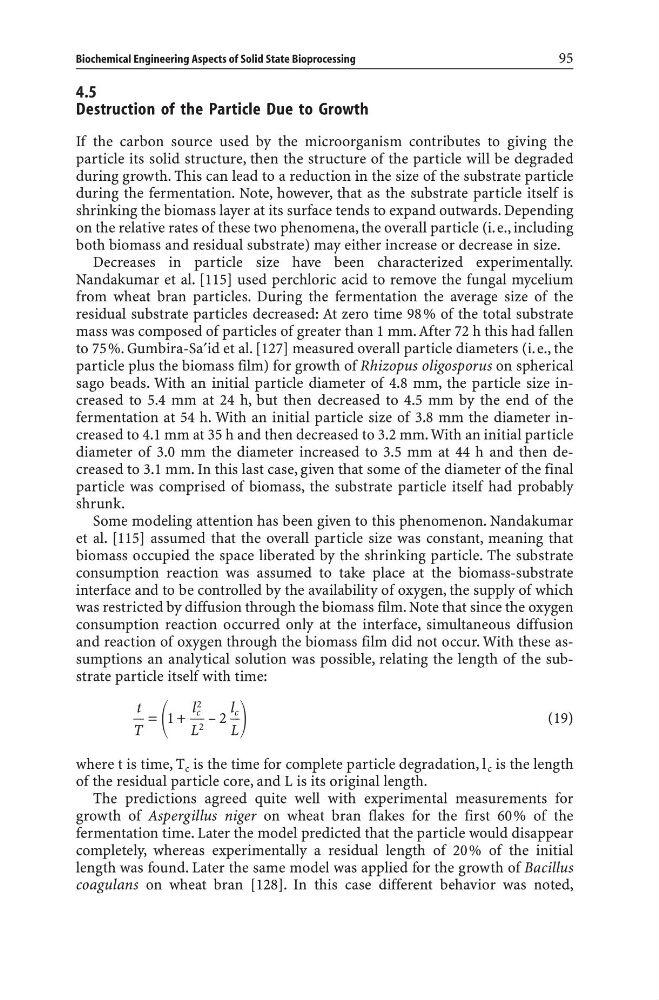
and reaction of oxygen through the biomass film did not occur. With these assumptions an analytical solution was possible, relating the length of the substrate particle itself with time:
t
l
2
c
l c
21 = 1 + 31 – 2 21
(19)
T
L
2
L
where t is time, T c is the time for complete particle degradation, l c is the length
of the residual particle core, and L is its original length.
The predictions agreed quite well with experimental measurements for
growth of Aspergillus niger on wheat bran flakes for the first 60% of the
fermentation time. Later the model predicted that the particle would disappear
completely, whereas experimentally a residual length of 20% of the initial
length was found. Later the same model was applied for the growth of Bacillus
coagulans on wheat bran [128]. In this case different behavior was noted,
Biochemical Engineering Aspects of Solid State Bioprocessing
95
Destruction of the Particle Due to Growth
If the carbon source used by the microorganism contributes to giving the
particle its solid structure, then the structure of the particle will be degraded
during growth. This can lead to a reduction in the size of the substrate particle
during the fermentation. Note, however, that as the substrate particle itself is
shrinking the biomass layer at its surface tends to expand outwards. Depending
on the relative rates of these two phenomena, the overall particle (i.e., including
both biomass and residual substrate) may either increase or decrease in size.
Decreases in particle size have been characterized experimentally.
Nandakumar et al. [115] used perchloric acid to remove the fungal mycelium
from wheat bran particles. During the fermentation the average size of the
residual substrate particles decreased: At zero time 98% of the total substrate
mass was composed of particles of greater than 1 mm. After 72 h this had fallen
to 75%. Gumbira-Sa¢id et al. [127] measured overall particle diameters (i.e., the
particle plus the biomass film) for growth of Rhizopus oligosporus on spherical
sago beads. With an initial particle diameter of 4.8 mm, the particle size increased to 5.4 mm at 24 h, but then decreased to 4.5 mm by the end of the
fermentation at 54 h. With an initial particle size of 3.8 mm the diameter increased to 4.1 mm at 35 h and then decreased to 3.2 mm. With an initial particle
diameter of 3.0 mm the diameter increased to 3.5 mm at 44 h and then decreased to 3.1 mm. In this last case, given that some of the diameter of the final
particle was comprised of biomass, the substrate particle itself had probably
shrunk.
Some modeling attention has been given to this phenomenon. Nandakumar
et al. [115] assumed that the overall particle size was constant, meaning that
biomass occupied the space liberated by the shrinking particle. The substrate
consumption reaction was assumed to take place at the biomass-substrate
interface and to be controlled by the availability of oxygen, the supply of which
was restricted by diffusion through the biomass film. Note that since the oxygen
consumption reaction occurred only at the interface, simultaneous diffusion
and reaction of oxygen through the biomass film did not occur. With these assumptions an analytical solution was possible, relating the length of the substrate particle itself with time:
t
l
2
c
l c
21 = 1 + 31 – 2 21
(19)
T
L
2
L
where t is time, T c is the time for complete particle degradation, l c is the length
of the residual particle core, and L is its original length.
The predictions agreed quite well with experimental measurements for
growth of Aspergillus niger on wheat bran flakes for the first 60% of the
fermentation time. Later the model predicted that the particle would disappear
completely, whereas experimentally a residual length of 20% of the initial
length was found. Later the same model was applied for the growth of Bacillus
coagulans on wheat bran [128]. In this case different behavior was noted,
Biochemical Engineering Aspects of Solid State Bioprocessing
95