

diffusion through water. Nopharatana et al. [116] developed a model more appropriate to describe the growth of a fungus. The existence of separate biomass
and air phases is recognized, although the air and aerial biomass are treated as
a single pseudohomogeneous phase, with each height simply being assigned a
biomass concentration. The biomass concentration at any height can increase
due to the movement of biomass into the region from lower heights, and the
production of biomass within that region itself.
With the mycelial growth form there is also usually the phenomenon of differentiation. Many of the filamentous fungi used in SSF produce spores called
conidia. Specialized aerial structures, called conidiophores, develop following
initial colonization of the substrate surface by vegetative hyphae. Later conidia
are produced on these structures. Differentiation within SSF systems has received some attention. Various workers have studied the stoichiometry of
growth and differentiation, showing that the stoichiometry of production of
vegetative biomass and conidia are different [117, 118]. However, differentiation
has received very little attention to date in SSF models. In their model of fungal
overculture growth Georgiou and Shuler [83] recognized four biomass forms –
vegetative biomass, competent biomass, mature conidiophores, and conidia.
The vegetative biomass become competent, i.e., able to differentiate, at 24 h. The
rates of conversion of competent biomass into conidiophores, and of conidiophores into conidia were related to the nitrate and glucose concentrations. The
model was able to describe the short lag of a few hours which occurs between
the emergence of the first conidiophores and the appearance of the first
conidia.
4.3
Effect of Microbial Growth on the Environment
The microorganism affects its environment through the release of extracellular
enzymes and metabolic end-products and also by the uptake of a range of
nutrients. As noted earlier, this leads to the establishment of concentration
gradients of enzymes, nutrients, products, and oxygen within the particle.
Approaches to describing these concentration gradients are described in the
following section. The present section focuses on simpler modeling approaches.
In many bioreactor models intraparticle concentration gradients are
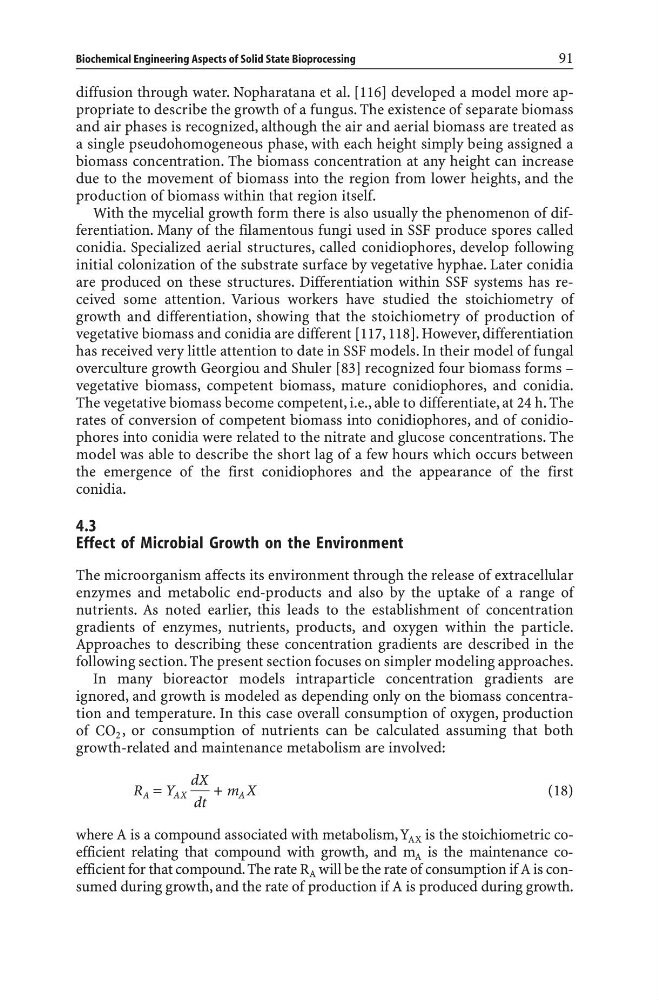
ignored, and growth is modeled as depending only on the biomass concentration and temperature. In this case overall consumption of oxygen, production
of CO 2 , or consumption of nutrients can be calculated assuming that both
growth-related and maintenance metabolism are involved:
dX
R A = Y AX 5 + m A X
(18)
dt
where A is a compound associated with metabolism, Y AX is the stoichiometric coefficient relating that compound with growth, and m A is the maintenance coefficient for that compound. The rate R A will be the rate of consumption if A is consumed during growth, and the rate of production if A is produced during growth.
Biochemical Engineering Aspects of Solid State Bioprocessing
91
and air phases is recognized, although the air and aerial biomass are treated as
a single pseudohomogeneous phase, with each height simply being assigned a
biomass concentration. The biomass concentration at any height can increase
due to the movement of biomass into the region from lower heights, and the
production of biomass within that region itself.
With the mycelial growth form there is also usually the phenomenon of differentiation. Many of the filamentous fungi used in SSF produce spores called
conidia. Specialized aerial structures, called conidiophores, develop following
initial colonization of the substrate surface by vegetative hyphae. Later conidia
are produced on these structures. Differentiation within SSF systems has received some attention. Various workers have studied the stoichiometry of
growth and differentiation, showing that the stoichiometry of production of
vegetative biomass and conidia are different [117, 118]. However, differentiation
has received very little attention to date in SSF models. In their model of fungal
overculture growth Georgiou and Shuler [83] recognized four biomass forms –
vegetative biomass, competent biomass, mature conidiophores, and conidia.
The vegetative biomass become competent, i.e., able to differentiate, at 24 h. The
rates of conversion of competent biomass into conidiophores, and of conidiophores into conidia were related to the nitrate and glucose concentrations. The
model was able to describe the short lag of a few hours which occurs between
the emergence of the first conidiophores and the appearance of the first
conidia.
4.3
Effect of Microbial Growth on the Environment
The microorganism affects its environment through the release of extracellular
enzymes and metabolic end-products and also by the uptake of a range of
nutrients. As noted earlier, this leads to the establishment of concentration
gradients of enzymes, nutrients, products, and oxygen within the particle.
Approaches to describing these concentration gradients are described in the
following section. The present section focuses on simpler modeling approaches.
In many bioreactor models intraparticle concentration gradients are
ignored, and growth is modeled as depending only on the biomass concentration and temperature. In this case overall consumption of oxygen, production
of CO 2 , or consumption of nutrients can be calculated assuming that both
growth-related and maintenance metabolism are involved:
dX
R A = Y AX 5 + m A X
(18)
dt
where A is a compound associated with metabolism, Y AX is the stoichiometric coefficient relating that compound with growth, and m A is the maintenance coefficient for that compound. The rate R A will be the rate of consumption if A is consumed during growth, and the rate of production if A is produced during growth.
Biochemical Engineering Aspects of Solid State Bioprocessing
91