

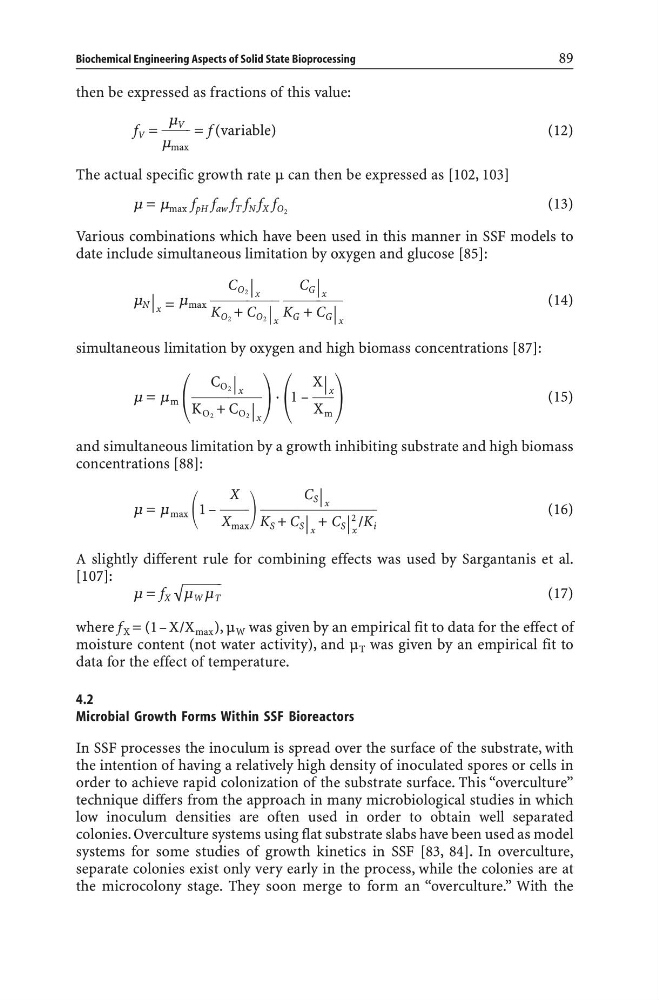
then be expressed as fractions of this value:
m V
f V = 71 = f (variable)
(12)
m max
The actual specific growth rate m can then be expressed as [102, 103]
m = m max f pH f aw f T f N f X f O 2
(13)
Various combinations which have been used in this manner in SSF models to
date include simultaneous limitation by oxygen and glucose [85]:
C O2 Ωx
C G Ωx
m N Ωx = m max 072 07
(14)
K O2 + C O2 Ωx K G + C G Ωx
simultaneous limitation by oxygen and high biomass concentrations [87]:
C O2 Ωx
X Ωx
m = m m 09
·
1 – 51
(15)
K O2 + C O2 Ωx
X m
and simultaneous limitation by a growth inhibiting substrate and high biomass
concentrations [88]:
X
C S Ωx
m = m max 1 – 71 0001
(16)
X max K S + C S Ωx + C S Ωx
2 /K i
A slightly different rule for combining effects was used by Sargantanis et al.
[107]:
01
m = f X ÷ m W m T
(17)
where f X = (1– X/X max ), m W was given by an empirical fit to data for the effect of
moisture content (not water activity), and m T was given by an empirical fit to
data for the effect of temperature.
4.2
Microbial Growth Forms Within SSF Bioreactors
In SSF processes the inoculum is spread over the surface of the substrate, with
the intention of having a relatively high density of inoculated spores or cells in
order to achieve rapid colonization of the substrate surface. This “overculture”
technique differs from the approach in many microbiological studies in which
low inoculum densities are often used in order to obtain well separated
colonies. Overculture systems using flat substrate slabs have been used as model
systems for some studies of growth kinetics in SSF [83, 84]. In overculture,
separate colonies exist only very early in the process, while the colonies are at
the microcolony stage. They soon merge to form an “overculture.” With the
Biochemical Engineering Aspects of Solid State Bioprocessing
89
m V
f V = 71 = f (variable)
(12)
m max
The actual specific growth rate m can then be expressed as [102, 103]
m = m max f pH f aw f T f N f X f O 2
(13)
Various combinations which have been used in this manner in SSF models to
date include simultaneous limitation by oxygen and glucose [85]:
C O2 Ωx
C G Ωx
m N Ωx = m max 072 07
(14)
K O2 + C O2 Ωx K G + C G Ωx
simultaneous limitation by oxygen and high biomass concentrations [87]:
C O2 Ωx
X Ωx
m = m m 09
·
1 – 51
(15)
K O2 + C O2 Ωx
X m
and simultaneous limitation by a growth inhibiting substrate and high biomass
concentrations [88]:
X
C S Ωx
m = m max 1 – 71 0001
(16)
X max K S + C S Ωx + C S Ωx
2 /K i
A slightly different rule for combining effects was used by Sargantanis et al.
[107]:
01
m = f X ÷ m W m T
(17)
where f X = (1– X/X max ), m W was given by an empirical fit to data for the effect of
moisture content (not water activity), and m T was given by an empirical fit to
data for the effect of temperature.
4.2
Microbial Growth Forms Within SSF Bioreactors
In SSF processes the inoculum is spread over the surface of the substrate, with
the intention of having a relatively high density of inoculated spores or cells in
order to achieve rapid colonization of the substrate surface. This “overculture”
technique differs from the approach in many microbiological studies in which
low inoculum densities are often used in order to obtain well separated
colonies. Overculture systems using flat substrate slabs have been used as model
systems for some studies of growth kinetics in SSF [83, 84]. In overculture,
separate colonies exist only very early in the process, while the colonies are at
the microcolony stage. They soon merge to form an “overculture.” With the
Biochemical Engineering Aspects of Solid State Bioprocessing
89