

4.1.2
Effect of Temperature on Growth
Temperature is an important variable in SSF systems because the difficulty of
removing waste metabolic heat from the substrate bed means that the temperature rises within the substrate bed, with the problem becoming more severe
as the size of the substrate bed increases. As a result, in most large-scale bioreactors the microorganism at any location within the bed is subjected to a
temporal variation in temperature, with the degree of variation depending on
the effectiveness of cooling at that location in the bed. Usually there is an initial
period of growth at the optimum temperature for growth, during the early
period when the biomass density is low and therefore the rate of release of
waste metabolic heat is low. However, as the biomass concentration increases
the growth rate increases and therefore the rate of heat production increases. If
the heat production rate exceeds the heat removal rate at that location in the
bed, then the temperature increases. In poorly cooled regions of the bed,
temperatures close to the maximum temperature for growth may be reached,
with this temperature being maintained for periods as low as 1 h to as long as
50 h. Later, growth decelerates, possibly due to negative effects of the high
temperature, but also possibly due to steric limitations on biomass density or
nutrient exhaustion, and, as a result of the decreased heat production rate, the
temperature falls again. As a result of the inevitability of temperature rises in
almost all types of bioreactors, it is essential to incorporate a description of
temperature effects on the growth kinetics.
To date, studies aimed at describing the effect of temperature on growth
kinetics have obtained data using an experimental procedure which can be
referred to as the “isothermal approach”: a range of cultures are incubated at a
range of temperatures, with each culture being maintained at a constant
temperature throughout the fermentation. This can be achieved by using a
small enough substrate sample (several grams) so that heat removal limitations
are negligible. The specific growth rates are then plotted as a function of the
incubation temperature and a mathematical expression, usually an Arrheniustype expression but sometimes simply a quadratic fit, is fitted to the data. In
those cases where temperature-related death of the biomass is not taken into
account the expression describes the net growth rate and needs to be able to
describe the decrease in growth rate above and below the optimum temperature
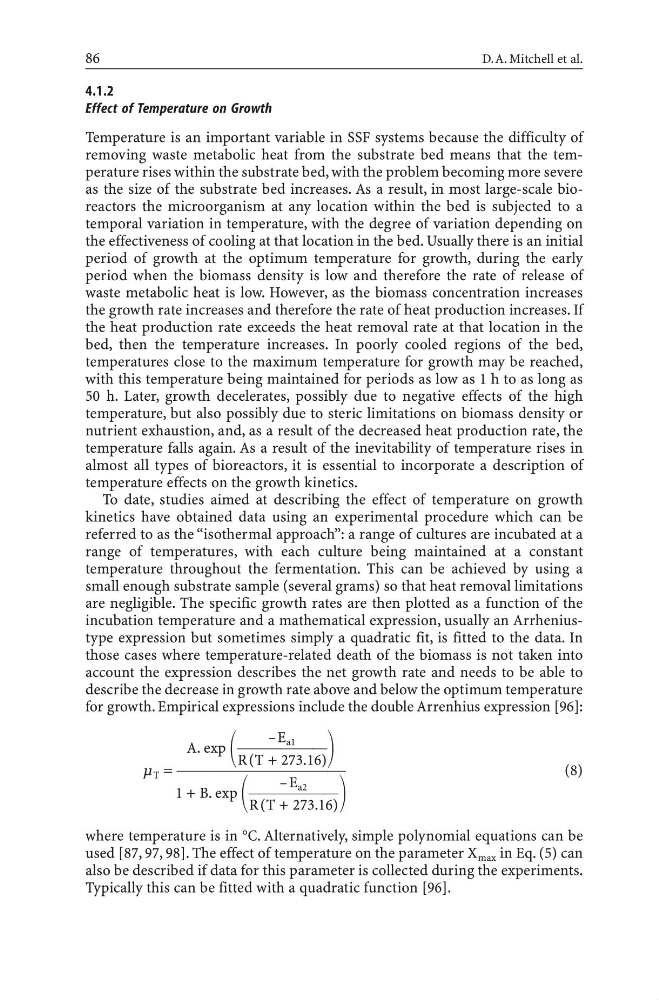
for growth. Empirical expressions include the double Arrenhius expression [96]:
–E a1
A. exp 004
R(T + 273.16)
m T = 00005
(8)
–E a2
1 + B. exp 004
R(T + 273.16)
where temperature is in °C. Alternatively, simple polynomial equations can be
used [87, 97, 98]. The effect of temperature on the parameter X max in Eq. (5) can
also be described if data for this parameter is collected during the experiments.
Typically this can be fitted with a quadratic function [96].
86
D.A. Mitchell et al.
Effect of Temperature on Growth
Temperature is an important variable in SSF systems because the difficulty of
removing waste metabolic heat from the substrate bed means that the temperature rises within the substrate bed, with the problem becoming more severe
as the size of the substrate bed increases. As a result, in most large-scale bioreactors the microorganism at any location within the bed is subjected to a
temporal variation in temperature, with the degree of variation depending on
the effectiveness of cooling at that location in the bed. Usually there is an initial
period of growth at the optimum temperature for growth, during the early
period when the biomass density is low and therefore the rate of release of
waste metabolic heat is low. However, as the biomass concentration increases
the growth rate increases and therefore the rate of heat production increases. If
the heat production rate exceeds the heat removal rate at that location in the
bed, then the temperature increases. In poorly cooled regions of the bed,
temperatures close to the maximum temperature for growth may be reached,
with this temperature being maintained for periods as low as 1 h to as long as
50 h. Later, growth decelerates, possibly due to negative effects of the high
temperature, but also possibly due to steric limitations on biomass density or
nutrient exhaustion, and, as a result of the decreased heat production rate, the
temperature falls again. As a result of the inevitability of temperature rises in
almost all types of bioreactors, it is essential to incorporate a description of
temperature effects on the growth kinetics.
To date, studies aimed at describing the effect of temperature on growth
kinetics have obtained data using an experimental procedure which can be
referred to as the “isothermal approach”: a range of cultures are incubated at a
range of temperatures, with each culture being maintained at a constant
temperature throughout the fermentation. This can be achieved by using a
small enough substrate sample (several grams) so that heat removal limitations
are negligible. The specific growth rates are then plotted as a function of the
incubation temperature and a mathematical expression, usually an Arrheniustype expression but sometimes simply a quadratic fit, is fitted to the data. In
those cases where temperature-related death of the biomass is not taken into
account the expression describes the net growth rate and needs to be able to
describe the decrease in growth rate above and below the optimum temperature
for growth. Empirical expressions include the double Arrenhius expression [96]:
–E a1
A. exp 004
R(T + 273.16)
m T = 00005
(8)
–E a2
1 + B. exp 004
R(T + 273.16)
where temperature is in °C. Alternatively, simple polynomial equations can be
used [87, 97, 98]. The effect of temperature on the parameter X max in Eq. (5) can
also be described if data for this parameter is collected during the experiments.
Typically this can be fitted with a quadratic function [96].
86
D.A. Mitchell et al.