

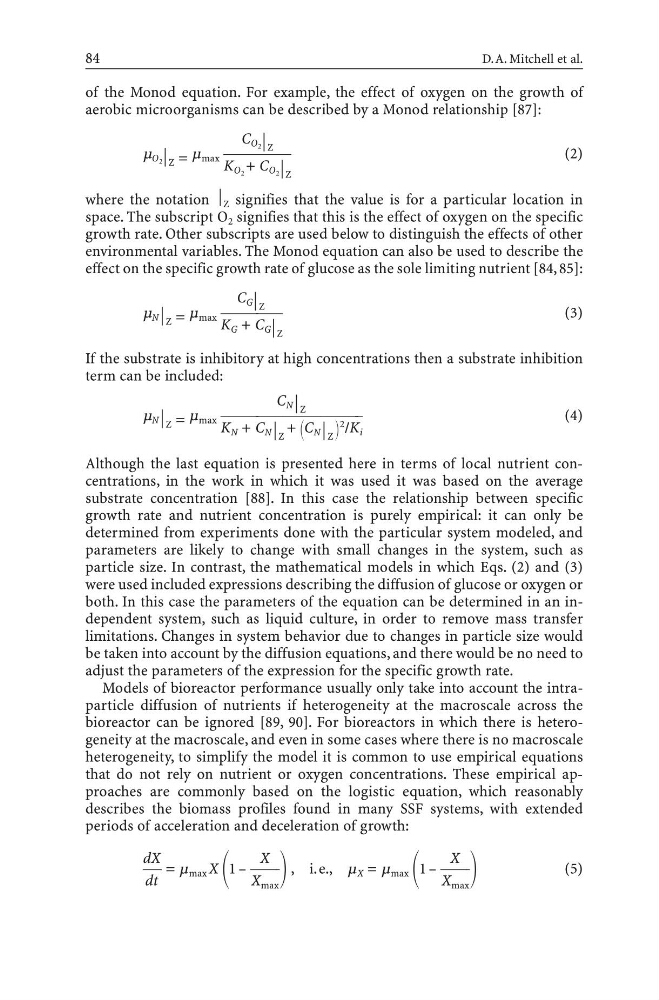
of the Monod equation. For example, the effect of oxygen on the growth of
aerobic microorganisms can be described by a Monod relationship [87]:
C O 2 ΩZ
m O 2 ΩZ = m max 08
(2)
K O 2 + C O 2 ΩZ
where the notation Ω Z signifies that the value is for a particular location in
space. The subscript O 2 signifies that this is the effect of oxygen on the specific
growth rate. Other subscripts are used below to distinguish the effects of other
environmental variables. The Monod equation can also be used to describe the
effect on the specific growth rate of glucose as the sole limiting nutrient [84, 85]:
C G ΩZ
m N ΩZ = m max 07
(3)
K G + C G ΩZ
If the substrate is inhibitory at high concentrations then a substrate inhibition
term can be included:
C N ΩZ
m N ΩZ = m max 07002
(4)
K N + C N ΩZ + C N ΩZ
2 /K i
Although the last equation is presented here in terms of local nutrient concentrations, in the work in which it was used it was based on the average
substrate concentration [88]. In this case the relationship between specific
growth rate and nutrient concentration is purely empirical: it can only be
determined from experiments done with the particular system modeled, and
parameters are likely to change with small changes in the system, such as
particle size. In contrast, the mathematical models in which Eqs. (2) and (3)
were used included expressions describing the diffusion of glucose or oxygen or
both. In this case the parameters of the equation can be determined in an independent system, such as liquid culture, in order to remove mass transfer
limitations. Changes in system behavior due to changes in particle size would
be taken into account by the diffusion equations, and there would be no need to
adjust the parameters of the expression for the specific growth rate.
Models of bioreactor performance usually only take into account the intraparticle diffusion of nutrients if heterogeneity at the macroscale across the
bioreactor can be ignored [89, 90]. For bioreactors in which there is heterogeneity at the macroscale, and even in some cases where there is no macroscale
heterogeneity, to simplify the model it is common to use empirical equations
that do not rely on nutrient or oxygen concentrations. These empirical approaches are commonly based on the logistic equation, which reasonably
describes the biomass profiles found in many SSF systems, with extended
periods of acceleration and deceleration of growth:
dX
X
X
5 = m max X 1 – 71 , i.e., m X = m max 1 – 71
(5)
dt
X max
X max
84
D.A. Mitchell et al.
aerobic microorganisms can be described by a Monod relationship [87]:
C O 2 ΩZ
m O 2 ΩZ = m max 08
(2)
K O 2 + C O 2 ΩZ
where the notation Ω Z signifies that the value is for a particular location in
space. The subscript O 2 signifies that this is the effect of oxygen on the specific
growth rate. Other subscripts are used below to distinguish the effects of other
environmental variables. The Monod equation can also be used to describe the
effect on the specific growth rate of glucose as the sole limiting nutrient [84, 85]:
C G ΩZ
m N ΩZ = m max 07
(3)
K G + C G ΩZ
If the substrate is inhibitory at high concentrations then a substrate inhibition
term can be included:
C N ΩZ
m N ΩZ = m max 07002
(4)
K N + C N ΩZ + C N ΩZ
2 /K i
Although the last equation is presented here in terms of local nutrient concentrations, in the work in which it was used it was based on the average
substrate concentration [88]. In this case the relationship between specific
growth rate and nutrient concentration is purely empirical: it can only be
determined from experiments done with the particular system modeled, and
parameters are likely to change with small changes in the system, such as
particle size. In contrast, the mathematical models in which Eqs. (2) and (3)
were used included expressions describing the diffusion of glucose or oxygen or
both. In this case the parameters of the equation can be determined in an independent system, such as liquid culture, in order to remove mass transfer
limitations. Changes in system behavior due to changes in particle size would
be taken into account by the diffusion equations, and there would be no need to
adjust the parameters of the expression for the specific growth rate.
Models of bioreactor performance usually only take into account the intraparticle diffusion of nutrients if heterogeneity at the macroscale across the
bioreactor can be ignored [89, 90]. For bioreactors in which there is heterogeneity at the macroscale, and even in some cases where there is no macroscale
heterogeneity, to simplify the model it is common to use empirical equations
that do not rely on nutrient or oxygen concentrations. These empirical approaches are commonly based on the logistic equation, which reasonably
describes the biomass profiles found in many SSF systems, with extended
periods of acceleration and deceleration of growth:
dX
X
X
5 = m max X 1 – 71 , i.e., m X = m max 1 – 71
(5)
dt
X max
X max
84
D.A. Mitchell et al.