

6
J. Mukherjee · M. Menge
(±)-Isofumigaclavine B,
Dehydrogenation of indolines to indoles with
[17]
(±)-lysergol,
phenylseleninic anhydride applied to the final
(±)-fumigaclavine B,
steps in the total synthesis of these alkaloids
(±)-isolysergol,
(±)-elymoclavine,
(±)-isolysergene,
(±)-agroclavine,
(±)-lysergene,
methyl(±)-lysergates
(±)-Lysergol,
Dehydrogenation of indolines to indoles with
[18]
(±)-isolysergol,
benzeneseleninic anhydride
(±)-elymoclavine
(±)-Chanoclavine I,
Total synthesis of 6,7-secoergolines based on the
[19]
(±)-isochanoclavine I
fragmentation reaction of 3-amino alcohols
Agroclavine I
Lewis acid assisted condensation reactions between [20]
a constituted 5-methoxy-isoxazolidine and siliconbased nucleophiles
(±)-Chanoclavine I,
Stereoselective total synthesis by a nitrone-olefin/
[21]
(±)-isochanoclavine I
cycloaddition
(±)-6,7-Secoagroclavine,
Stereoselective total synthesis by a nitrone-olefin/
[22]
(±)-paliclavine,
cycloaddition
(±)-costaclavine
(–)-Chanoclavine I
The key step of the synthesis involves the creation [23]
of the C ring by the formation of the C5-C10 bond,
catalyzed by chiral palladium(0) complexes
(±)-Chanoclavine I
Palladium catalyzed intramolecular cyclization
[24]
(Heck reaction)
(±)-Norchanoclavine I,
Regioselective oxidation of the Z-methyl group of
[25]
(±)-chanoclavine I,
the isoprenyl system with selenium dioxide
(±)-isochanoclavine
(±)-Agroclavine I,
Regioselective oxidation of the Z-methyl group of
[26]
(±)-6-norchanoclavine II, the isoprenyl system with selenium dioxide
(±)-chanoclavine II
(±)-Chanoclavine I,
Synthesis involves a synthetic method of
[27]
(±)-dihydrosetoclavine
4-alkylindoles
6,7-Secoagroclavine
Synthesis of the versatile intermediate
[28]
4-(sulfonyl-methyl)indole from 4-oxo-4,5,6,7tetrahydroindole for the formal total synthesis
Chanoclavine I
Intramolecular [3+2] cycloaddition reaction
[29]
(±)-Lysergic acid
Intramolecular Imino-Diels-Alder-Reaction
[30]
starting from 4-hydroxymethyl-1-tosylindole
(±)-Claviciptic acid
Combinational use of 4-selective lithiation of
[31]
1-(triisopropylsilyl)gramine and fluoride ion
induced elimination-addition reaction of
4-[(E)-3-hydroxy-3-methyl-1-butenyl]-1(triisopropylsilyl)gramine
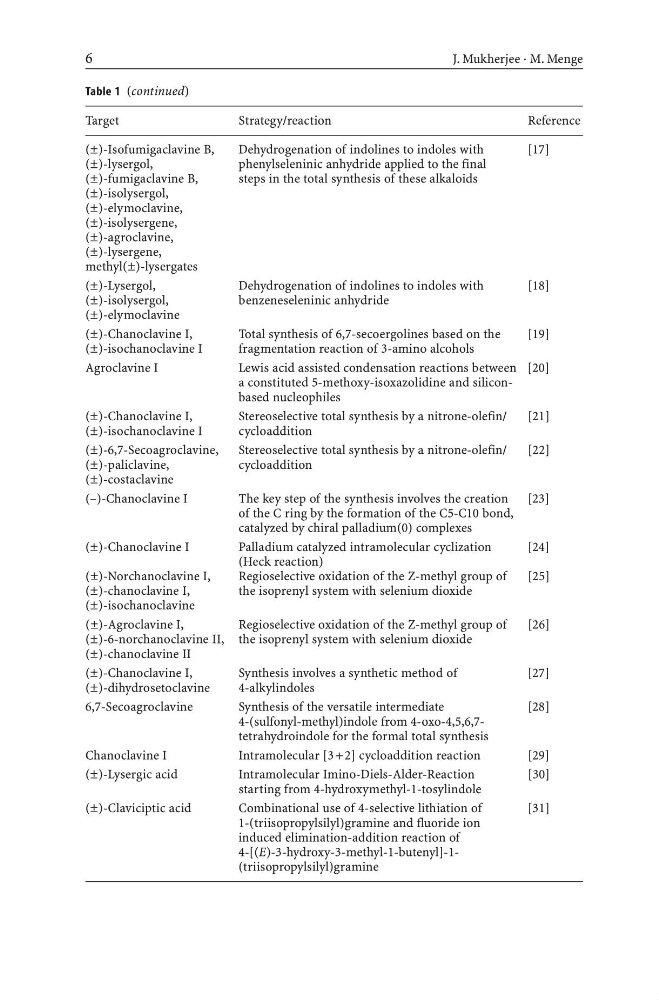
Table 1 (continued)
Target
Strategy/reaction
Reference
J. Mukherjee · M. Menge
(±)-Isofumigaclavine B,
Dehydrogenation of indolines to indoles with
[17]
(±)-lysergol,
phenylseleninic anhydride applied to the final
(±)-fumigaclavine B,
steps in the total synthesis of these alkaloids
(±)-isolysergol,
(±)-elymoclavine,
(±)-isolysergene,
(±)-agroclavine,
(±)-lysergene,
methyl(±)-lysergates
(±)-Lysergol,
Dehydrogenation of indolines to indoles with
[18]
(±)-isolysergol,
benzeneseleninic anhydride
(±)-elymoclavine
(±)-Chanoclavine I,
Total synthesis of 6,7-secoergolines based on the
[19]
(±)-isochanoclavine I
fragmentation reaction of 3-amino alcohols
Agroclavine I
Lewis acid assisted condensation reactions between [20]
a constituted 5-methoxy-isoxazolidine and siliconbased nucleophiles
(±)-Chanoclavine I,
Stereoselective total synthesis by a nitrone-olefin/
[21]
(±)-isochanoclavine I
cycloaddition
(±)-6,7-Secoagroclavine,
Stereoselective total synthesis by a nitrone-olefin/
[22]
(±)-paliclavine,
cycloaddition
(±)-costaclavine
(–)-Chanoclavine I
The key step of the synthesis involves the creation [23]
of the C ring by the formation of the C5-C10 bond,
catalyzed by chiral palladium(0) complexes
(±)-Chanoclavine I
Palladium catalyzed intramolecular cyclization
[24]
(Heck reaction)
(±)-Norchanoclavine I,
Regioselective oxidation of the Z-methyl group of
[25]
(±)-chanoclavine I,
the isoprenyl system with selenium dioxide
(±)-isochanoclavine
(±)-Agroclavine I,
Regioselective oxidation of the Z-methyl group of
[26]
(±)-6-norchanoclavine II, the isoprenyl system with selenium dioxide
(±)-chanoclavine II
(±)-Chanoclavine I,
Synthesis involves a synthetic method of
[27]
(±)-dihydrosetoclavine
4-alkylindoles
6,7-Secoagroclavine
Synthesis of the versatile intermediate
[28]
4-(sulfonyl-methyl)indole from 4-oxo-4,5,6,7tetrahydroindole for the formal total synthesis
Chanoclavine I
Intramolecular [3+2] cycloaddition reaction
[29]
(±)-Lysergic acid
Intramolecular Imino-Diels-Alder-Reaction
[30]
starting from 4-hydroxymethyl-1-tosylindole
(±)-Claviciptic acid
Combinational use of 4-selective lithiation of
[31]
1-(triisopropylsilyl)gramine and fluoride ion
induced elimination-addition reaction of
4-[(E)-3-hydroxy-3-methyl-1-butenyl]-1(triisopropylsilyl)gramine
Table 1 (continued)
Target
Strategy/reaction
Reference