

pharmacologically interesting alkaloid analogs. Our objective in this part of the
review is to unify the knowledge gained in these endeavors.
2.1
Chemical Synthesis
2.1.1
Chemical Structures
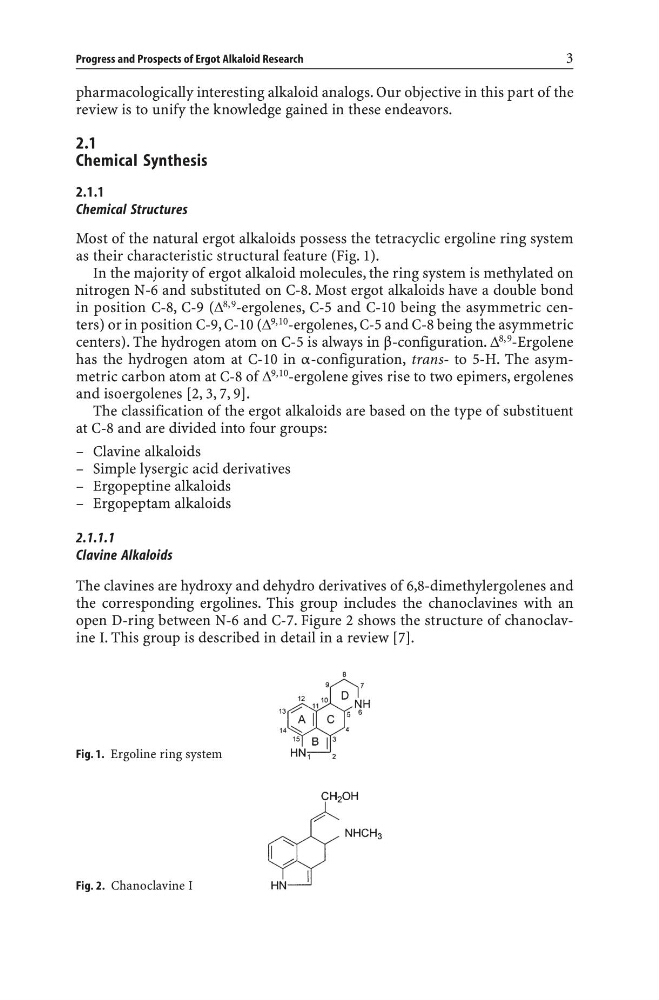
Most of the natural ergot alkaloids possess the tetracyclic ergoline ring system
as their characteristic structural feature (Fig. 1).
In the majority of ergot alkaloid molecules, the ring system is methylated on
nitrogen N-6 and substituted on C-8. Most ergot alkaloids have a double bond
in position C-8, C-9 (D 8,9 -ergolenes, C-5 and C-10 being the asymmetric centers) or in position C-9, C-10 (D 9,10 -ergolenes, C-5 and C-8 being the asymmetric
centers). The hydrogen atom on C-5 is always in b-configuration. D 8,9 -Ergolene
has the hydrogen atom at C-10 in a-configuration, trans- to 5-H. The asymmetric carbon atom at C-8 of D 9,10 -ergolene gives rise to two epimers, ergolenes
and isoergolenes [2, 3, 7, 9].
The classification of the ergot alkaloids are based on the type of substituent
at C-8 and are divided into four groups:
– Clavine alkaloids
– Simple lysergic acid derivatives
– Ergopeptine alkaloids
– Ergopeptam alkaloids
2.1.1.1
Clavine Alkaloids
The clavines are hydroxy and dehydro derivatives of 6,8-dimethylergolenes and
the corresponding ergolines. This group includes the chanoclavines with an
open D-ring between N-6 and C-7. Figure 2 shows the structure of chanoclavine I. This group is described in detail in a review [7].
Progress and Prospects of Ergot Alkaloid Research
3
Fig. 1. Ergoline ring system
Fig. 2. Chanoclavine I
review is to unify the knowledge gained in these endeavors.
2.1
Chemical Synthesis
2.1.1
Chemical Structures
Most of the natural ergot alkaloids possess the tetracyclic ergoline ring system
as their characteristic structural feature (Fig. 1).
In the majority of ergot alkaloid molecules, the ring system is methylated on
nitrogen N-6 and substituted on C-8. Most ergot alkaloids have a double bond
in position C-8, C-9 (D 8,9 -ergolenes, C-5 and C-10 being the asymmetric centers) or in position C-9, C-10 (D 9,10 -ergolenes, C-5 and C-8 being the asymmetric
centers). The hydrogen atom on C-5 is always in b-configuration. D 8,9 -Ergolene
has the hydrogen atom at C-10 in a-configuration, trans- to 5-H. The asymmetric carbon atom at C-8 of D 9,10 -ergolene gives rise to two epimers, ergolenes
and isoergolenes [2, 3, 7, 9].
The classification of the ergot alkaloids are based on the type of substituent
at C-8 and are divided into four groups:
– Clavine alkaloids
– Simple lysergic acid derivatives
– Ergopeptine alkaloids
– Ergopeptam alkaloids
2.1.1.1
Clavine Alkaloids
The clavines are hydroxy and dehydro derivatives of 6,8-dimethylergolenes and
the corresponding ergolines. This group includes the chanoclavines with an
open D-ring between N-6 and C-7. Figure 2 shows the structure of chanoclavine I. This group is described in detail in a review [7].
Progress and Prospects of Ergot Alkaloid Research
3
Fig. 1. Ergoline ring system
Fig. 2. Chanoclavine I