

74]. Pediocin PA-1 was shown to dissipate the proton motive force and inhibit
the amino acid transport in sensitive cells [75]. Lipoteichoic acid is essential for
non-specific pediocin AcH binding, and sensitive cells present a specific receptor that potentiates contact with the membrane [17, 66]. Pediocin PA-1 displays
an important N-terminal -Y-G-N-G-V-X-C- consensus common with other
anti-Listeria bacteriocins such as sakacin A (= curvacin A) and P, and leucocin
A. This finding suggests an important role of the N-terminus in either the
recognition and/or activity of the pediocin-like bacteriocins.
The mechanism of action of the class III bacteriocins remains to be
elucidated [21].
In general, the secondary structures of membrane-active peptides play a
significant role in their biological activity [76]. For several of the membrane
active bacteriocins, the presence of amphiphilic a-helices or b-sheets which
form a hydrophobic and a hydrophilic face has been predicted [43, 47, 70].
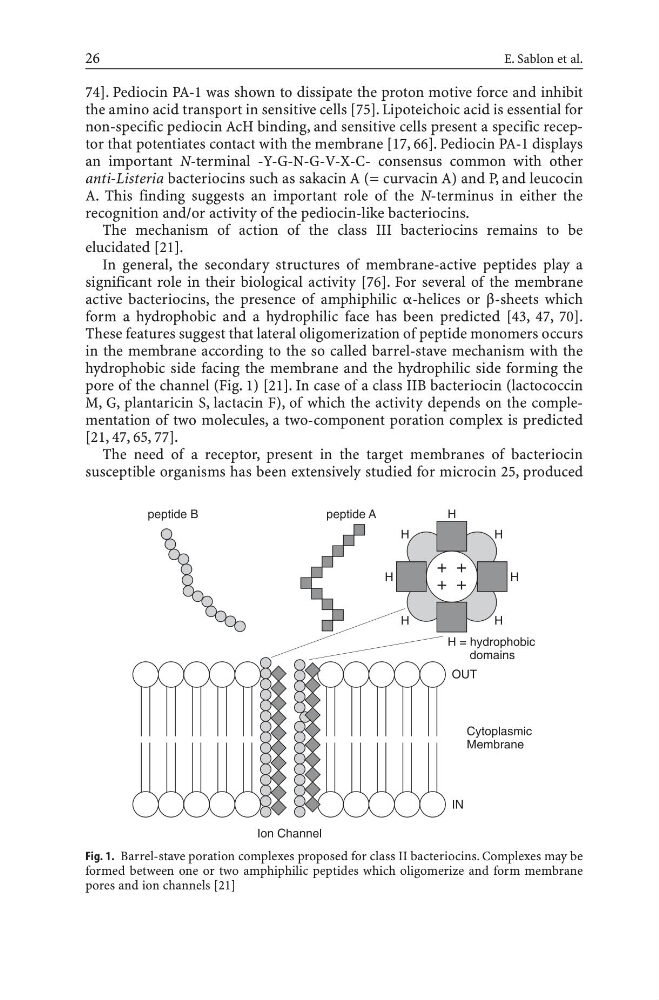
These features suggest that lateral oligomerization of peptide monomers occurs
in the membrane according to the so called barrel-stave mechanism with the
hydrophobic side facing the membrane and the hydrophilic side forming the
pore of the channel (Fig. 1) [21]. In case of a class IIB bacteriocin (lactococcin
M, G, plantaricin S, lactacin F), of which the activity depends on the complementation of two molecules, a two-component poration complex is predicted
[21, 47, 65, 77].
The need of a receptor, present in the target membranes of bacteriocin
susceptible organisms has been extensively studied for microcin 25, produced
26
E. Sablon et al.
Fig. 1. Barrel-stave poration complexes proposed for class II bacteriocins. Complexes may be
formed between one or two amphiphilic peptides which oligomerize and form membrane
pores and ion channels [21]
the amino acid transport in sensitive cells [75]. Lipoteichoic acid is essential for
non-specific pediocin AcH binding, and sensitive cells present a specific receptor that potentiates contact with the membrane [17, 66]. Pediocin PA-1 displays
an important N-terminal -Y-G-N-G-V-X-C- consensus common with other
anti-Listeria bacteriocins such as sakacin A (= curvacin A) and P, and leucocin
A. This finding suggests an important role of the N-terminus in either the
recognition and/or activity of the pediocin-like bacteriocins.
The mechanism of action of the class III bacteriocins remains to be
elucidated [21].
In general, the secondary structures of membrane-active peptides play a
significant role in their biological activity [76]. For several of the membrane
active bacteriocins, the presence of amphiphilic a-helices or b-sheets which
form a hydrophobic and a hydrophilic face has been predicted [43, 47, 70].
These features suggest that lateral oligomerization of peptide monomers occurs
in the membrane according to the so called barrel-stave mechanism with the
hydrophobic side facing the membrane and the hydrophilic side forming the
pore of the channel (Fig. 1) [21]. In case of a class IIB bacteriocin (lactococcin
M, G, plantaricin S, lactacin F), of which the activity depends on the complementation of two molecules, a two-component poration complex is predicted
[21, 47, 65, 77].
The need of a receptor, present in the target membranes of bacteriocin
susceptible organisms has been extensively studied for microcin 25, produced
26
E. Sablon et al.
Fig. 1. Barrel-stave poration complexes proposed for class II bacteriocins. Complexes may be
formed between one or two amphiphilic peptides which oligomerize and form membrane
pores and ion channels [21]