

of the column 2 cm below the foam exit. The operating conditions were: feed
superficial velocity 0.21 cm s –1 , air superficial velocity 0.31 cm s –1 , bubble
column height 60 cm, foam column height 40 cm, yeast concentration 2 g l –1 ,
surfactant concentration 40 mg l –1 , pH 5. Without surfactant the rehydrated
yeast suspension formed only a very low amount of foam, or no foam at all.
Therefore alkyl polyglycoside surfactant (APG 625CS; Henkel) was added to the
suspension. The recovery of the surfactant amounted to R = 86–95%, the yeast
enrichment E * = 11 and recovery R * = 55% The addition of sodium, potassium,
magnesium and calcium chloride to the feed, respectively, increased E * and R * ,
and the use of wash water reduced them by an order of magnitude, because it
removed the cells from the foam. The most effective salt levels for cell flotation
were in the concentration range in which the electrophoretic mobility of the
cells has a minimum. The proteins excreted by the yeast cells are obviously
better „collectors“ than the surfactant APG 625CS.
4.3
Modeling of Microbial Cell Recovery by Foam Flotation
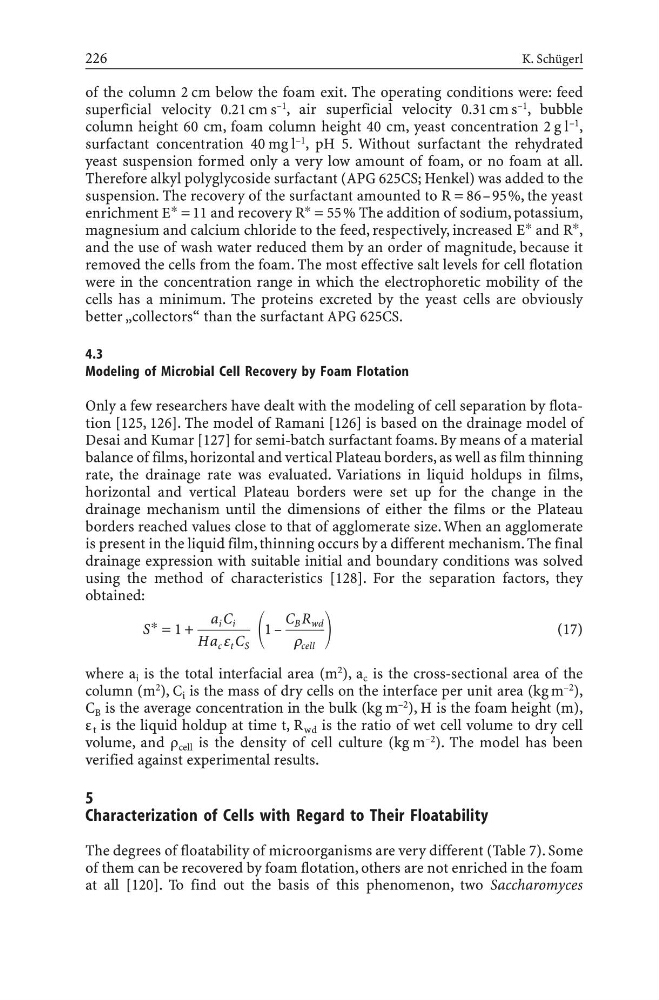
Only a few researchers have dealt with the modeling of cell separation by flotation [125, 126]. The model of Ramani [126] is based on the drainage model of
Desai and Kumar [127] for semi-batch surfactant foams. By means of a material
balance of films, horizontal and vertical Plateau borders, as well as film thinning
rate, the drainage rate was evaluated. Variations in liquid holdups in films,
horizontal and vertical Plateau borders were set up for the change in the
drainage mechanism until the dimensions of either the films or the Plateau
borders reached values close to that of agglomerate size. When an agglomerate
is present in the liquid film, thinning occurs by a different mechanism. The final
drainage expression with suitable initial and boundary conditions was solved
using the method of characteristics [128]. For the separation factors, they
obtained:
a i C i
C B R wd
S * = 1 + 04 1 – 01
(17)
Ha c e t C S
Ç cell
where a i is the total interfacial area (m 2 ), a c is the cross-sectional area of the
column (m 2 ), C i is the mass of dry cells on the interface per unit area (kg m –2 ),
C B is the average concentration in the bulk (kg m –2 ), H is the foam height (m),
e t is the liquid holdup at time t, R wd is the ratio of wet cell volume to dry cell
volume, and Ç cell is the density of cell culture (kg m –2 ). The model has been
verified against experimental results.
5
Characterization of Cells with Regard to Their Floatability
The degrees of floatability of microorganisms are very different (Table 7). Some
of them can be recovered by foam flotation, others are not enriched in the foam
at all [120]. To find out the basis of this phenomenon, two Saccharomyces
226
K. Schügerl
superficial velocity 0.21 cm s –1 , air superficial velocity 0.31 cm s –1 , bubble
column height 60 cm, foam column height 40 cm, yeast concentration 2 g l –1 ,
surfactant concentration 40 mg l –1 , pH 5. Without surfactant the rehydrated
yeast suspension formed only a very low amount of foam, or no foam at all.
Therefore alkyl polyglycoside surfactant (APG 625CS; Henkel) was added to the
suspension. The recovery of the surfactant amounted to R = 86–95%, the yeast
enrichment E * = 11 and recovery R * = 55% The addition of sodium, potassium,
magnesium and calcium chloride to the feed, respectively, increased E * and R * ,
and the use of wash water reduced them by an order of magnitude, because it
removed the cells from the foam. The most effective salt levels for cell flotation
were in the concentration range in which the electrophoretic mobility of the
cells has a minimum. The proteins excreted by the yeast cells are obviously
better „collectors“ than the surfactant APG 625CS.
4.3
Modeling of Microbial Cell Recovery by Foam Flotation
Only a few researchers have dealt with the modeling of cell separation by flotation [125, 126]. The model of Ramani [126] is based on the drainage model of
Desai and Kumar [127] for semi-batch surfactant foams. By means of a material
balance of films, horizontal and vertical Plateau borders, as well as film thinning
rate, the drainage rate was evaluated. Variations in liquid holdups in films,
horizontal and vertical Plateau borders were set up for the change in the
drainage mechanism until the dimensions of either the films or the Plateau
borders reached values close to that of agglomerate size. When an agglomerate
is present in the liquid film, thinning occurs by a different mechanism. The final
drainage expression with suitable initial and boundary conditions was solved
using the method of characteristics [128]. For the separation factors, they
obtained:
a i C i
C B R wd
S * = 1 + 04 1 – 01
(17)
Ha c e t C S
Ç cell
where a i is the total interfacial area (m 2 ), a c is the cross-sectional area of the
column (m 2 ), C i is the mass of dry cells on the interface per unit area (kg m –2 ),
C B is the average concentration in the bulk (kg m –2 ), H is the foam height (m),
e t is the liquid holdup at time t, R wd is the ratio of wet cell volume to dry cell
volume, and Ç cell is the density of cell culture (kg m –2 ). The model has been
verified against experimental results.
5
Characterization of Cells with Regard to Their Floatability
The degrees of floatability of microorganisms are very different (Table 7). Some
of them can be recovered by foam flotation, others are not enriched in the foam
at all [120]. To find out the basis of this phenomenon, two Saccharomyces
226
K. Schügerl