

pepsin and 90% of trypsin were retained at high flow rates, above
300 cm 3 min –1 , at 2.2 mg ml –1 lysozyme, 0.2 mg ml –1 pepsin and 0.1 mg ml –1
trypsin initial concentrations [81].
3.5
Mathematical Modeling
To describe and quantify the effects of the various operational variables on the
performance of foam flotation, several authors have developed mathematical
models. Earlier investigators assumed equal-sized bubbles, infinite surface
viscosity and accounted only for the gravity drainage [84–86]. Later on, the
influence of the surface viscosity on the liquid drainage was also considered
[87–89] and the liquid holdup profile in a foam column was predicted by considering the liquid drainage from the Plateau border [90]. The change in the
bubble size distribution due to inter-bubble gas diffusion was also taken into
account [91–94]. Uraizee and Narsimhan [95, 96] developed an advanced model
for continuous foam concentration of protein which accounts for (i) kinetics of
the adsorption of proteins in the liquid pool and in the foam, (ii) the liquid
drainage from this film due to Plateau border suction, (iii) the gravity drainage
of liquid from the Plateau border, and (iv) the bubble coalescence in the foam.
The mass balances of liquid in the film and Plateau border, the protein balances
in the film and Plateau border, and the balance of the bubbles are used with appropriate boundary conditions. The protein concentration in the liquid pool,
the kinetics of adsorption of protein, the time of bubble formation, the
residence time of the bubbles in the liquid pool and the coalescence rate are
needed for the calculation.
In order to solve the balance equations, the velocities of the film and Plateau
border drainage as well as the kinetics of the protein adsorption in the films are
used. The velocity of drainage of Plateau borders, u, depends on the flow due to
gravity and due to the gradient of Plateau border suction. By neglecting the
latter one obtains:
C u a p Çg
u ≈ 03
(11)
61
20 ÷3m P
where C v is the velocity coefficient for gravity drainage of the Plateau border, a P
is the cross-sectional area of the Plateau border (m 2 ), Ç is the density of the
protein solution, g is the acceleration of gravity, and m P is the viscosity of the
protein solution.
Since the velocity of the film drainage is small, protein adsorption in films is
assumed to be diffusion controlled. The enrichment was calculated by using the
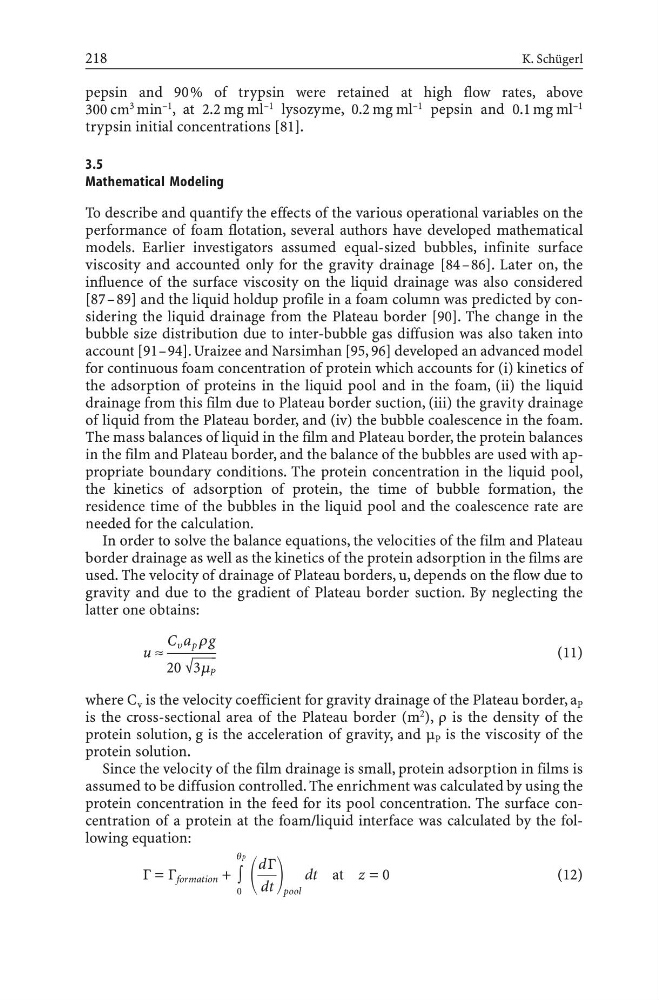
protein concentration in the feed for its pool concentration. The surface concentration of a protein at the foam/liquid interface was calculated by the following equation:
qp dG
G = G formation + ∫ 5 dt at z = 0
(12)
0
dt pool
218
K. Schügerl
300 cm 3 min –1 , at 2.2 mg ml –1 lysozyme, 0.2 mg ml –1 pepsin and 0.1 mg ml –1
trypsin initial concentrations [81].
3.5
Mathematical Modeling
To describe and quantify the effects of the various operational variables on the
performance of foam flotation, several authors have developed mathematical
models. Earlier investigators assumed equal-sized bubbles, infinite surface
viscosity and accounted only for the gravity drainage [84–86]. Later on, the
influence of the surface viscosity on the liquid drainage was also considered
[87–89] and the liquid holdup profile in a foam column was predicted by considering the liquid drainage from the Plateau border [90]. The change in the
bubble size distribution due to inter-bubble gas diffusion was also taken into
account [91–94]. Uraizee and Narsimhan [95, 96] developed an advanced model
for continuous foam concentration of protein which accounts for (i) kinetics of
the adsorption of proteins in the liquid pool and in the foam, (ii) the liquid
drainage from this film due to Plateau border suction, (iii) the gravity drainage
of liquid from the Plateau border, and (iv) the bubble coalescence in the foam.
The mass balances of liquid in the film and Plateau border, the protein balances
in the film and Plateau border, and the balance of the bubbles are used with appropriate boundary conditions. The protein concentration in the liquid pool,
the kinetics of adsorption of protein, the time of bubble formation, the
residence time of the bubbles in the liquid pool and the coalescence rate are
needed for the calculation.
In order to solve the balance equations, the velocities of the film and Plateau
border drainage as well as the kinetics of the protein adsorption in the films are
used. The velocity of drainage of Plateau borders, u, depends on the flow due to
gravity and due to the gradient of Plateau border suction. By neglecting the
latter one obtains:
C u a p Çg
u ≈ 03
(11)
61
20 ÷3m P
where C v is the velocity coefficient for gravity drainage of the Plateau border, a P
is the cross-sectional area of the Plateau border (m 2 ), Ç is the density of the
protein solution, g is the acceleration of gravity, and m P is the viscosity of the
protein solution.
Since the velocity of the film drainage is small, protein adsorption in films is
assumed to be diffusion controlled. The enrichment was calculated by using the
protein concentration in the feed for its pool concentration. The surface concentration of a protein at the foam/liquid interface was calculated by the following equation:
qp dG
G = G formation + ∫ 5 dt at z = 0
(12)
0
dt pool
218
K. Schügerl