

Silicone-oil-free AFAs influence the OTR only slightly. Silicone-oil-containing AFAs considerably reduce OTR in the early stages of the cultivation, but
later on they have only a slight effect. The same holds true for their influence on
k L a. When a silicone-oil-containing AFA was added to the reactor, the bubble
velocities suddenly increased, but within 60–100 min they dropped to their
original values, which indicated the removal of AFA from the medium. The
removal rate is a first-order process [51] (Fig. 4):
u B = u Bo s o f A exp(–kt)
(5)
where u B and u B0 are the actual and original bubble velocities (m s
–1)
, s o the
volumetric concentration of the AFA (ml l
–1 ), f A the signal activity coefficient
(ml s
–1 ml
–1)
, k the time constant (h
–1) and t the time since the maximum of the
bubble velocity was attained (h). At the beginning of the cultivation the removal
rate is the highest, later this process decelerates.
The addition of an AFA to the medium caused a short increase in the CO 2
concentration in the off-gas and the pH value in the medium. Since the
solubility of CO 2 and the pH value are not influenced by the AFA, the change in
their values is due to a short decrease of dissolved CO 2 concentration in the
medium by foam destruction, which is in agreement with earlier results [46, 47].
The following amounts of AFAs are necessary to complete foam depression in
a small stirred tank reactor: S184 (2000 ppm), SE9 (1000 ppm), SLM54474
(300 ppm) VP1133 (100 ppm). The pure silicone oil (S184) is not effective for
foam depression in large reactors, due to a low dispersion rate, while pure PPG is
not an effective AFA at all. The PPG/silicone oil mixture (VP1133) and the silicone
oil emulsion (SE9) are very effective. AFAs in large reactors only slightly influence
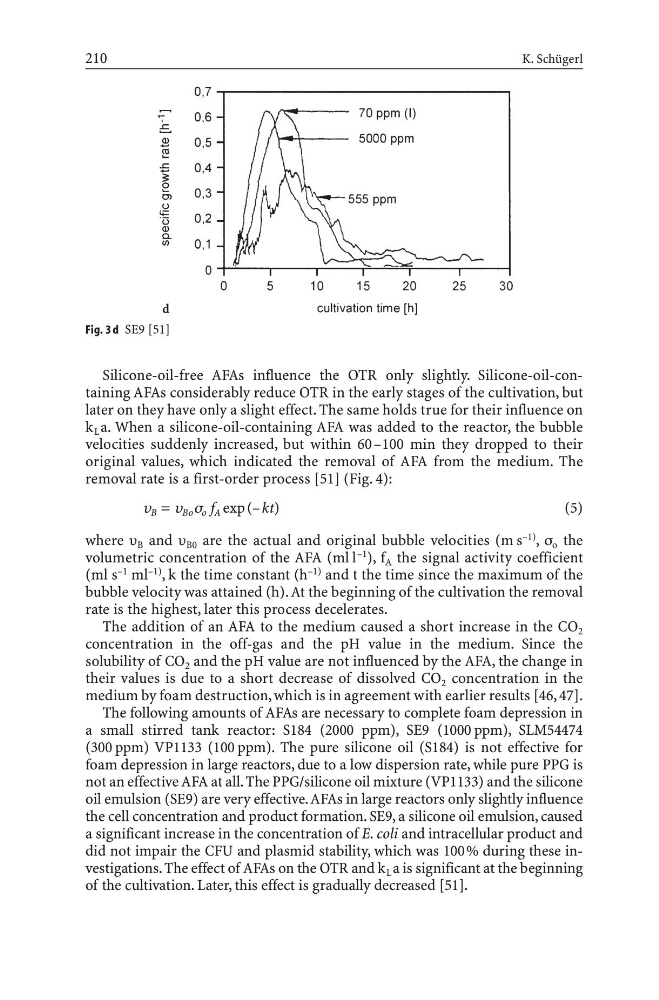
the cell concentration and product formation. SE9, a silicone oil emulsion, caused
a significant increase in the concentration of E. coli and intracellular product and
did not impair the CFU and plasmid stability, which was 100% during these investigations. The effect of AFAs on the OTR and k L a is significant at the beginning
of the cultivation. Later, this effect is gradually decreased [51].
210
K. Schügerl
Fig. 3 d SE9 [51]
d
later on they have only a slight effect. The same holds true for their influence on
k L a. When a silicone-oil-containing AFA was added to the reactor, the bubble
velocities suddenly increased, but within 60–100 min they dropped to their
original values, which indicated the removal of AFA from the medium. The
removal rate is a first-order process [51] (Fig. 4):
u B = u Bo s o f A exp(–kt)
(5)
where u B and u B0 are the actual and original bubble velocities (m s
–1)
, s o the
volumetric concentration of the AFA (ml l
–1 ), f A the signal activity coefficient
(ml s
–1 ml
–1)
, k the time constant (h
–1) and t the time since the maximum of the
bubble velocity was attained (h). At the beginning of the cultivation the removal
rate is the highest, later this process decelerates.
The addition of an AFA to the medium caused a short increase in the CO 2
concentration in the off-gas and the pH value in the medium. Since the
solubility of CO 2 and the pH value are not influenced by the AFA, the change in
their values is due to a short decrease of dissolved CO 2 concentration in the
medium by foam destruction, which is in agreement with earlier results [46, 47].
The following amounts of AFAs are necessary to complete foam depression in
a small stirred tank reactor: S184 (2000 ppm), SE9 (1000 ppm), SLM54474
(300 ppm) VP1133 (100 ppm). The pure silicone oil (S184) is not effective for
foam depression in large reactors, due to a low dispersion rate, while pure PPG is
not an effective AFA at all. The PPG/silicone oil mixture (VP1133) and the silicone
oil emulsion (SE9) are very effective. AFAs in large reactors only slightly influence
the cell concentration and product formation. SE9, a silicone oil emulsion, caused
a significant increase in the concentration of E. coli and intracellular product and
did not impair the CFU and plasmid stability, which was 100% during these investigations. The effect of AFAs on the OTR and k L a is significant at the beginning
of the cultivation. Later, this effect is gradually decreased [51].
210
K. Schügerl
Fig. 3 d SE9 [51]
d