

oxide) with a mean molecular weight of 2000] and silicone oil at w SG = 4 cm s –1
are compared [40].
With increasing gas velocity, the volumetric mass transfer coefficient
and bubble coalescence are enhanced and the efficiency of antifoam agents
are enlarged, i.e. in the presence of an antifoam agent the m corr values
decrease. For example, during the cultivation of Hansenula polymorpha on
ethanol substrate under oxygen transfer limitation with silicone oil, the corrected coalescence index m corr reduces from 1.52 at w SG = 4 cm s –1 to 1.23 at
w SG = 6 cm s –1 . The same m corr values were obtained during the cultivation of
the same yeast on ethanol substrate under substrate limitation with the
Desmophen AFA.
With increasing amounts of AFA in Hansenula polymorpha cultivation
medium, k L a passes a maximum at 1.0‰ (w/w) Desmophen. However, gas
holdup attains the maximum at 10‰ (w/w) Desmophen [41]. The surface
tension diminishes and the surface viscosity increases with increasing antifoam
concentration in distilled water and in BSA solution. Foaminess S drops from
200 to 1 s already at low concentrations of Desmophen (<1mg l –1 ). In a cultivation media of Hansenula polymorpha and E. coli, the surface tension and surface viscosity remain constant during the entire cultivation time in the presence
of Desmophen [22]. As already pointed out, the maximum of foaminess which
arises at the transition from the growth phase to the production phase during
the production of penicillin V by Penicillium chrysogenum can be eliminated by
adding Desmophen to the cultivation medium. The foaminess is reduced from
400 to 100 s [26].
Several AFAs (various silicone emulsions produced by Wacker, Goldschmidt,
Dow Corning and Bayer, and others) were tested under standardized conditions
with regard to their foam-reducing effect on BSA solutions. The surface tension
and foaminess were measured at 0.0, 0.0005, 0.001, 0.005 and 0.01% of the active
components of antifoam agents [42]. BSA foams exhibit equilibrium surface
tensions in the range of 40 mN m –1 with most of the AFAs. The foaminess S
decreased with increasing antifoam concentrations and, at an antifoam concentration of 1 mg l –1 (Desmophen) and 5 mg l –1 (Wacker silicones), respectively,
the foam disappeared. The silicones from other manufacturers only had partly
the same efficiency. Because of the various types of antifoam agents and their
different composition, no general relationship could be obtained with respect to
their efficiency. However, particular results were published.
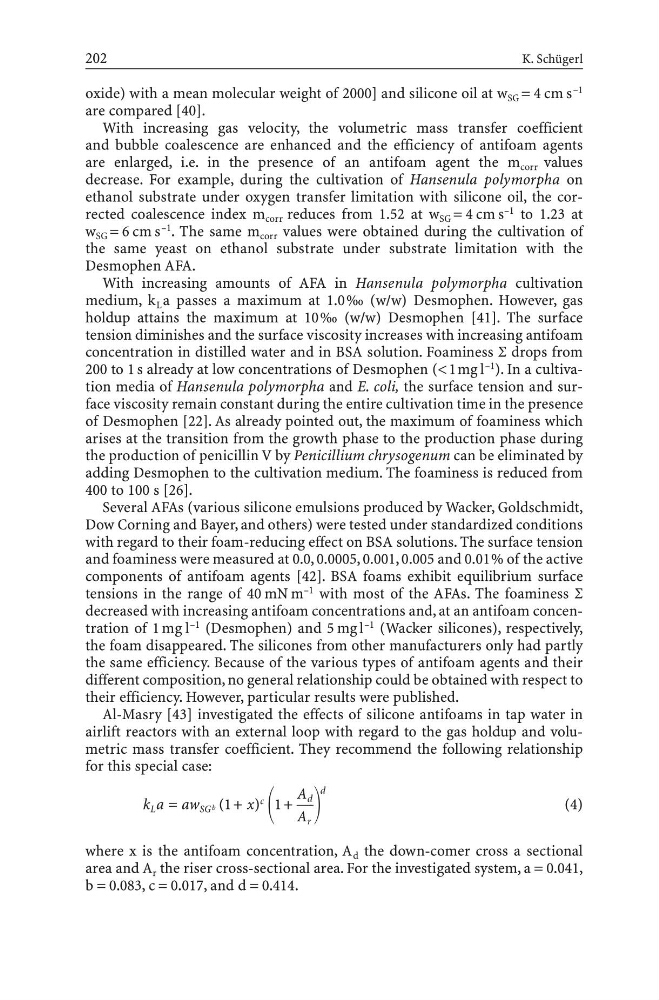
Al-Masry [43] investigated the effects of silicone antifoams in tap water in
airlift reactors with an external loop with regard to the gas holdup and volumetric mass transfer coefficient. They recommend the following relationship
for this special case:
A d
d
k L a = aw SG b (1 + x) c
1+ 41
(4)
A r
where x is the antifoam concentration, A d the down-comer cross a sectional
area and A r the riser cross-sectional area. For the investigated system, a = 0.041,
b = 0.083, c = 0.017, and d = 0.414.
202
K. Schügerl
are compared [40].
With increasing gas velocity, the volumetric mass transfer coefficient
and bubble coalescence are enhanced and the efficiency of antifoam agents
are enlarged, i.e. in the presence of an antifoam agent the m corr values
decrease. For example, during the cultivation of Hansenula polymorpha on
ethanol substrate under oxygen transfer limitation with silicone oil, the corrected coalescence index m corr reduces from 1.52 at w SG = 4 cm s –1 to 1.23 at
w SG = 6 cm s –1 . The same m corr values were obtained during the cultivation of
the same yeast on ethanol substrate under substrate limitation with the
Desmophen AFA.
With increasing amounts of AFA in Hansenula polymorpha cultivation
medium, k L a passes a maximum at 1.0‰ (w/w) Desmophen. However, gas
holdup attains the maximum at 10‰ (w/w) Desmophen [41]. The surface
tension diminishes and the surface viscosity increases with increasing antifoam
concentration in distilled water and in BSA solution. Foaminess S drops from
200 to 1 s already at low concentrations of Desmophen (<1mg l –1 ). In a cultivation media of Hansenula polymorpha and E. coli, the surface tension and surface viscosity remain constant during the entire cultivation time in the presence
of Desmophen [22]. As already pointed out, the maximum of foaminess which
arises at the transition from the growth phase to the production phase during
the production of penicillin V by Penicillium chrysogenum can be eliminated by
adding Desmophen to the cultivation medium. The foaminess is reduced from
400 to 100 s [26].
Several AFAs (various silicone emulsions produced by Wacker, Goldschmidt,
Dow Corning and Bayer, and others) were tested under standardized conditions
with regard to their foam-reducing effect on BSA solutions. The surface tension
and foaminess were measured at 0.0, 0.0005, 0.001, 0.005 and 0.01% of the active
components of antifoam agents [42]. BSA foams exhibit equilibrium surface
tensions in the range of 40 mN m –1 with most of the AFAs. The foaminess S
decreased with increasing antifoam concentrations and, at an antifoam concentration of 1 mg l –1 (Desmophen) and 5 mg l –1 (Wacker silicones), respectively,
the foam disappeared. The silicones from other manufacturers only had partly
the same efficiency. Because of the various types of antifoam agents and their
different composition, no general relationship could be obtained with respect to
their efficiency. However, particular results were published.
Al-Masry [43] investigated the effects of silicone antifoams in tap water in
airlift reactors with an external loop with regard to the gas holdup and volumetric mass transfer coefficient. They recommend the following relationship
for this special case:
A d
d
k L a = aw SG b (1 + x) c
1+ 41
(4)
A r
where x is the antifoam concentration, A d the down-comer cross a sectional
area and A r the riser cross-sectional area. For the investigated system, a = 0.041,
b = 0.083, c = 0.017, and d = 0.414.
202
K. Schügerl