

by the model, which suitably predicts separations of mixtures of cells or molecules having different electrophoretic mobilities as well.
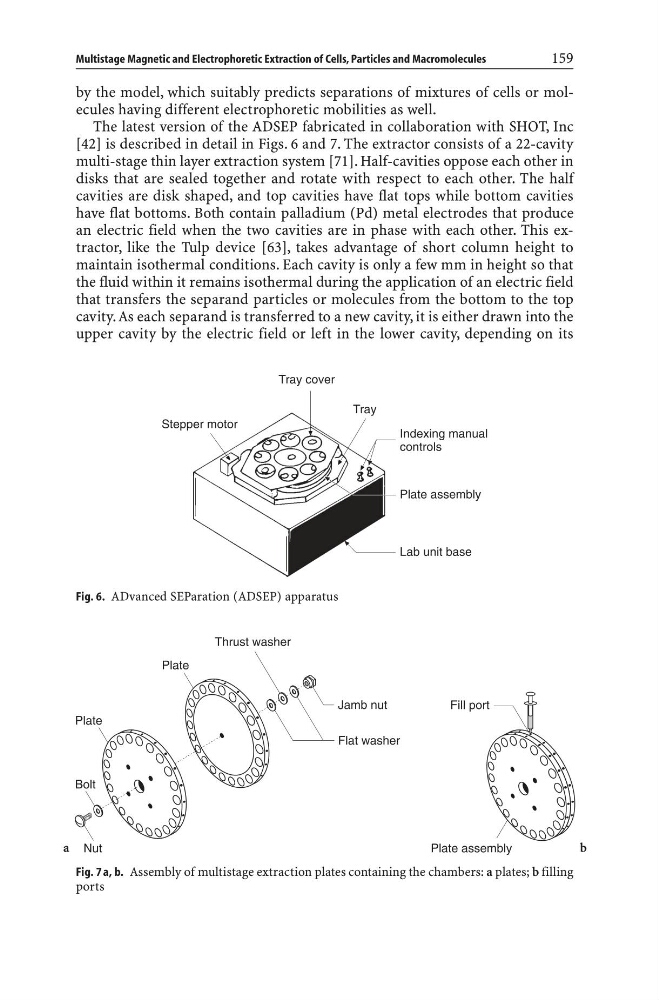
The latest version of the ADSEP fabricated in collaboration with SHOT, Inc
[42] is described in detail in Figs. 6 and 7. The extractor consists of a 22-cavity
multi-stage thin layer extraction system [71]. Half-cavities oppose each other in
disks that are sealed together and rotate with respect to each other. The half
cavities are disk shaped, and top cavities have flat tops while bottom cavities
have flat bottoms. Both contain palladium (Pd) metal electrodes that produce
an electric field when the two cavities are in phase with each other. This extractor, like the Tulp device [63], takes advantage of short column height to
maintain isothermal conditions. Each cavity is only a few mm in height so that
the fluid within it remains isothermal during the application of an electric field
that transfers the separand particles or molecules from the bottom to the top
cavity. As each separand is transferred to a new cavity, it is either drawn into the
upper cavity by the electric field or left in the lower cavity, depending on its
Multistage Magnetic and Electrophoretic Extraction of Cells, Particles and Macromolecules
159
Fig. 6. ADvanced SEParation (ADSEP) apparatus
Fig. 7 a, b. Assembly of multistage extraction plates containing the chambers: a plates; b filling
ports
b
a
The latest version of the ADSEP fabricated in collaboration with SHOT, Inc
[42] is described in detail in Figs. 6 and 7. The extractor consists of a 22-cavity
multi-stage thin layer extraction system [71]. Half-cavities oppose each other in
disks that are sealed together and rotate with respect to each other. The half
cavities are disk shaped, and top cavities have flat tops while bottom cavities
have flat bottoms. Both contain palladium (Pd) metal electrodes that produce
an electric field when the two cavities are in phase with each other. This extractor, like the Tulp device [63], takes advantage of short column height to
maintain isothermal conditions. Each cavity is only a few mm in height so that
the fluid within it remains isothermal during the application of an electric field
that transfers the separand particles or molecules from the bottom to the top
cavity. As each separand is transferred to a new cavity, it is either drawn into the
upper cavity by the electric field or left in the lower cavity, depending on its
Multistage Magnetic and Electrophoretic Extraction of Cells, Particles and Macromolecules
159
Fig. 6. ADvanced SEParation (ADSEP) apparatus
Fig. 7 a, b. Assembly of multistage extraction plates containing the chambers: a plates; b filling
ports
b
a