

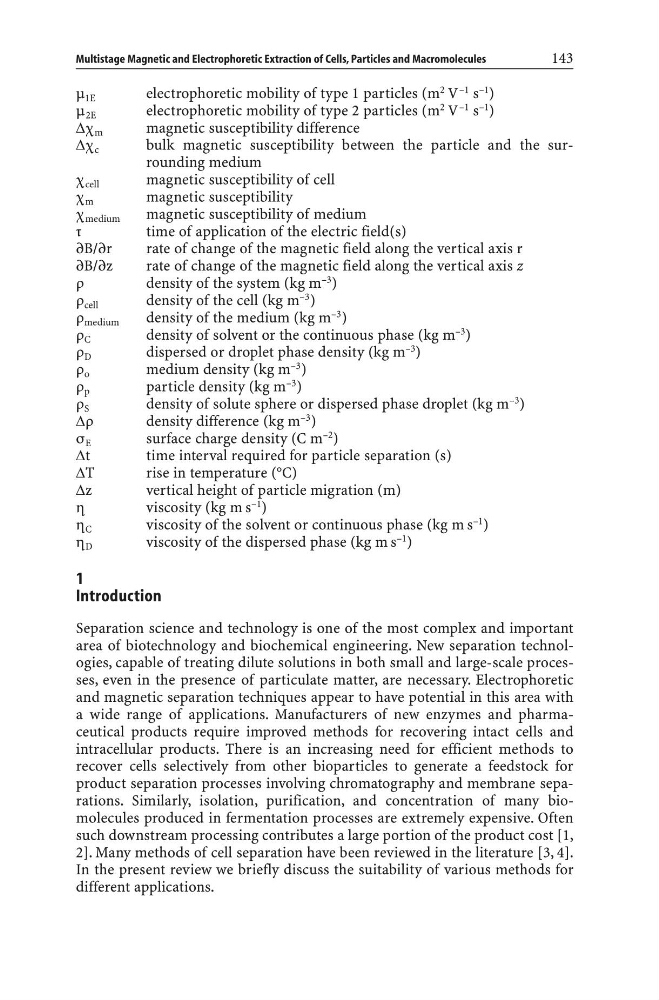
m 1E
electrophoretic mobility of type 1 particles (m 2 V –1 s –1 )
m 2E
electrophoretic mobility of type 2 particles (m 2 V –1 s –1 )
Dc m
magnetic susceptibility difference
Dc c
bulk magnetic susceptibility between the particle and the surrounding medium
c cell
magnetic susceptibility of cell
c m
magnetic susceptibility
c medium
magnetic susceptibility of medium
t
time of application of the electric field(s)
∂B/∂r
rate of change of the magnetic field along the vertical axis r
∂B/∂z
rate of change of the magnetic field along the vertical axis z
Ç
density of the system (kg m –3 )
Ç cell
density of the cell (kg m –3 )
Ç medium
density of the medium (kg m –3 )
Ç C
density of solvent or the continuous phase (kg m –3 )
Ç D
dispersed or droplet phase density (kg m –3 )
Ç o
medium density (kg m –3 )
Ç p
particle density (kg m –3 )
Ç S
density of solute sphere or dispersed phase droplet (kg m –3 )
DÇ
density difference (kg m –3 )
s E
surface charge density (C m –2 )
Dt
time interval required for particle separation (s)
DT
rise in temperature (°C)
Dz
vertical height of particle migration (m)
h
viscosity (kg m s –1 )
h C
viscosity of the solvent or continuous phase (kg m s –1 )
h D
viscosity of the dispersed phase (kg m s –1 )
1
Introduction
Separation science and technology is one of the most complex and important
area of biotechnology and biochemical engineering. New separation technologies, capable of treating dilute solutions in both small and large-scale processes, even in the presence of particulate matter, are necessary. Electrophoretic
and magnetic separation techniques appear to have potential in this area with
a wide range of applications. Manufacturers of new enzymes and pharmaceutical products require improved methods for recovering intact cells and
intracellular products. There is an increasing need for efficient methods to
recover cells selectively from other bioparticles to generate a feedstock for
product separation processes involving chromatography and membrane separations. Similarly, isolation, purification, and concentration of many biomolecules produced in fermentation processes are extremely expensive. Often
such downstream processing contributes a large portion of the product cost [1,
2]. Many methods of cell separation have been reviewed in the literature [3, 4].
In the present review we briefly discuss the suitability of various methods for
different applications.
Multistage Magnetic and Electrophoretic Extraction of Cells, Particles and Macromolecules
143
electrophoretic mobility of type 1 particles (m 2 V –1 s –1 )
m 2E
electrophoretic mobility of type 2 particles (m 2 V –1 s –1 )
Dc m
magnetic susceptibility difference
Dc c
bulk magnetic susceptibility between the particle and the surrounding medium
c cell
magnetic susceptibility of cell
c m
magnetic susceptibility
c medium
magnetic susceptibility of medium
t
time of application of the electric field(s)
∂B/∂r
rate of change of the magnetic field along the vertical axis r
∂B/∂z
rate of change of the magnetic field along the vertical axis z
Ç
density of the system (kg m –3 )
Ç cell
density of the cell (kg m –3 )
Ç medium
density of the medium (kg m –3 )
Ç C
density of solvent or the continuous phase (kg m –3 )
Ç D
dispersed or droplet phase density (kg m –3 )
Ç o
medium density (kg m –3 )
Ç p
particle density (kg m –3 )
Ç S
density of solute sphere or dispersed phase droplet (kg m –3 )
DÇ
density difference (kg m –3 )
s E
surface charge density (C m –2 )
Dt
time interval required for particle separation (s)
DT
rise in temperature (°C)
Dz
vertical height of particle migration (m)
h
viscosity (kg m s –1 )
h C
viscosity of the solvent or continuous phase (kg m s –1 )
h D
viscosity of the dispersed phase (kg m s –1 )
1
Introduction
Separation science and technology is one of the most complex and important
area of biotechnology and biochemical engineering. New separation technologies, capable of treating dilute solutions in both small and large-scale processes, even in the presence of particulate matter, are necessary. Electrophoretic
and magnetic separation techniques appear to have potential in this area with
a wide range of applications. Manufacturers of new enzymes and pharmaceutical products require improved methods for recovering intact cells and
intracellular products. There is an increasing need for efficient methods to
recover cells selectively from other bioparticles to generate a feedstock for
product separation processes involving chromatography and membrane separations. Similarly, isolation, purification, and concentration of many biomolecules produced in fermentation processes are extremely expensive. Often
such downstream processing contributes a large portion of the product cost [1,
2]. Many methods of cell separation have been reviewed in the literature [3, 4].
In the present review we briefly discuss the suitability of various methods for
different applications.
Multistage Magnetic and Electrophoretic Extraction of Cells, Particles and Macromolecules
143