

Off-line measurements of biomass are also problematic because it is usually impossible to separate the fungal biomass from the substrate. Therefore indirect
methods of following growth have to be used. A wide range of methods can be
used, but most fall into three categories – direct separation of the biomass from the
solid matrix, measuring metabolic activities, and measuring biomass components.
With a few substrates, most of the substrate can be digested enzymatically:
this is especially true for substrates which predominantly consist of starch.
After digestion the biomass can be recovered by filtration. Alternatively, for
unicellular microorganisms the organisms can be washed from the substrate
particles and estimated by viable count.
The most useful metabolic activities to measure for following growth are O 2
consumption and CO 2 evolution, which result from microbial respiration. Either
one or both of these can be measured. If both are measured then it is possible
to determine the respiratory quotient of the microorganism, which can give
information about its metabolic state. These respiratory activities can be
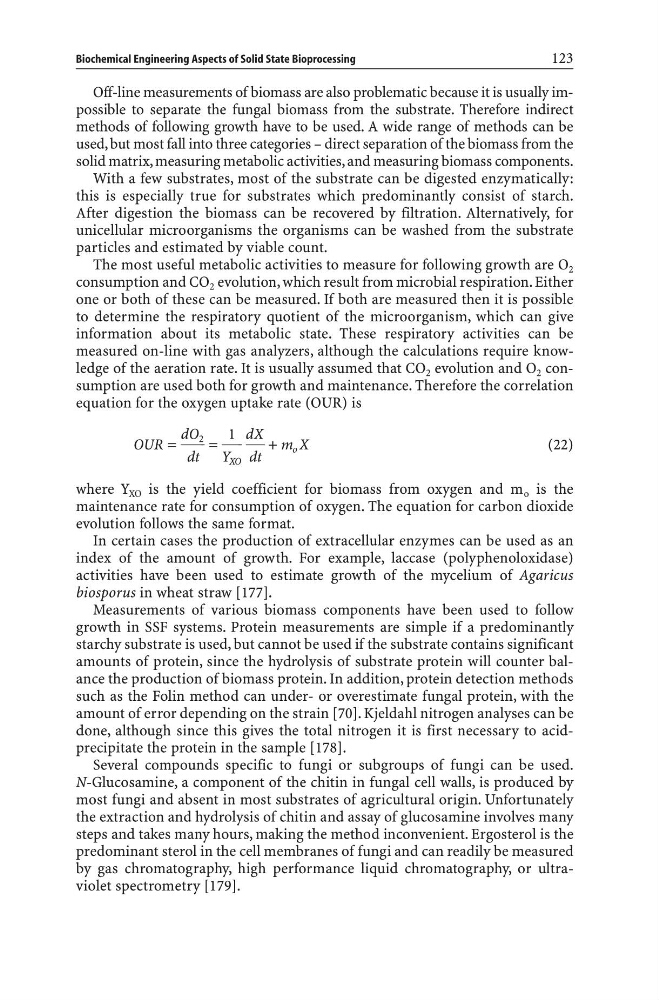
measured on-line with gas analyzers, although the calculations require knowledge of the aeration rate. It is usually assumed that CO 2 evolution and O 2 consumption are used both for growth and maintenance. Therefore the correlation
equation for the oxygen uptake rate (OUR) is
dO 2
1 dX
OUR = 61 = 51 5 + m o X
(22)
dt Y XO dt
where Y XO is the yield coefficient for biomass from oxygen and m o is the
maintenance rate for consumption of oxygen. The equation for carbon dioxide
evolution follows the same format.
In certain cases the production of extracellular enzymes can be used as an
index of the amount of growth. For example, laccase (polyphenoloxidase)
activities have been used to estimate growth of the mycelium of Agaricus
biosporus in wheat straw [177].
Measurements of various biomass components have been used to follow
growth in SSF systems. Protein measurements are simple if a predominantly
starchy substrate is used, but cannot be used if the substrate contains significant
amounts of protein, since the hydrolysis of substrate protein will counter balance the production of biomass protein. In addition, protein detection methods
such as the Folin method can under- or overestimate fungal protein, with the
amount of error depending on the strain [70]. Kjeldahl nitrogen analyses can be
done, although since this gives the total nitrogen it is first necessary to acidprecipitate the protein in the sample [178].
Several compounds specific to fungi or subgroups of fungi can be used.
N-Glucosamine, a component of the chitin in fungal cell walls, is produced by
most fungi and absent in most substrates of agricultural origin. Unfortunately
the extraction and hydrolysis of chitin and assay of glucosamine involves many
steps and takes many hours, making the method inconvenient. Ergosterol is the
predominant sterol in the cell membranes of fungi and can readily be measured
by gas chromatography, high performance liquid chromatography, or ultraviolet spectrometry [179].
Biochemical Engineering Aspects of Solid State Bioprocessing
123
methods of following growth have to be used. A wide range of methods can be
used, but most fall into three categories – direct separation of the biomass from the
solid matrix, measuring metabolic activities, and measuring biomass components.
With a few substrates, most of the substrate can be digested enzymatically:
this is especially true for substrates which predominantly consist of starch.
After digestion the biomass can be recovered by filtration. Alternatively, for
unicellular microorganisms the organisms can be washed from the substrate
particles and estimated by viable count.
The most useful metabolic activities to measure for following growth are O 2
consumption and CO 2 evolution, which result from microbial respiration. Either
one or both of these can be measured. If both are measured then it is possible
to determine the respiratory quotient of the microorganism, which can give
information about its metabolic state. These respiratory activities can be
measured on-line with gas analyzers, although the calculations require knowledge of the aeration rate. It is usually assumed that CO 2 evolution and O 2 consumption are used both for growth and maintenance. Therefore the correlation
equation for the oxygen uptake rate (OUR) is
dO 2
1 dX
OUR = 61 = 51 5 + m o X
(22)
dt Y XO dt
where Y XO is the yield coefficient for biomass from oxygen and m o is the
maintenance rate for consumption of oxygen. The equation for carbon dioxide
evolution follows the same format.
In certain cases the production of extracellular enzymes can be used as an
index of the amount of growth. For example, laccase (polyphenoloxidase)
activities have been used to estimate growth of the mycelium of Agaricus
biosporus in wheat straw [177].
Measurements of various biomass components have been used to follow
growth in SSF systems. Protein measurements are simple if a predominantly
starchy substrate is used, but cannot be used if the substrate contains significant
amounts of protein, since the hydrolysis of substrate protein will counter balance the production of biomass protein. In addition, protein detection methods
such as the Folin method can under- or overestimate fungal protein, with the
amount of error depending on the strain [70]. Kjeldahl nitrogen analyses can be
done, although since this gives the total nitrogen it is first necessary to acidprecipitate the protein in the sample [178].
Several compounds specific to fungi or subgroups of fungi can be used.
N-Glucosamine, a component of the chitin in fungal cell walls, is produced by
most fungi and absent in most substrates of agricultural origin. Unfortunately
the extraction and hydrolysis of chitin and assay of glucosamine involves many
steps and takes many hours, making the method inconvenient. Ergosterol is the
predominant sterol in the cell membranes of fungi and can readily be measured
by gas chromatography, high performance liquid chromatography, or ultraviolet spectrometry [179].
Biochemical Engineering Aspects of Solid State Bioprocessing
123