

applications rotating drum bioreactors are typically operated with fractional
fillings around 30%. However, mixing patterns within the bed have not received
any attention except to correlate transverse mixing regimes for drums without
lifters with those observed in non-SSF applications of rotating drums. A critical
speed can be identified for these rotating drums, which is the speed at which the
solids are centrifuged against the drum wall. For horizontal drums the critical
speed in rpm (N C ) is equal to 42.3D
0.5
, where D is the drum diameter in meters.
For drum speeds up to about 0.1N C there is little movement within the bed
itself. Rather the bed as a whole tends to be dragged upwards by the drum
rotation and then to slump back to the bottom. In this slumping regime the bed
will perform similarly to a tray. Between 0.1N C and 0.6 N C particles tumble
down the face of the bed. Above 0.6 N C particles are thrown into the air. In
practice, rotating drum bioreactors have only rarely been operated in the
tumbling regime; rather they tend to be operated at speeds of a few rpm or even
less. At these speeds transfer between the bed and headspace is greatly improved by the inclusion of lifters [149, 150].
Flow patterns within the headspace have been investigated by studying
the residence time distributions of oxygen as a tracer gas [151]. In an unbaffled
drum operated at various fractional fillings and air flow rates, the flow
patterns were best described by either a plug flow with axial dispersion model
or a model of several continuous stirred tanks in series. However, these flow
patterns cannot simply be assumed to occur in other rotating drum bioreactors. Gas flow patterns will be greatly affected not only by the design
of the rotating drum bioreactor itself, such as length to diameter ratio and
Biochemical Engineering Aspects of Solid State Bioprocessing
111
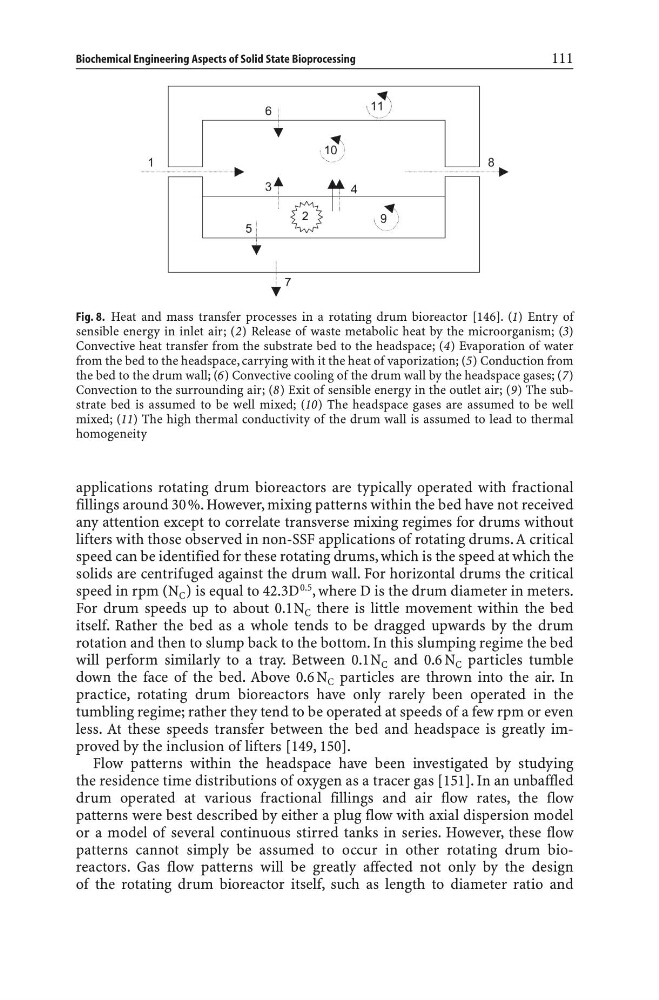
Fig. 8. Heat and mass transfer processes in a rotating drum bioreactor [146]. (1) Entry of
sensible energy in inlet air; (2) Release of waste metabolic heat by the microorganism; (3)
Convective heat transfer from the substrate bed to the headspace; (4) Evaporation of water
from the bed to the headspace, carrying with it the heat of vaporization; (5) Conduction from
the bed to the drum wall; (6) Convective cooling of the drum wall by the headspace gases; (7)
Convection to the surrounding air; (8) Exit of sensible energy in the outlet air; (9) The substrate bed is assumed to be well mixed; (10) The headspace gases are assumed to be well
mixed; (11) The high thermal conductivity of the drum wall is assumed to lead to thermal
homogeneity
fillings around 30%. However, mixing patterns within the bed have not received
any attention except to correlate transverse mixing regimes for drums without
lifters with those observed in non-SSF applications of rotating drums. A critical
speed can be identified for these rotating drums, which is the speed at which the
solids are centrifuged against the drum wall. For horizontal drums the critical
speed in rpm (N C ) is equal to 42.3D
0.5
, where D is the drum diameter in meters.
For drum speeds up to about 0.1N C there is little movement within the bed
itself. Rather the bed as a whole tends to be dragged upwards by the drum
rotation and then to slump back to the bottom. In this slumping regime the bed
will perform similarly to a tray. Between 0.1N C and 0.6 N C particles tumble
down the face of the bed. Above 0.6 N C particles are thrown into the air. In
practice, rotating drum bioreactors have only rarely been operated in the
tumbling regime; rather they tend to be operated at speeds of a few rpm or even
less. At these speeds transfer between the bed and headspace is greatly improved by the inclusion of lifters [149, 150].
Flow patterns within the headspace have been investigated by studying
the residence time distributions of oxygen as a tracer gas [151]. In an unbaffled
drum operated at various fractional fillings and air flow rates, the flow
patterns were best described by either a plug flow with axial dispersion model
or a model of several continuous stirred tanks in series. However, these flow
patterns cannot simply be assumed to occur in other rotating drum bioreactors. Gas flow patterns will be greatly affected not only by the design
of the rotating drum bioreactor itself, such as length to diameter ratio and
Biochemical Engineering Aspects of Solid State Bioprocessing
111
Fig. 8. Heat and mass transfer processes in a rotating drum bioreactor [146]. (1) Entry of
sensible energy in inlet air; (2) Release of waste metabolic heat by the microorganism; (3)
Convective heat transfer from the substrate bed to the headspace; (4) Evaporation of water
from the bed to the headspace, carrying with it the heat of vaporization; (5) Conduction from
the bed to the drum wall; (6) Convective cooling of the drum wall by the headspace gases; (7)
Convection to the surrounding air; (8) Exit of sensible energy in the outlet air; (9) The substrate bed is assumed to be well mixed; (10) The headspace gases are assumed to be well
mixed; (11) The high thermal conductivity of the drum wall is assumed to lead to thermal
homogeneity