

Tray processes have a long history in the production of traditional fermented foods such as soy sauce, koji, and tempe, and more recently have been used
for commercial production of enzymes, but these processes are small- to
medium-rather than large-scale [132, 133]. Due to the difficulty of automating
the handling of trays, handling is usually done by hand, leading to relatively
high labor costs. Therefore tray processes are only economical where labor
costs are low.
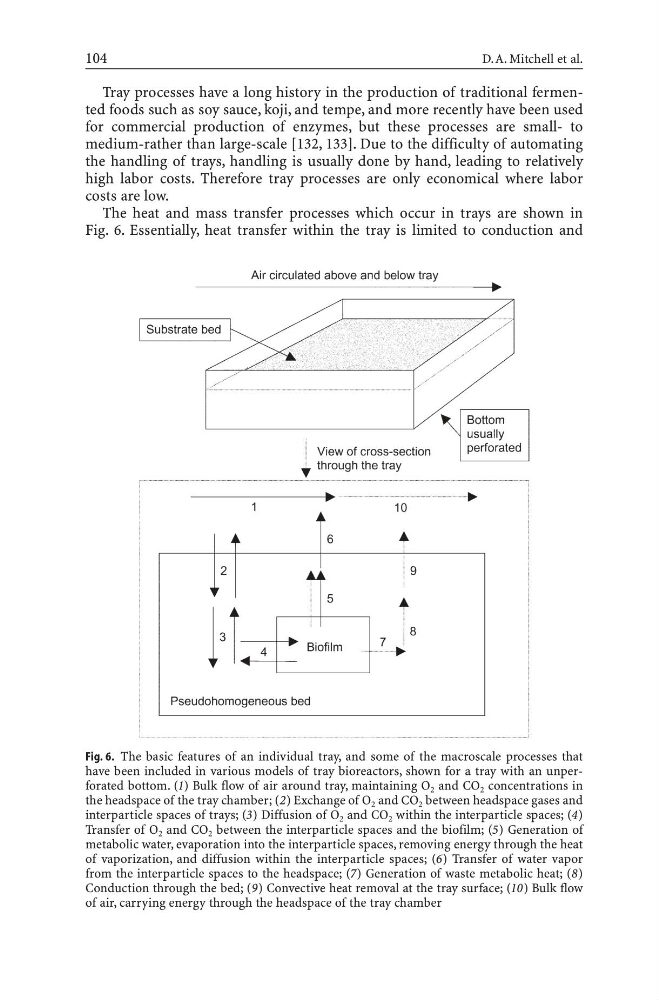
The heat and mass transfer processes which occur in trays are shown in
Fig. 6. Essentially, heat transfer within the tray is limited to conduction and
104
D.A. Mitchell et al.
Fig. 6. The basic features of an individual tray, and some of the macroscale processes that
have been included in various models of tray bioreactors, shown for a tray with an unperforated bottom. (1) Bulk flow of air around tray, maintaining O 2 and CO 2 concentrations in
the headspace of the tray chamber; (2) Exchange of O 2 and CO 2 between headspace gases and
interparticle spaces of trays; (3) Diffusion of O 2 and CO 2 within the interparticle spaces; (4)
Transfer of O 2 and CO 2 between the interparticle spaces and the biofilm; (5) Generation of
metabolic water, evaporation into the interparticle spaces, removing energy through the heat
of vaporization, and diffusion within the interparticle spaces; (6) Transfer of water vapor
from the interparticle spaces to the headspace; (7) Generation of waste metabolic heat; (8)
Conduction through the bed; (9) Convective heat removal at the tray surface; (10) Bulk flow
of air, carrying energy through the headspace of the tray chamber
for commercial production of enzymes, but these processes are small- to
medium-rather than large-scale [132, 133]. Due to the difficulty of automating
the handling of trays, handling is usually done by hand, leading to relatively
high labor costs. Therefore tray processes are only economical where labor
costs are low.
The heat and mass transfer processes which occur in trays are shown in
Fig. 6. Essentially, heat transfer within the tray is limited to conduction and
104
D.A. Mitchell et al.
Fig. 6. The basic features of an individual tray, and some of the macroscale processes that
have been included in various models of tray bioreactors, shown for a tray with an unperforated bottom. (1) Bulk flow of air around tray, maintaining O 2 and CO 2 concentrations in
the headspace of the tray chamber; (2) Exchange of O 2 and CO 2 between headspace gases and
interparticle spaces of trays; (3) Diffusion of O 2 and CO 2 within the interparticle spaces; (4)
Transfer of O 2 and CO 2 between the interparticle spaces and the biofilm; (5) Generation of
metabolic water, evaporation into the interparticle spaces, removing energy through the heat
of vaporization, and diffusion within the interparticle spaces; (6) Transfer of water vapor
from the interparticle spaces to the headspace; (7) Generation of waste metabolic heat; (8)
Conduction through the bed; (9) Convective heat removal at the tray surface; (10) Bulk flow
of air, carrying energy through the headspace of the tray chamber