

Protein Sequencing or Genome Sequencing
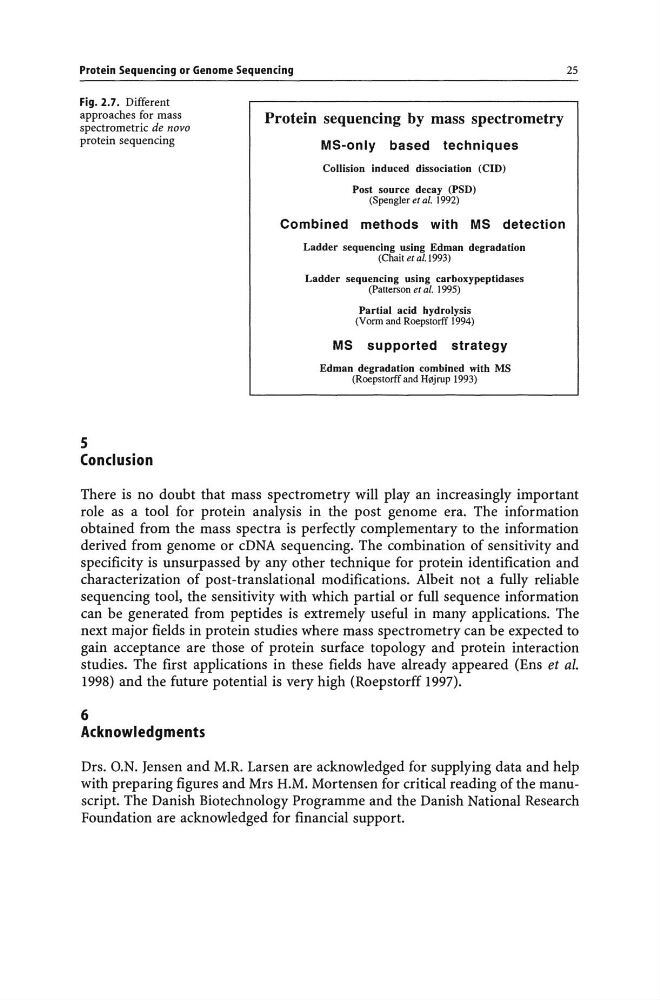
Fig. 2.7. Different
approaches for mass
spectrometric de novo
protein sequencing
5
Conclusion
Protein sequencing by mass spectrometry
MS-only based techniques
Collision induced dissociation (CID)
Post source decay (PSD)
(Spengler el al. 1992)
Combined methods with MS detection
Ladder sequencing using Edman degradation
(Chait el a1.1993)
Ladder sequencing using carboxypeptidases
(Patterson el al. 1995)
Partial acid hydrolysis
(V orm and Roepstorff 1994)
MS supported strategy
Edman degradation combined with MS
(Roepstorff and HlljruP 1993)
25
There is no doubt that mass spectrometry will play an increasingly important
role as a tool for protein analysis in the post genome era. The information
obtained from the mass spectra is perfectly complementary to the information
derived from genome or cDNA sequencing. The combination of sensitivity and
specificity is unsurpassed by any other technique for protein identification and
characterization of post-translational modifications. Albeit not a fully reliable
sequencing tool, the sensitivity with which partial or full sequence information
can be generated from peptides is extremely useful in many applications. The
next major fields in protein studies where mass spectrometry can be expected to
gain acceptance are those of protein surface topology and protein interaction
studies. The first applications in these fields have already appeared (Ens et al.
1998) and the future potential is very high (Roepstorff 1997).
6
Acknowledgments
Drs. O.N. Jensen and M.R. Larsen are acknowledged for supplying data and help
with preparing figures and Mrs H.M. Mortensen for critical reading of the manuscript. The Danish Biotechnology Programme and the Danish National Research
Foundation are acknowledged for financial support.
Fig. 2.7. Different
approaches for mass
spectrometric de novo
protein sequencing
5
Conclusion
Protein sequencing by mass spectrometry
MS-only based techniques
Collision induced dissociation (CID)
Post source decay (PSD)
(Spengler el al. 1992)
Combined methods with MS detection
Ladder sequencing using Edman degradation
(Chait el a1.1993)
Ladder sequencing using carboxypeptidases
(Patterson el al. 1995)
Partial acid hydrolysis
(V orm and Roepstorff 1994)
MS supported strategy
Edman degradation combined with MS
(Roepstorff and HlljruP 1993)
25
There is no doubt that mass spectrometry will play an increasingly important
role as a tool for protein analysis in the post genome era. The information
obtained from the mass spectra is perfectly complementary to the information
derived from genome or cDNA sequencing. The combination of sensitivity and
specificity is unsurpassed by any other technique for protein identification and
characterization of post-translational modifications. Albeit not a fully reliable
sequencing tool, the sensitivity with which partial or full sequence information
can be generated from peptides is extremely useful in many applications. The
next major fields in protein studies where mass spectrometry can be expected to
gain acceptance are those of protein surface topology and protein interaction
studies. The first applications in these fields have already appeared (Ens et al.
1998) and the future potential is very high (Roepstorff 1997).
6
Acknowledgments
Drs. O.N. Jensen and M.R. Larsen are acknowledged for supplying data and help
with preparing figures and Mrs H.M. Mortensen for critical reading of the manuscript. The Danish Biotechnology Programme and the Danish National Research
Foundation are acknowledged for financial support.