

Proteoglycans: Biological Roles and Strategies
(A)
AnI
1
o
10
- u
... to o
f
v .,
(8)
10
01
1S
o
Migration time (min)
1
I.
10
359
IS
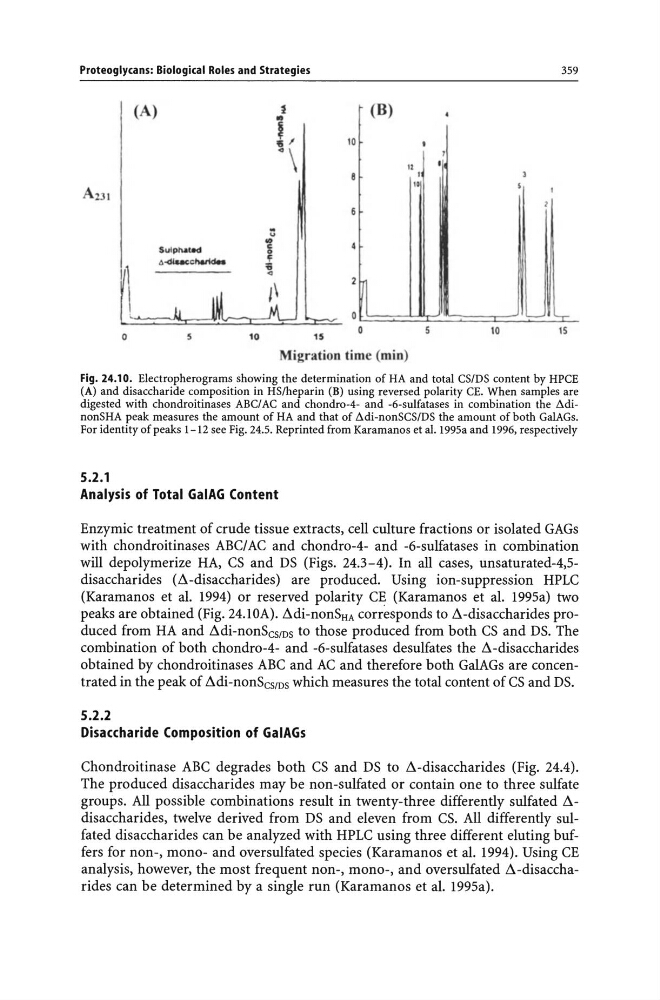
Fig. 24.10. Electropherograms showing the determination of HA and total CS/DS content by HPCE
(A) and disaccharide composition in HS/heparin (B) using reversed polarity CEo When samples are
digested with chondroitinases ABCI AC and chondro-4- and -6-sulfatases in combination the ~dinonSHA peak measures the amount of HA and that of ~di-nonSCS/DS the amount of both GalAGs.
For identity of peaks 1-12 see Fig. 24.5. Reprinted from Karamanos et al. 1995a and 1996, respectively
5.2.1
Analysis of Total GalAG Content
Enzymic treatment of crude tissue extracts, cell culture fractions or isolated GAGs
with chondroitinases ABCI AC and chondro-4- and -6-sulfatases in combination
will depolymerize HA, CS and DS (Figs. 24.3-4). In all cases, unsaturated-4,Sdisaccharides (~-disaccharides) are produced. Using ion-suppression HPLC
(Karamanos et al. 1994) or reserved polarity CE (Karamanos et al. 1995a) two
peaks are obtained (Fig. 24.10A). ~di-nonSHA corresponds to ~-disaccharides produced from HA and ~di-nonScS/DS to those produced from both CS and DS. The
combination of both chondro-4- and -6-sulfatases desulfates the ~-disaccharides
obtained by chondroitinases ABC and AC and therefore both GalAGs are concentrated in the peak of ~di-nonScs/Ds which measures the total content of CS and DS.
5.2.2
Disaccharide Composition of GalAGs
Chondroitinase ABC degrades both CS and DS to ~-disaccharides (Fig. 24.4).
The produced disaccharides may be non-sulfated or contain one to three sulfate
groups. All possible combinations result in twenty-three differently sulfated ~disaccharides, twelve derived from DS and eleven from CS. All differently sulfated disaccharides can be analyzed with HPLC using three different eluting buffers for non-, mono- and oversulfated species (Karamanos et al. 1994). Using CE
analysis, however, the most frequent non-, mono-, and oversulfated ~-disaccharides can be determined by a single run (Karamanos et al. 1995a).
(A)
AnI
1
o
10
- u
... to o
f
v .,
(8)
10
01
1S
o
Migration time (min)
1
I.
10
359
IS
Fig. 24.10. Electropherograms showing the determination of HA and total CS/DS content by HPCE
(A) and disaccharide composition in HS/heparin (B) using reversed polarity CEo When samples are
digested with chondroitinases ABCI AC and chondro-4- and -6-sulfatases in combination the ~dinonSHA peak measures the amount of HA and that of ~di-nonSCS/DS the amount of both GalAGs.
For identity of peaks 1-12 see Fig. 24.5. Reprinted from Karamanos et al. 1995a and 1996, respectively
5.2.1
Analysis of Total GalAG Content
Enzymic treatment of crude tissue extracts, cell culture fractions or isolated GAGs
with chondroitinases ABCI AC and chondro-4- and -6-sulfatases in combination
will depolymerize HA, CS and DS (Figs. 24.3-4). In all cases, unsaturated-4,Sdisaccharides (~-disaccharides) are produced. Using ion-suppression HPLC
(Karamanos et al. 1994) or reserved polarity CE (Karamanos et al. 1995a) two
peaks are obtained (Fig. 24.10A). ~di-nonSHA corresponds to ~-disaccharides produced from HA and ~di-nonScS/DS to those produced from both CS and DS. The
combination of both chondro-4- and -6-sulfatases desulfates the ~-disaccharides
obtained by chondroitinases ABC and AC and therefore both GalAGs are concentrated in the peak of ~di-nonScs/Ds which measures the total content of CS and DS.
5.2.2
Disaccharide Composition of GalAGs
Chondroitinase ABC degrades both CS and DS to ~-disaccharides (Fig. 24.4).
The produced disaccharides may be non-sulfated or contain one to three sulfate
groups. All possible combinations result in twenty-three differently sulfated ~disaccharides, twelve derived from DS and eleven from CS. All differently sulfated disaccharides can be analyzed with HPLC using three different eluting buffers for non-, mono- and oversulfated species (Karamanos et al. 1994). Using CE
analysis, however, the most frequent non-, mono-, and oversulfated ~-disaccharides can be determined by a single run (Karamanos et al. 1995a).