

Proteoglycans: Biological Roles and Strategies
355
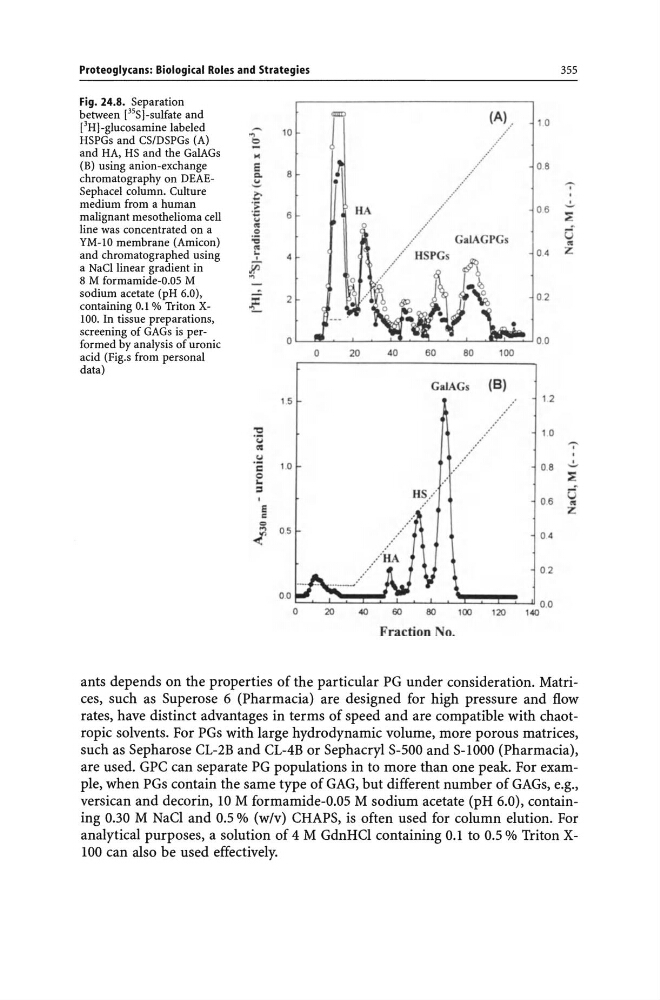
Fig. 24.B. Separation
between [ 35 S1-sulfate and
CIIIIC
[,Hl-glucosamine labeled
1 0
'"
10
HSPGs and CS/DSPGs (A)
I:>
and HA, HS and the GalAGs
. .
(B) using anion-exchange
E
08
chromatography on DEAEg,
8
~
•
";"
Sephacel column. Culture
C
,
medium from a human
.s;:
HA
06
...!,..
malignant mesothelioma cell
'l:
6
::o!
...
line was concentrated on a
.,
0
Q
0
YM-lO membrane (Amicon)
:;;
.,
.,
z:
and chromatographed using
':'
4
0 4
a NaCI linear gradient in
ifi
8 M formamide-0.05 M
'"
sodium acetate (pH 6.0),
...::
02
containing 0.1 % Triton X-E
2
100. In tissue preparations,
screening of GAGs is per0
0.0
formed by analysis of uronic
acid (Fig.s from personal
0
20
40
60
80
100
data)
GalAGs
(8)
15
12
"C
1 0
'y
=
";"
.!:!
,
c
1.0
08
...!,..
0
::o!
.. =
HS /
- "
"
06
.,
E
z:
=
'" ... 05
..t
0 4
02
00
0
20
40
60
eo
00
HXl
120
140
Fraction No.
ants depends on the properties of the particular PG under consideration. Matrices, such as Superose 6 (Pharmacia) are designed for high pressure and flow
rates, have distinct advantages in terms of speed and are compatible with chaotropic solvents. For PGs with large hydrodynamic volume, more porous matrices,
such as Sepharose CL-2B and CL-4B or Sephacryl S-500 and S-1000 (Pharmacia),
are used. GPC can separate PG populations in to more than one peak. For example, when PGs contain the same type of GAG, but different number of GAGs, e.g.,
versican and decorin, 10 M formamide-0.05 M sodium acetate (pH 6.0), containing 0.30 M NaCI and 0.5 % (w/v) CHAPS, is often used for column elution. For
analytical purposes, a solution of 4 M GdnHCI containing 0.1 to 0.5 % Triton X100 can also be used effectively.
355
Fig. 24.B. Separation
between [ 35 S1-sulfate and
CIIIIC
[,Hl-glucosamine labeled
1 0
'"
10
HSPGs and CS/DSPGs (A)
I:>
and HA, HS and the GalAGs
. .
(B) using anion-exchange
E
08
chromatography on DEAEg,
8
~
•
";"
Sephacel column. Culture
C
,
medium from a human
.s;:
HA
06
...!,..
malignant mesothelioma cell
'l:
6
::o!
...
line was concentrated on a
.,
0
Q
0
YM-lO membrane (Amicon)
:;;
.,
.,
z:
and chromatographed using
':'
4
0 4
a NaCI linear gradient in
ifi
8 M formamide-0.05 M
'"
sodium acetate (pH 6.0),
...::
02
containing 0.1 % Triton X-E
2
100. In tissue preparations,
screening of GAGs is per0
0.0
formed by analysis of uronic
acid (Fig.s from personal
0
20
40
60
80
100
data)
GalAGs
(8)
15
12
"C
1 0
'y
=
";"
.!:!
,
c
1.0
08
...!,..
0
::o!
.. =
HS /
- "
"
06
.,
E
z:
=
'" ... 05
..t
0 4
02
00
0
20
40
60
eo
00
HXl
120
140
Fraction No.
ants depends on the properties of the particular PG under consideration. Matrices, such as Superose 6 (Pharmacia) are designed for high pressure and flow
rates, have distinct advantages in terms of speed and are compatible with chaotropic solvents. For PGs with large hydrodynamic volume, more porous matrices,
such as Sepharose CL-2B and CL-4B or Sephacryl S-500 and S-1000 (Pharmacia),
are used. GPC can separate PG populations in to more than one peak. For example, when PGs contain the same type of GAG, but different number of GAGs, e.g.,
versican and decorin, 10 M formamide-0.05 M sodium acetate (pH 6.0), containing 0.30 M NaCI and 0.5 % (w/v) CHAPS, is often used for column elution. For
analytical purposes, a solution of 4 M GdnHCI containing 0.1 to 0.5 % Triton X100 can also be used effectively.