

346
(A)
~o Jm
COCR,
-
4GlcAlp- 3GaINAclPj chondroitinases ABCI A C
N.K.KARAMANOS
- 4GJ.cA/ll- 3GalNAcPl- 4IdoAlP-3GalNAcPl1
chondroitinasc
ABC
~-Uronic acid-GalNAc
ACIB
1
chondroitinases
~-uronic acid-GalNAc
+
~-oligosaccbarides
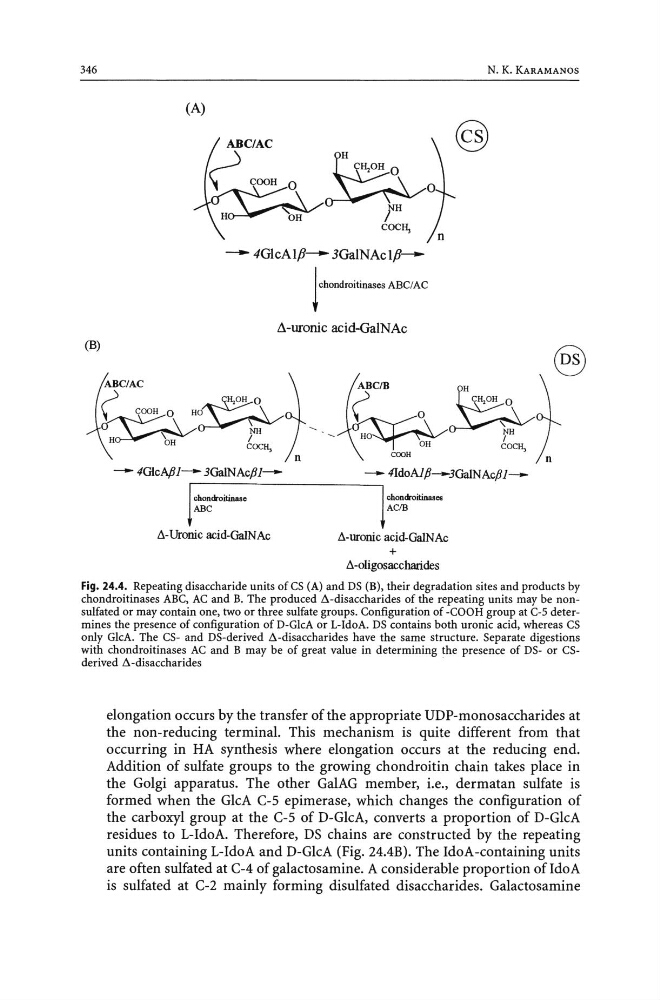
Fig. 24.4. Repeating disaccharide units of CS (A) and DS (B), their degradation sites and products by
chondroitinases ABC, AC and B. The produced ~-disaccharides of the repeating units may be nonsulfated or may contain one, two or three sulfate groups. Configuration of -COOH group at c-s determines the presence of configuration of D-GIcA or L-IdoA. DS contains both uronic acid, whereas CS
only GIcA. The CS- and DS-derived ~-disaccharides have the same structure. Separate digestions
with chondroitinases AC and B may be of great value in determining the presence of DS- or CSderived ~-disaccharides
elongation occurs by the transfer of the appropriate UDP-monosaccharides at
the non-reducing terminal. This mechanism is quite different from that
occurring in HA synthesis where elongation occurs at the reducing end.
Addition of sulfate groups to the growing chondroitin chain takes place in
the Golgi apparatus. The other GalAG member, i.e., dermatan sulfate is
formed when the GlcA C-5 epimerase, which changes the configuration of
the carboxyl group at the C-5 of D-GlcA, converts a proportion of D-GlcA
residues to L-IdoA. Therefore, DS chains are constructed by the repeating
units containing L-IdoA and D-GlcA (Fig. 24.4B). The IdoA-containing units
are often sulfated at C-4 of galactosamine. A considerable proportion of IdoA
is sulfated at C-2 mainly forming disulfated disaccharides. Galactosamine
(A)
~o Jm
COCR,
-
4GlcAlp- 3GaINAclPj chondroitinases ABCI A C
N.K.KARAMANOS
- 4GJ.cA/ll- 3GalNAcPl- 4IdoAlP-3GalNAcPl1
chondroitinasc
ABC
~-Uronic acid-GalNAc
ACIB
1
chondroitinases
~-uronic acid-GalNAc
+
~-oligosaccbarides
Fig. 24.4. Repeating disaccharide units of CS (A) and DS (B), their degradation sites and products by
chondroitinases ABC, AC and B. The produced ~-disaccharides of the repeating units may be nonsulfated or may contain one, two or three sulfate groups. Configuration of -COOH group at c-s determines the presence of configuration of D-GIcA or L-IdoA. DS contains both uronic acid, whereas CS
only GIcA. The CS- and DS-derived ~-disaccharides have the same structure. Separate digestions
with chondroitinases AC and B may be of great value in determining the presence of DS- or CSderived ~-disaccharides
elongation occurs by the transfer of the appropriate UDP-monosaccharides at
the non-reducing terminal. This mechanism is quite different from that
occurring in HA synthesis where elongation occurs at the reducing end.
Addition of sulfate groups to the growing chondroitin chain takes place in
the Golgi apparatus. The other GalAG member, i.e., dermatan sulfate is
formed when the GlcA C-5 epimerase, which changes the configuration of
the carboxyl group at the C-5 of D-GlcA, converts a proportion of D-GlcA
residues to L-IdoA. Therefore, DS chains are constructed by the repeating
units containing L-IdoA and D-GlcA (Fig. 24.4B). The IdoA-containing units
are often sulfated at C-4 of galactosamine. A considerable proportion of IdoA
is sulfated at C-2 mainly forming disulfated disaccharides. Galactosamine