

344
N. K. KARAMANOS
N-glycosidic
O=C linka
g
\
AsrI'J ~H-C~COJ
Fuc
~
-GlCNAC(
Man-GlcNAc-Gal GlcAc-Gal)n -SA
KS disaccharide
unit
N-linked oligosaccharide
O=f
~l ~lf13:"il1
~ ?H-CH, -O{XylGal-GaliGlCA-(GlCNIdoA-Hexosamine)n
Serrrhr HN
\
CSIDS or HS/heparin units
O-glycosidic linkage
O=f
c(GICNAC-Gal fGlcNAc-Gal)n- SA
CH-CH, -0 GalNA
I
H1j'
GlcNAc-Gal GlcNAc-Gal)n -SA
, KS disaccharide
O-linked oligosaccharide
unit
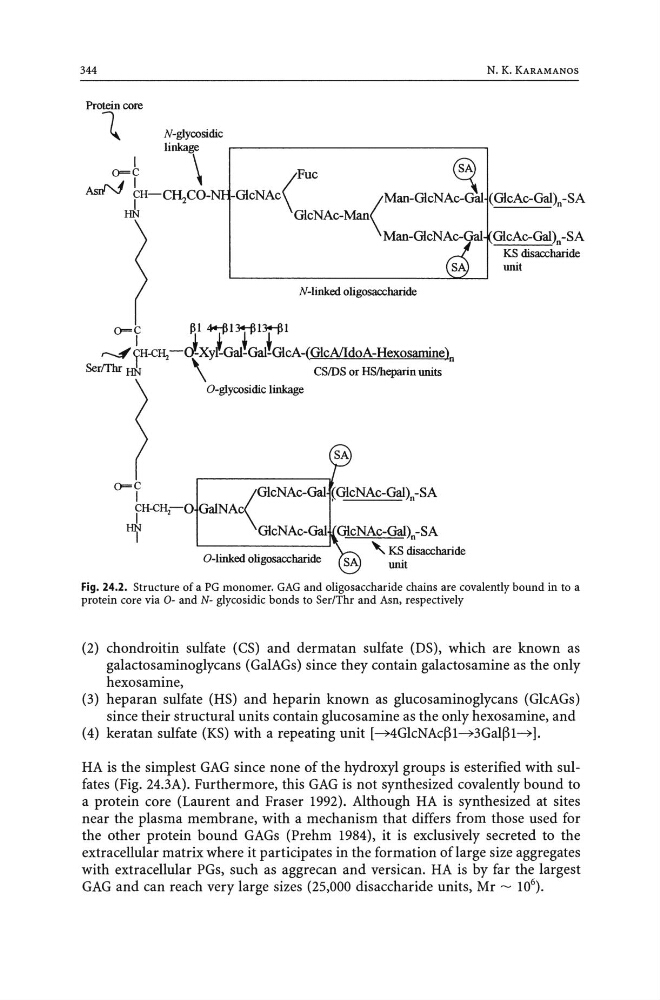
Fig. 24.2. Structure of a PG monomer. GAG and oligosaccharide chains are covalently bound in to a
protein core via 0- and N- glycosidic bonds to Ser/Thr and Asn, respectively
(2) chondroitin sulfate (CS) and dermatan sulfate (DS), which are known as
galactosaminoglycans (GaIAGs) since they contain galactosamine as the only
hexosamine,
(3) heparan sulfate (HS) and heparin known as glucosaminoglycans (GlcAGs)
since their structural units contain glucosamine as the only hexosamine, and
(4) keratan sulfate (KS) with a repeating unit [--;>4GlcNAc~1--;>3Gal~1--;>1.
HA is the simplest GAG since none of the hydroxyl groups is esterified with sulfates (Fig. 24.3A). Furthermore, this GAG is not synthesized covalently bound to
a protein core (Laurent and Fraser 1992). Although HA is synthesized at sites
near the plasma membrane, with a mechanism that differs from those used for
the other protein bound GAGs (Prehm 1984), it is exclusively secreted to the
extracellular matrix where it participates in the formation oflarge size aggregates
with extracellular PGs, such as aggrecan and versican. HA is by far the largest
GAG and can reach very large sizes (25,000 disaccharide units, Mr ~ 10 6 ).
N. K. KARAMANOS
N-glycosidic
O=C linka
g
\
AsrI'J ~H-C~COJ
Fuc
~
-GlCNAC(
Man-GlcNAc-Gal GlcAc-Gal)n -SA
KS disaccharide
unit
N-linked oligosaccharide
O=f
~l ~lf13:"il1
~ ?H-CH, -O{XylGal-GaliGlCA-(GlCNIdoA-Hexosamine)n
Serrrhr HN
\
CSIDS or HS/heparin units
O-glycosidic linkage
O=f
c(GICNAC-Gal fGlcNAc-Gal)n- SA
CH-CH, -0 GalNA
I
H1j'
GlcNAc-Gal GlcNAc-Gal)n -SA
, KS disaccharide
O-linked oligosaccharide
unit
Fig. 24.2. Structure of a PG monomer. GAG and oligosaccharide chains are covalently bound in to a
protein core via 0- and N- glycosidic bonds to Ser/Thr and Asn, respectively
(2) chondroitin sulfate (CS) and dermatan sulfate (DS), which are known as
galactosaminoglycans (GaIAGs) since they contain galactosamine as the only
hexosamine,
(3) heparan sulfate (HS) and heparin known as glucosaminoglycans (GlcAGs)
since their structural units contain glucosamine as the only hexosamine, and
(4) keratan sulfate (KS) with a repeating unit [--;>4GlcNAc~1--;>3Gal~1--;>1.
HA is the simplest GAG since none of the hydroxyl groups is esterified with sulfates (Fig. 24.3A). Furthermore, this GAG is not synthesized covalently bound to
a protein core (Laurent and Fraser 1992). Although HA is synthesized at sites
near the plasma membrane, with a mechanism that differs from those used for
the other protein bound GAGs (Prehm 1984), it is exclusively secreted to the
extracellular matrix where it participates in the formation oflarge size aggregates
with extracellular PGs, such as aggrecan and versican. HA is by far the largest
GAG and can reach very large sizes (25,000 disaccharide units, Mr ~ 10 6 ).