

326
P. M. RUDD et al.
(iv) IgG Glycans may provide an Additional Route to Inflammation in RA by
Activating the Classical Complement Pathway Through Binding to MBL
In general, the requirement for multiple presentation ensures that single oligosaccharides attached to 'self' proteins do not trigger biological activities which
are defence mechanisms normally initiated only by 'non-self' pathogens. An
exception to this may provide an additional route to inflammation in rheumatoid
arthritis (RA). In RA the galactosylation status of IgG is a prognostic indicator,
and increased levels of sugars lacking terminal galactose (GO type) (Fig. 23.6)
(Parekh et al 1985) compared with age matched normal controls correlate with
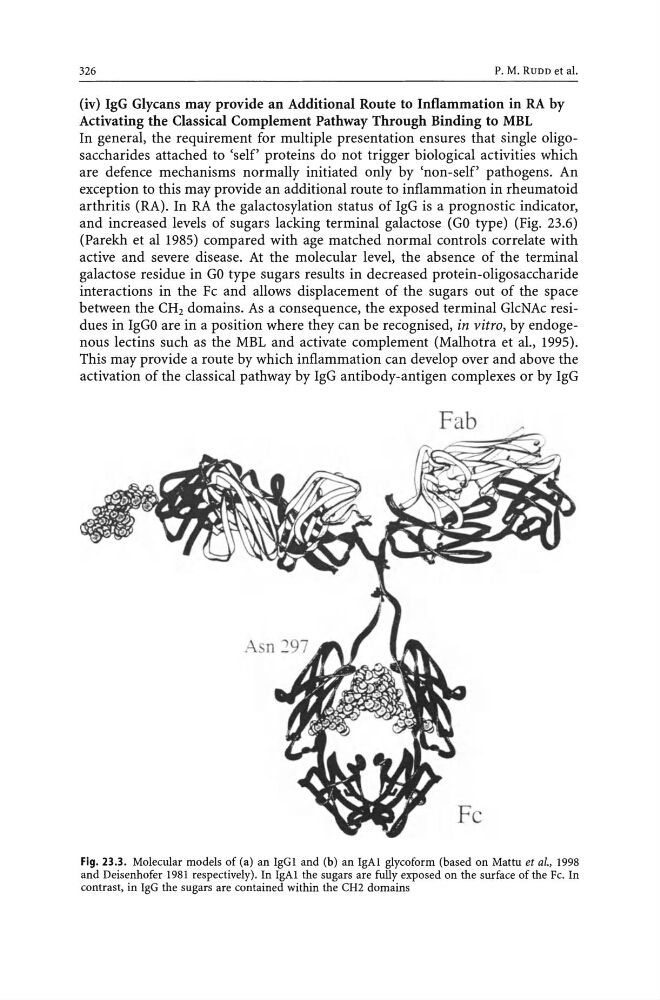
active and severe disease. At the molecular level, the absence of the terminal
galactose residue in GO type sugars results in decreased protein-oligosaccharide
interactions in the Fc and allows displacement of the sugars out of the space
between the CHz domains. As a consequence, the exposed terminal GlcNAc residues in IgGO are in a position where they can be recognised, in vitro, by endogenous lectins such as the MBL and activate complement (Malhotra et aI., 1995).
This may provide a route by which inflammation can develop over and above the
activation of the classical pathway by IgG antibody-antigen complexes or by IgG
Fab
Fe
Fig. 23.3. Molecular models of (a) an IgGl and (b) an IgAl glycoform (based on Mattu et aI., 1998
and Deisenhofer 1981 respectively). In IgAl the sugars are fully exposed on the surface of the Fe. In
contrast, in IgG the sugars are contained within the CH2 domains
P. M. RUDD et al.
(iv) IgG Glycans may provide an Additional Route to Inflammation in RA by
Activating the Classical Complement Pathway Through Binding to MBL
In general, the requirement for multiple presentation ensures that single oligosaccharides attached to 'self' proteins do not trigger biological activities which
are defence mechanisms normally initiated only by 'non-self' pathogens. An
exception to this may provide an additional route to inflammation in rheumatoid
arthritis (RA). In RA the galactosylation status of IgG is a prognostic indicator,
and increased levels of sugars lacking terminal galactose (GO type) (Fig. 23.6)
(Parekh et al 1985) compared with age matched normal controls correlate with
active and severe disease. At the molecular level, the absence of the terminal
galactose residue in GO type sugars results in decreased protein-oligosaccharide
interactions in the Fc and allows displacement of the sugars out of the space
between the CHz domains. As a consequence, the exposed terminal GlcNAc residues in IgGO are in a position where they can be recognised, in vitro, by endogenous lectins such as the MBL and activate complement (Malhotra et aI., 1995).
This may provide a route by which inflammation can develop over and above the
activation of the classical pathway by IgG antibody-antigen complexes or by IgG
Fab
Fe
Fig. 23.3. Molecular models of (a) an IgGl and (b) an IgAl glycoform (based on Mattu et aI., 1998
and Deisenhofer 1981 respectively). In IgAl the sugars are fully exposed on the surface of the Fe. In
contrast, in IgG the sugars are contained within the CH2 domains