

304
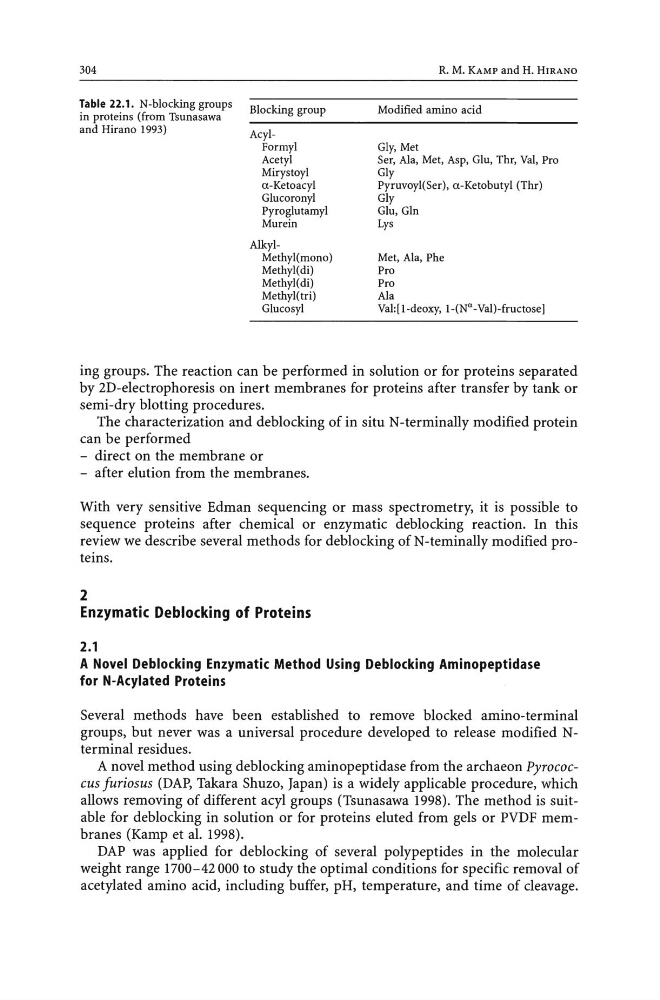
Table 22.1. N-blocking groups
in proteins (from Tsunasawa
and Hirano 1993)
Blocking group
AcylFormyl
Acetyl
Mirystoyl
a-Ketoacyl
Glucoronyl
Pyroglutamyl
Murein
AlkylMethyl(mono)
Methyl(di)
Methyl(di)
Methyl( tri)
Glucosyl
R. M. KAMP and H. HIRANO
Modified amino acid
Gly, Met
Ser, Ala, Met, Asp, Glu, Thr, Val, Pro
Gly
Pyruvoyl(Ser), a-Ketobutyl (Thr)
Gly
Glu, Gin
Lys
Met, Ala, Phe
Pro
Pro
Ala
Val:[I-deoxy, 1_(N U _ Val)-fructose]
ing groups. The reaction can be performed in solution or for proteins separated
by 2D-electrophoresis on inert membranes for proteins after transfer by tank or
semi-dry blotting procedures.
The characterization and deblocking of in situ N-terminally modified protein
can be performed
- direct on the membrane or
- after elution from the membranes.
With very sensitive Edman sequencing or mass spectrometry, it is possible to
sequence proteins after chemical or enzymatic deblocking reaction. In this
review we describe several methods for deblocking ofN-teminally modified proteins.
2
Enzymatic Deblocking of Proteins
2.1
A Novel Deblocking Enzymatic Method Using Deblocking Aminopeptidase
for N-Acylated Proteins
Several methods have been established to remove blocked amino-terminal
groups, but never was a universal procedure developed to release modified Nterminal residues.
A novel method using deblocking aminopeptidase from the archaeon Pyrococcus furiosus (DAP, Takara Shuzo, Japan) is a widely applicable procedure, which
allows removing of different acyl groups (Tsunasawa 1998). The method is suitable for deblocking in solution or for proteins eluted from gels or PVDF membranes (Kamp et al. 1998).
DAP was applied for deblocking of several polypeptides in the molecular
weight range 1700-42000 to study the optimal conditions for specific removal of
acetylated amino acid, including buffer, pH, temperature, and time of cleavage.
Table 22.1. N-blocking groups
in proteins (from Tsunasawa
and Hirano 1993)
Blocking group
AcylFormyl
Acetyl
Mirystoyl
a-Ketoacyl
Glucoronyl
Pyroglutamyl
Murein
AlkylMethyl(mono)
Methyl(di)
Methyl(di)
Methyl( tri)
Glucosyl
R. M. KAMP and H. HIRANO
Modified amino acid
Gly, Met
Ser, Ala, Met, Asp, Glu, Thr, Val, Pro
Gly
Pyruvoyl(Ser), a-Ketobutyl (Thr)
Gly
Glu, Gin
Lys
Met, Ala, Phe
Pro
Pro
Ala
Val:[I-deoxy, 1_(N U _ Val)-fructose]
ing groups. The reaction can be performed in solution or for proteins separated
by 2D-electrophoresis on inert membranes for proteins after transfer by tank or
semi-dry blotting procedures.
The characterization and deblocking of in situ N-terminally modified protein
can be performed
- direct on the membrane or
- after elution from the membranes.
With very sensitive Edman sequencing or mass spectrometry, it is possible to
sequence proteins after chemical or enzymatic deblocking reaction. In this
review we describe several methods for deblocking ofN-teminally modified proteins.
2
Enzymatic Deblocking of Proteins
2.1
A Novel Deblocking Enzymatic Method Using Deblocking Aminopeptidase
for N-Acylated Proteins
Several methods have been established to remove blocked amino-terminal
groups, but never was a universal procedure developed to release modified Nterminal residues.
A novel method using deblocking aminopeptidase from the archaeon Pyrococcus furiosus (DAP, Takara Shuzo, Japan) is a widely applicable procedure, which
allows removing of different acyl groups (Tsunasawa 1998). The method is suitable for deblocking in solution or for proteins eluted from gels or PVDF membranes (Kamp et al. 1998).
DAP was applied for deblocking of several polypeptides in the molecular
weight range 1700-42000 to study the optimal conditions for specific removal of
acetylated amino acid, including buffer, pH, temperature, and time of cleavage.