

The Perception of Hydrophobic Clusters in the Native and Partially Unfolded States
3
The Degeneration of the Hydrophobic Clusters During
the Thermal Unfolding of Bovine a-Lactalbumin
3.1
Aim
215
It is generally accepted that the progressive accumulation of hydrophobic interactions plays the main role in protein folding. Nevertheless no systematic studies of
the hydrophobic behaviour of globular proteins during (un)folding are available.
Therefore, we have related the thermal unfolding of apo- and Ca 2 +-bound bovine
a-lactalbumin (BLA), determined by CD measurements at 220 and 270 nm, with
the ability of the hydrophobic groups to interact with bis-ANS. The measurements allow to follow the progressive degeneration of the hydrophobic regions
during the thermal unfolding of Ca2+-free and Ca 2 +-bound BLA.
3.2
Thermal Unfolding of BLA Monitored by Circular Dichroism
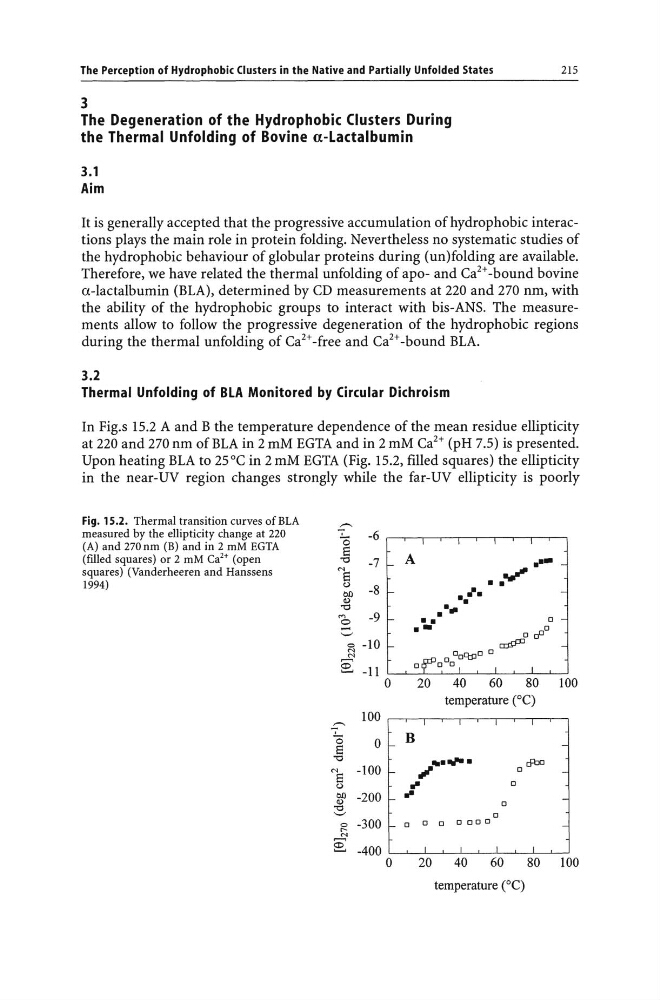
In Fig.s 15.2 A and B the temperature dependence of the mean residue ellipticity
at 220 and 270 nm of BLA in 2 mM EGTA and in 2 mM Ca2+ (pH 7.5) is presented.
Upon heating BLA to 25°C in 2 mM EGTA (Fig. 15.2, filled squares) the ellipticity
in the near-UV region changes strongly while the far-UV ellipticity is poorly
Fig. 15.2. Thermal transition curves of BLA
measured by the ellipticity change at 220
(A) and 270 nm (B) and in 2 mM EGTA
(fIlled squares) or 2 mM Ca 2 + (open
squares) (Vanderheeren and Hanssens
1994)
M
o
-7
-8 r-9 rg -10 f~
~-11 o
100
,:::-.
lc;
0
8
"0
'" -100
8 Q
A
.. ~.
.. -
••
... -
. ../
I
20
40
60
80
temperature (0C)
I
I
I
I
B
_ . .". . cfbJ
"z'
0
. .
0
/:lO -200 f- ..
Q)
0
"0
'-'
0
0
-300 f- 0 0 0 o 000
r'"
§:: -400
I
I
j
I
0
20
40
60
80
temperature COC)
-
100
-
-
100
3
The Degeneration of the Hydrophobic Clusters During
the Thermal Unfolding of Bovine a-Lactalbumin
3.1
Aim
215
It is generally accepted that the progressive accumulation of hydrophobic interactions plays the main role in protein folding. Nevertheless no systematic studies of
the hydrophobic behaviour of globular proteins during (un)folding are available.
Therefore, we have related the thermal unfolding of apo- and Ca 2 +-bound bovine
a-lactalbumin (BLA), determined by CD measurements at 220 and 270 nm, with
the ability of the hydrophobic groups to interact with bis-ANS. The measurements allow to follow the progressive degeneration of the hydrophobic regions
during the thermal unfolding of Ca2+-free and Ca 2 +-bound BLA.
3.2
Thermal Unfolding of BLA Monitored by Circular Dichroism
In Fig.s 15.2 A and B the temperature dependence of the mean residue ellipticity
at 220 and 270 nm of BLA in 2 mM EGTA and in 2 mM Ca2+ (pH 7.5) is presented.
Upon heating BLA to 25°C in 2 mM EGTA (Fig. 15.2, filled squares) the ellipticity
in the near-UV region changes strongly while the far-UV ellipticity is poorly
Fig. 15.2. Thermal transition curves of BLA
measured by the ellipticity change at 220
(A) and 270 nm (B) and in 2 mM EGTA
(fIlled squares) or 2 mM Ca 2 + (open
squares) (Vanderheeren and Hanssens
1994)
M
o
-7
-8 r-9 rg -10 f~
~-11 o
100
,:::-.
lc;
0
8
"0
'" -100
8 Q
A
.. ~.
.. -
••
... -
. ../
I
20
40
60
80
temperature (0C)
I
I
I
I
B
_ . .". . cfbJ
"z'
0
. .
0
/:lO -200 f- ..
Q)
0
"0
'-'
0
0
-300 f- 0 0 0 o 000
r'"
§:: -400
I
I
j
I
0
20
40
60
80
temperature COC)
-
100
-
-
100