

212
G. V ANDERHEEREN and 1. HANSSENS
explore the structural perturbations of the native protein as a consequence of the
above mentioned interaction.
1.2
a-Lactalbumin
a-Lactalbumin, the protein of this study, has a single polypeptidechain of 123
amino acids. The amino acid sequence and the conformation of a-lactalbumin
resembles that of c-type lysozyme. However, both homologous proteins have
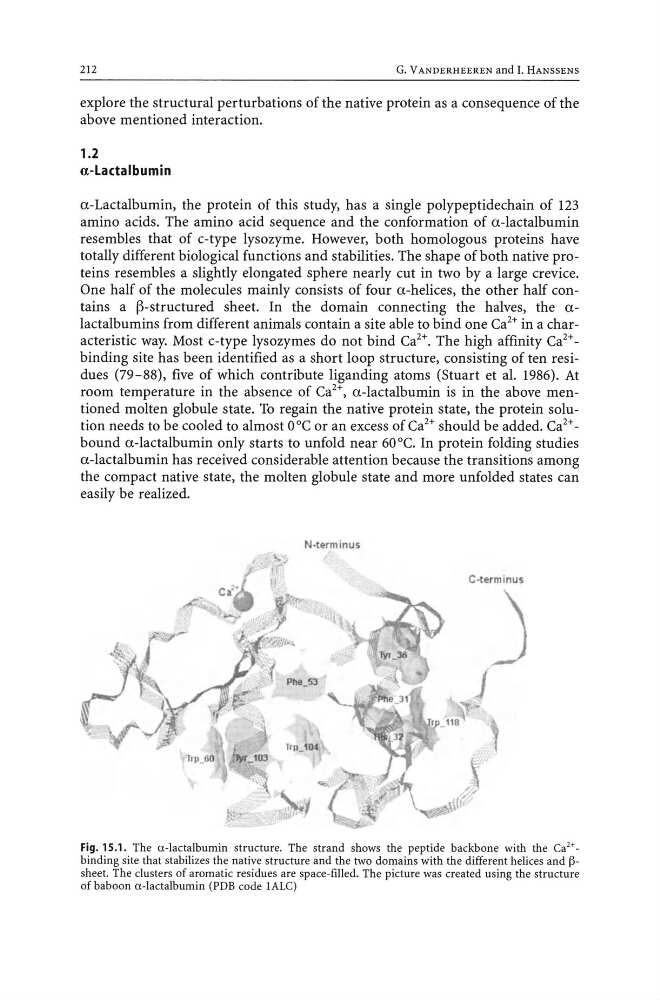
totally different biological functions and stabilities. The shape of both native proteins resembles a slightly elongated sphere nearly cut in two by a large crevice.
One half of the molecules mainly consists of four a-helices, the other half contains a (3-structured sheet. In the domain connecting the halves, the alactalbumins from different animals contain a site able to bind one Ca 2 + in a characteristic way. Most c-type lysozymes do not bind Ca 2 +. The high affinity Ca 2 +_
binding site has been identified as a short loop structure, consisting of ten residues (79-88), five of which contribute liganding atoms (Stuart et al. 1986). At
room temperature in the absence of Ca 2 +, a-lactalbumin is in the above mentioned molten globule state. To regain the native protein state, the protein solution needs to be cooled to almost O°C or an excess of Ca 2 + should be added. Ca 2 +bound a-lactalbumin only starts to unfold near 60°C. In protein folding studies
a-lactalbumin has received considerable attention because the transitions among
the compact native state, the molten globule state and more unfolded states can
easily be realized.
N·terminus
C·term inus
/..j
PIle_53
j
Trp_104
Fig. 15.1. The a-lactalbumin structure. The strand shows the peptide backbone with the Ca 1 +_
binding site that stabilizes the native structure and the two domains with the different helices and /3sheet. The clusters of aromatic residues are space-filled. The picture was created using the structure
of baboon a-lactalbumin (PDB code lALC)
G. V ANDERHEEREN and 1. HANSSENS
explore the structural perturbations of the native protein as a consequence of the
above mentioned interaction.
1.2
a-Lactalbumin
a-Lactalbumin, the protein of this study, has a single polypeptidechain of 123
amino acids. The amino acid sequence and the conformation of a-lactalbumin
resembles that of c-type lysozyme. However, both homologous proteins have
totally different biological functions and stabilities. The shape of both native proteins resembles a slightly elongated sphere nearly cut in two by a large crevice.
One half of the molecules mainly consists of four a-helices, the other half contains a (3-structured sheet. In the domain connecting the halves, the alactalbumins from different animals contain a site able to bind one Ca 2 + in a characteristic way. Most c-type lysozymes do not bind Ca 2 +. The high affinity Ca 2 +_
binding site has been identified as a short loop structure, consisting of ten residues (79-88), five of which contribute liganding atoms (Stuart et al. 1986). At
room temperature in the absence of Ca 2 +, a-lactalbumin is in the above mentioned molten globule state. To regain the native protein state, the protein solution needs to be cooled to almost O°C or an excess of Ca 2 + should be added. Ca 2 +bound a-lactalbumin only starts to unfold near 60°C. In protein folding studies
a-lactalbumin has received considerable attention because the transitions among
the compact native state, the molten globule state and more unfolded states can
easily be realized.
N·terminus
C·term inus
/..j
PIle_53
j
Trp_104
Fig. 15.1. The a-lactalbumin structure. The strand shows the peptide backbone with the Ca 1 +_
binding site that stabilizes the native structure and the two domains with the different helices and /3sheet. The clusters of aromatic residues are space-filled. The picture was created using the structure
of baboon a-lactalbumin (PDB code lALC)