

186
u , ou
A
,11
0 . 0 0
~ B
:s •• '10 .... . . , M' OONOr.I . • C ''lM N ov L4
Retained fraction
.1 9~ -"
I O: l :t
n
L. J. GONZALEZ et aI.
roo . on
a
...,
rL
'_L~L~JJ
Non-retained fraction
~
-~
.
S '"-I'-' oU
"
, Mrnn.I\ S!.: . e lIN ov . .L tH' . u .: ~J
S • .-.nLlo' ..l : IL 4 NO :;J . C I'M ..Ju l U G .ltJttU
.L ::':~:"
Retained fraction
-
. .
bU . OD
o
a
00
~11=--1~~======~_-==_~=I ~ ~~l ~ l ==~=j~==~======~o6
OJ
Non-retained fraction
I
gQ
~
"
71--11"
-
,L.iLl
-- a
0.00
.;:: • ~ ., •.• I
, , MIU ' Nne l , " ltM M . .... ~H' IUU U I U : J "
. .
cO . no
9
~
C
Retained fraction
ullJ~, ~ W~, ~J
,1\
~.l
~
Non-retained fraction
9
J\
a
u . uu
~ ..... . ... I
<
MU"n ~s '.n .C II'"
,., ... ~:... I ~ I ~ I U 111 : _11.
"
I . U
. IU'
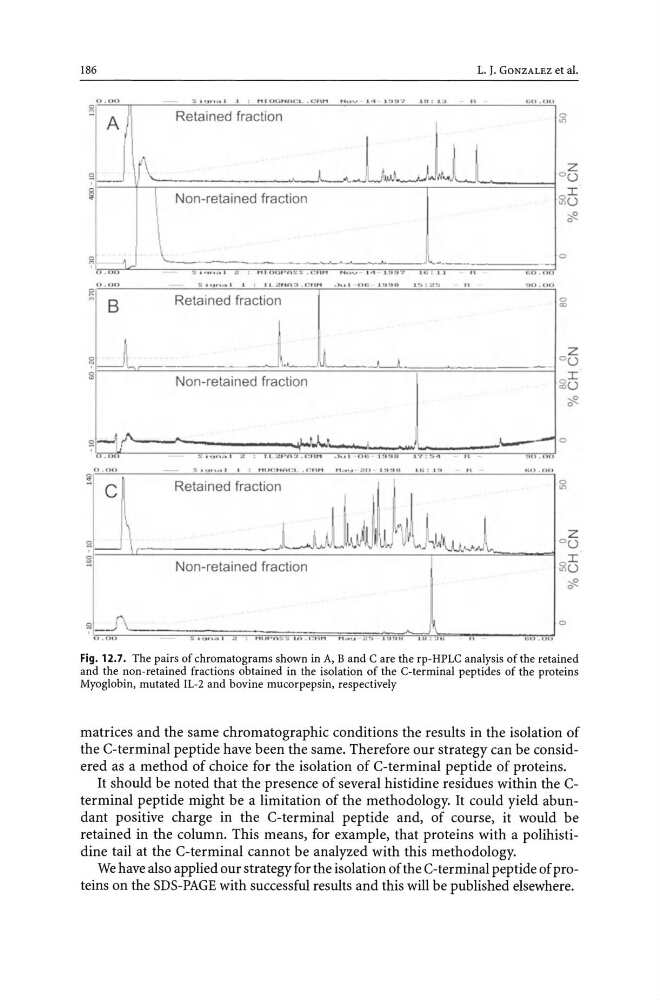
Fig. 12.7. The pairs of chromatograms shown in A, Band C are the rp-HPLC analysis of the retained
and the non-retained fractions obtained in the isolation of the C-terminal peptides of the proteins
Myoglobin, mutated lL-2 and bovine mucorpepsin, respectively
matrices and the same chromatographic conditions the results in the isolation of
the C-terminal peptide have been the same. Therefore our strategy can be considered as a method of choice for the isolation of C-terminal peptide of proteins.
It should be noted that the presence of several histidine residues within the Cterminal peptide might be a limitation of the methodology. It could yield abundant positive charge in the C-terminal peptide and, of course, it would be
retained in the column. This means, for example, that proteins with a polihistidine tail at the C-terminal cannot be analyzed with this methodology.
We have also applied our strategy for the isolation of the C-terminal peptide of proteins on the SDS-PAGE with successful results and this will be published elsewhere.
u , ou
A
,11
0 . 0 0
~ B
:s •• '10 .... . . , M' OONOr.I . • C ''lM N ov L4
Retained fraction
.1 9~ -"
I O: l :t
n
L. J. GONZALEZ et aI.
roo . on
a
...,
rL
'_L~L~JJ
Non-retained fraction
~
-~
.
S '"-I'-' oU
"
, Mrnn.I\ S!.: . e lIN ov . .L tH' . u .: ~J
S • .-.nLlo' ..l : IL 4 NO :;J . C I'M ..Ju l U G .ltJttU
.L ::':~:"
Retained fraction
-
. .
bU . OD
o
a
00
~11=--1~~======~_-==_~=I ~ ~~l ~ l ==~=j~==~======~o6
OJ
Non-retained fraction
I
gQ
~
"
71--11"
-
,L.iLl
-- a
0.00
.;:: • ~ ., •.• I
, , MIU ' Nne l , " ltM M . .... ~H' IUU U I U : J "
. .
cO . no
9
~
C
Retained fraction
ullJ~, ~ W~, ~J
,1\
~.l
~
Non-retained fraction
9
J\
a
u . uu
~ ..... . ... I
<
MU"n ~s '.n .C II'"
,., ... ~:... I ~ I ~ I U 111 : _11.
"
I . U
. IU'
Fig. 12.7. The pairs of chromatograms shown in A, Band C are the rp-HPLC analysis of the retained
and the non-retained fractions obtained in the isolation of the C-terminal peptides of the proteins
Myoglobin, mutated lL-2 and bovine mucorpepsin, respectively
matrices and the same chromatographic conditions the results in the isolation of
the C-terminal peptide have been the same. Therefore our strategy can be considered as a method of choice for the isolation of C-terminal peptide of proteins.
It should be noted that the presence of several histidine residues within the Cterminal peptide might be a limitation of the methodology. It could yield abundant positive charge in the C-terminal peptide and, of course, it would be
retained in the column. This means, for example, that proteins with a polihistidine tail at the C-terminal cannot be analyzed with this methodology.
We have also applied our strategy for the isolation of the C-terminal peptide of proteins on the SDS-PAGE with successful results and this will be published elsewhere.