

162
PH. BULET and S. UTTENWEILER-JOSEPH
hel1lul y mph (ruin kHllnllnUIH!-rhullcllJ,:t.'C1 ny
_ _ __ ~~--'~h.mUIYmph
cell c IrH(' t fra m jrl\lnunc·chliUc-n~cd f1l e
7tK)(1
IfjlUI)
mIl
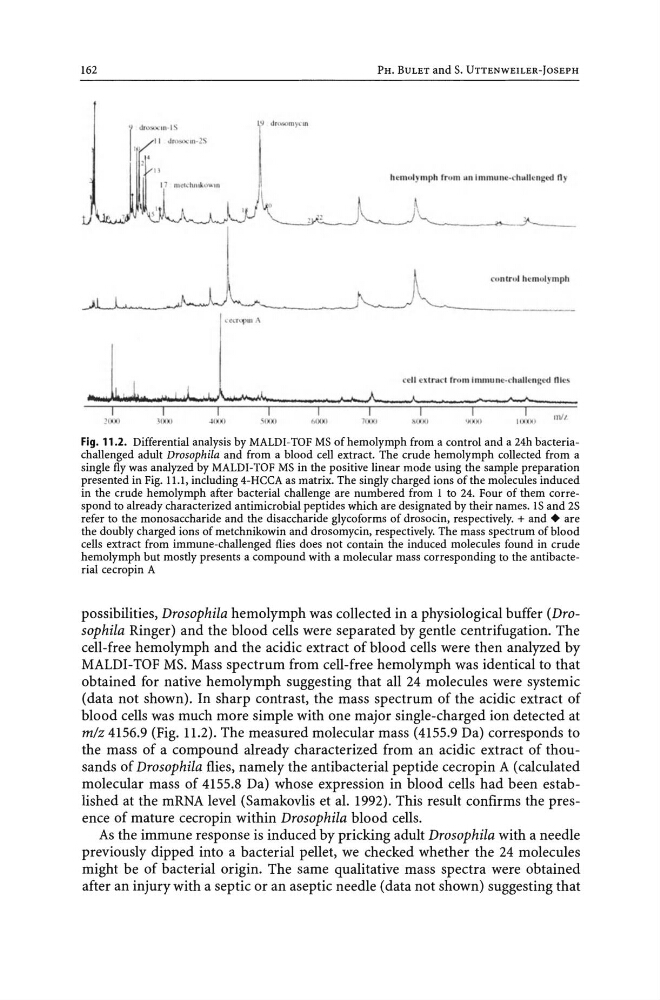
Fig. 11.2. Differential analysis by MALD!-TOF MS of hemolymph from a control and a 24h bacteriachallenged adult Drosophila and from a blood cell extract. The crude hemolymph collected from a
single fly was analyzed by MALD! -TOF MS in the positive linear mode using the sample preparation
presented in Fig. 11.1, including 4-HCCA as matrix. The singly charged ions of the molecules induced
in the crude hemolymph after bacterial challenge are numbered from 1 to 24. Four of them correspond to already characterized antimicrobial peptides which are designated by their names. 1 Sand 2S
refer to the monosaccharide and the disaccharide glycoforms of drosocin, respectively. + and. are
the doubly charged ions of metchnikowin and drosomycin, respectively. The mass spectrum of blood
cells extract from immune-challenged flies does not contain the induced molecules found in crude
hemolymph but mostly presents a compound with a molecular mass corresponding to the antibacterial cecropin A
possibilities, Drosophila hemolymph was collected in a physiological buffer (Drosophila Ringer) and the blood cells were separated by gentle centrifugation. The
cell-free hemolymph and the acidic extract of blood cells were then analyzed by
MALDI-TOF MS. Mass spectrum from cell-free hemolymph was identical to that
obtained for native hemolymph suggesting that all 24 molecules were systemic
(data not shown). In sharp contrast, the mass spectrum of the acidic extract of
blood cells was much more simple with one major single-charged ion detected at
m/z 4156.9 (Fig. 11.2). The measured molecular mass (4155.9 Da) corresponds to
the mass of a compound already characterized from an acidic extract of thousands of Drosophila flies, namely the antibacterial peptide cecropin A (calculated
molecular mass of 4155.8 Da) whose expression in blood cells had been established at the mRNA level (Samakovlis et al. 1992). This result confirms the presence of mature cecropin within Drosophila blood cells.
As the immune response is induced by pricking adult Drosophila with a needle
previously dipped into a bacterial pellet, we checked whether the 24 molecules
might be of bacterial origin. The same qualitative mass spectra were obtained
after an injury with a septic or an aseptic needle (data not shown) suggesting that
PH. BULET and S. UTTENWEILER-JOSEPH
hel1lul y mph (ruin kHllnllnUIH!-rhullcllJ,:t.'C1 ny
_ _ __ ~~--'~h.mUIYmph
cell c IrH(' t fra m jrl\lnunc·chliUc-n~cd f1l e
7tK)(1
IfjlUI)
mIl
Fig. 11.2. Differential analysis by MALD!-TOF MS of hemolymph from a control and a 24h bacteriachallenged adult Drosophila and from a blood cell extract. The crude hemolymph collected from a
single fly was analyzed by MALD! -TOF MS in the positive linear mode using the sample preparation
presented in Fig. 11.1, including 4-HCCA as matrix. The singly charged ions of the molecules induced
in the crude hemolymph after bacterial challenge are numbered from 1 to 24. Four of them correspond to already characterized antimicrobial peptides which are designated by their names. 1 Sand 2S
refer to the monosaccharide and the disaccharide glycoforms of drosocin, respectively. + and. are
the doubly charged ions of metchnikowin and drosomycin, respectively. The mass spectrum of blood
cells extract from immune-challenged flies does not contain the induced molecules found in crude
hemolymph but mostly presents a compound with a molecular mass corresponding to the antibacterial cecropin A
possibilities, Drosophila hemolymph was collected in a physiological buffer (Drosophila Ringer) and the blood cells were separated by gentle centrifugation. The
cell-free hemolymph and the acidic extract of blood cells were then analyzed by
MALDI-TOF MS. Mass spectrum from cell-free hemolymph was identical to that
obtained for native hemolymph suggesting that all 24 molecules were systemic
(data not shown). In sharp contrast, the mass spectrum of the acidic extract of
blood cells was much more simple with one major single-charged ion detected at
m/z 4156.9 (Fig. 11.2). The measured molecular mass (4155.9 Da) corresponds to
the mass of a compound already characterized from an acidic extract of thousands of Drosophila flies, namely the antibacterial peptide cecropin A (calculated
molecular mass of 4155.8 Da) whose expression in blood cells had been established at the mRNA level (Samakovlis et al. 1992). This result confirms the presence of mature cecropin within Drosophila blood cells.
As the immune response is induced by pricking adult Drosophila with a needle
previously dipped into a bacterial pellet, we checked whether the 24 molecules
might be of bacterial origin. The same qualitative mass spectra were obtained
after an injury with a septic or an aseptic needle (data not shown) suggesting that