

142
E. LEHMANN and R. ZENOBI
determined using CD spectroscopy. The degree of peptide folding was found to
decrease from Zn2+ over Cd 2 + to N?+. Since complexation induces folding, the CD
spectra give a qualitative estimate of the affinity of p55Fl for the different metal
ions.
If MALDI spectra reflect this behavior in solution, then the use of the different
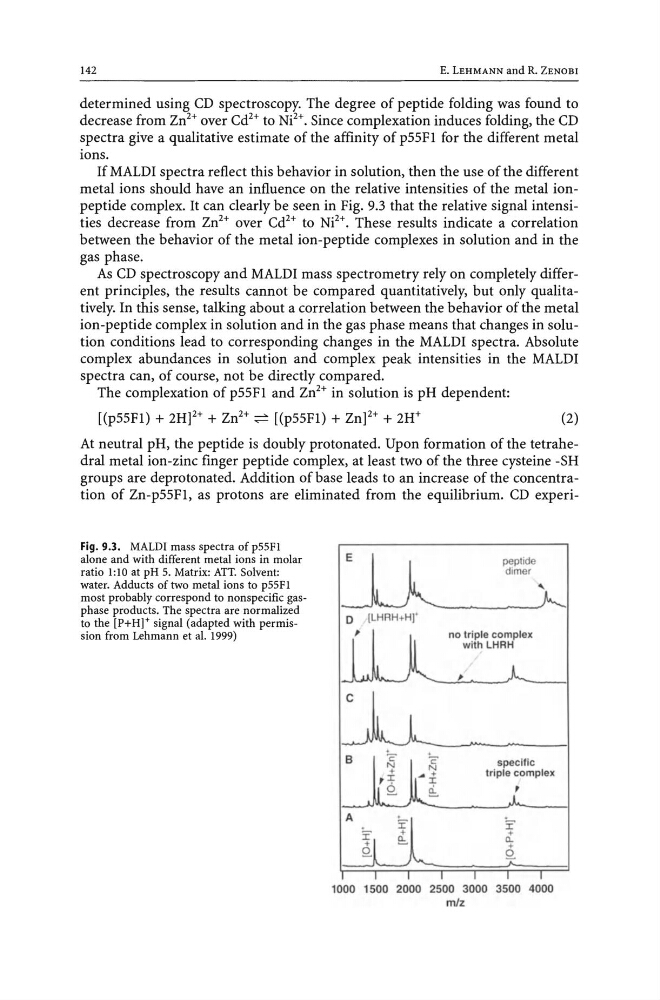
metal ions should have an influence on the relative intensities of the metal ionpeptide complex. It can clearly be seen in Fig. 9.3 that the relative signal intensities decrease from Zn 2 + over Cd 2 + to N?+. These results indicate a correlation
between the behavior of the metal ion-peptide complexes in solution and in the
gas phase.
As CD spectroscopy and MALDI mass spectrometry rely on completely different principles, the results cannot be compared quantitatively, but only qualitatively. In this sense, talking about a correlation between the behavior of the metal
ion-peptide complex in solution and in the gas phase means that changes in solution conditions lead to corresponding changes in the MALDI spectra. Absolute
complex abundances in solution and complex peak intensities in the MALDI
spectra can, of course, not be directly compared.
The complexation of p55Fl and Zn 2 + in solution is pH dependent:
[(p55Fl) + 2H]2+ + Zn 2 + ~ [(p55Fl) + Zn]2+ + 2H+
(2)
At neutral pH, the peptide is doubly protonated. Upon formation of the tetrahedral metal ion-zinc finger peptide complex, at least two of the three cysteine -SH
groups are deprotonated. Addition of base leads to an increase of the concentration of Zn-p55Fl, as protons are eliminated from the equilibrium. CD experiFig. 9.3. MALDI mass spectra of p55F1
alone and with different metal ions in molar
ratio 1:10 at pH 5. Matrix: ATT. Solvent:
water. Adducts of two metal ions to p55F1
most probably correspond to nonspecific gasphase products. The spectra are normalized
to the [P+Hj+ signal (adapted with permission from Lehmann et al. 1999)
E
o [LHRH+H)'
B
A
peptide
dlmer
no triple complex
with LHRH
specific
triple complex
1000 1500 2000 2500 3000 3500 4000
m/z.
E. LEHMANN and R. ZENOBI
determined using CD spectroscopy. The degree of peptide folding was found to
decrease from Zn2+ over Cd 2 + to N?+. Since complexation induces folding, the CD
spectra give a qualitative estimate of the affinity of p55Fl for the different metal
ions.
If MALDI spectra reflect this behavior in solution, then the use of the different
metal ions should have an influence on the relative intensities of the metal ionpeptide complex. It can clearly be seen in Fig. 9.3 that the relative signal intensities decrease from Zn 2 + over Cd 2 + to N?+. These results indicate a correlation
between the behavior of the metal ion-peptide complexes in solution and in the
gas phase.
As CD spectroscopy and MALDI mass spectrometry rely on completely different principles, the results cannot be compared quantitatively, but only qualitatively. In this sense, talking about a correlation between the behavior of the metal
ion-peptide complex in solution and in the gas phase means that changes in solution conditions lead to corresponding changes in the MALDI spectra. Absolute
complex abundances in solution and complex peak intensities in the MALDI
spectra can, of course, not be directly compared.
The complexation of p55Fl and Zn 2 + in solution is pH dependent:
[(p55Fl) + 2H]2+ + Zn 2 + ~ [(p55Fl) + Zn]2+ + 2H+
(2)
At neutral pH, the peptide is doubly protonated. Upon formation of the tetrahedral metal ion-zinc finger peptide complex, at least two of the three cysteine -SH
groups are deprotonated. Addition of base leads to an increase of the concentration of Zn-p55Fl, as protons are eliminated from the equilibrium. CD experiFig. 9.3. MALDI mass spectra of p55F1
alone and with different metal ions in molar
ratio 1:10 at pH 5. Matrix: ATT. Solvent:
water. Adducts of two metal ions to p55F1
most probably correspond to nonspecific gasphase products. The spectra are normalized
to the [P+Hj+ signal (adapted with permission from Lehmann et al. 1999)
E
o [LHRH+H)'
B
A
peptide
dlmer
no triple complex
with LHRH
specific
triple complex
1000 1500 2000 2500 3000 3500 4000
m/z.