

122
J. J. GORMAN et aI.
3.1.2
Post-Source Decay Analyses by MALDI-TOF-MS
The availability of these different forms of the peptide allowed a systematic investigation of the previously observed PSD behaviour of the immunologically active
byproduct (Purcell et al. 1998). The isolated byproduct was used for analysis of
metastable fragments produced by PSD of ions generated by MALDI-TOF-MS.
This revealed C- and N-terminal ion series consisting principally of z- and y-type
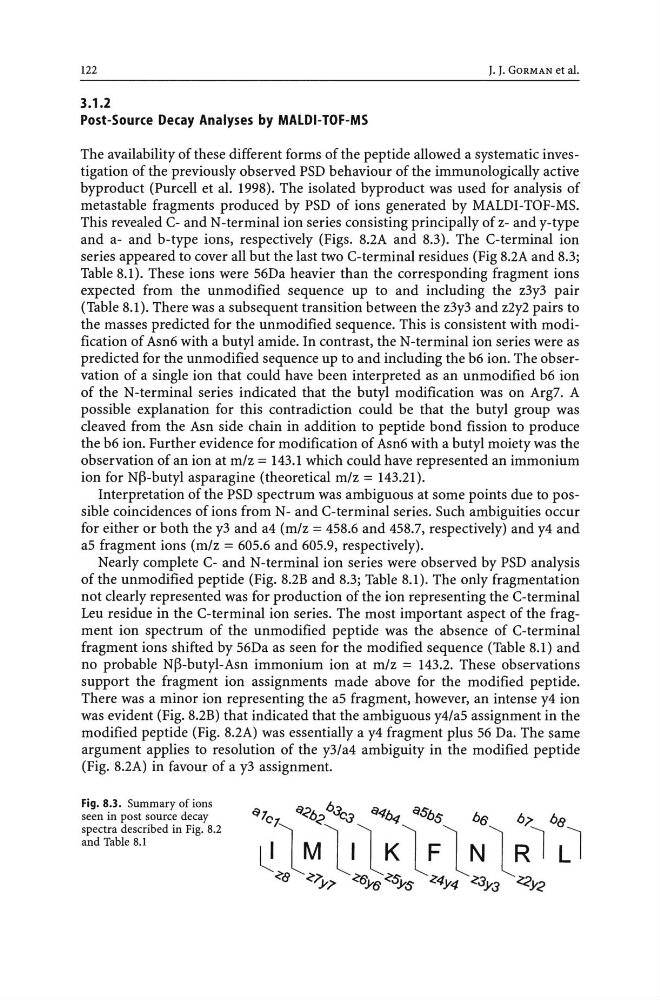
and a- and b-type ions, respectively (Figs. 8.2A and 8.3). The C-terminal ion
series appeared to cover all but the last two C-terminal residues (Fig 8.2A and 8.3;
Table 8.1). These ions were 56Da heavier than the corresponding fragment ions
expected from the unmodified sequence up to and including the z3y3 pair
(Table 8.1). There was a subsequent transition between the z3y3 and z2y2 pairs to
the masses predicted for the unmodified sequence. This is consistent with modification of Asn6 with a butyl amide. In contrast, the N-terminal ion series were as
predicted for the unmodified sequence up to and including the b6 ion. The observation of a single ion that could have been interpreted as an unmodified b6 ion
of the N-terminal series indicated that the butyl modification was on Arg7. A
possible explanation for this contradiction could be that the butyl group was
cleaved from the Asn side chain in addition to peptide bond fission to produce
the b6 ion. Further evidence for modification of Asn6 with a butyl moiety was the
observation of an ion at m/z = 143.1 which could have represented an immonium
ion for Nj3-butyl asparagine (theoretical m/z = 143.21).
Interpretation of the PSD spectrum was ambiguous at some points due to possible coincidences of ions from N- and C-terminal series. Such ambiguities occur
for either or both the y3 and a4 (m/z = 458.6 and 458.7, respectively) and y4 and
a5 fragment ions (m/z = 605.6 and 605.9, respectively).
Nearly complete C- and N-terminal ion series were observed by PSD analysis
of the unmodified peptide (Fig. 8.2B and 8.3; Table 8.1). The only fragmentation
not clearly represented was for production of the ion representing the C-terminal
Leu residue in the C-terminal ion series. The most important aspect of the fragment ion spectrum of the unmodified peptide was the absence of C-terminal
fragment ions shifted by 56Da as seen for the modified sequence (Table 8.1) and
no probable Nj3-butyl-Asn immonium ion at m/z = 143.2. These observations
support the fragment ion assignments made above for the modified peptide.
There was a minor ion representing the a5 fragment, however, an intense y4 ion
was evident (Fig. 8.2B) that indicated that the ambiguous y4/a5 assignment in the
modified peptide (Fig. 8.2A) was essentially a y4 fragment plus 56 Da. The same
argument applies to resolution of the y3/a4 ambiguity in the modified peptide
(Fig. 8.2A) in favour of a y3 assignment.
Fig. S.3. Summary of ions
seen in post source decay
spectra described in Fig. 8.2
and Table 8.1
J. J. GORMAN et aI.
3.1.2
Post-Source Decay Analyses by MALDI-TOF-MS
The availability of these different forms of the peptide allowed a systematic investigation of the previously observed PSD behaviour of the immunologically active
byproduct (Purcell et al. 1998). The isolated byproduct was used for analysis of
metastable fragments produced by PSD of ions generated by MALDI-TOF-MS.
This revealed C- and N-terminal ion series consisting principally of z- and y-type
and a- and b-type ions, respectively (Figs. 8.2A and 8.3). The C-terminal ion
series appeared to cover all but the last two C-terminal residues (Fig 8.2A and 8.3;
Table 8.1). These ions were 56Da heavier than the corresponding fragment ions
expected from the unmodified sequence up to and including the z3y3 pair
(Table 8.1). There was a subsequent transition between the z3y3 and z2y2 pairs to
the masses predicted for the unmodified sequence. This is consistent with modification of Asn6 with a butyl amide. In contrast, the N-terminal ion series were as
predicted for the unmodified sequence up to and including the b6 ion. The observation of a single ion that could have been interpreted as an unmodified b6 ion
of the N-terminal series indicated that the butyl modification was on Arg7. A
possible explanation for this contradiction could be that the butyl group was
cleaved from the Asn side chain in addition to peptide bond fission to produce
the b6 ion. Further evidence for modification of Asn6 with a butyl moiety was the
observation of an ion at m/z = 143.1 which could have represented an immonium
ion for Nj3-butyl asparagine (theoretical m/z = 143.21).
Interpretation of the PSD spectrum was ambiguous at some points due to possible coincidences of ions from N- and C-terminal series. Such ambiguities occur
for either or both the y3 and a4 (m/z = 458.6 and 458.7, respectively) and y4 and
a5 fragment ions (m/z = 605.6 and 605.9, respectively).
Nearly complete C- and N-terminal ion series were observed by PSD analysis
of the unmodified peptide (Fig. 8.2B and 8.3; Table 8.1). The only fragmentation
not clearly represented was for production of the ion representing the C-terminal
Leu residue in the C-terminal ion series. The most important aspect of the fragment ion spectrum of the unmodified peptide was the absence of C-terminal
fragment ions shifted by 56Da as seen for the modified sequence (Table 8.1) and
no probable Nj3-butyl-Asn immonium ion at m/z = 143.2. These observations
support the fragment ion assignments made above for the modified peptide.
There was a minor ion representing the a5 fragment, however, an intense y4 ion
was evident (Fig. 8.2B) that indicated that the ambiguous y4/a5 assignment in the
modified peptide (Fig. 8.2A) was essentially a y4 fragment plus 56 Da. The same
argument applies to resolution of the y3/a4 ambiguity in the modified peptide
(Fig. 8.2A) in favour of a y3 assignment.
Fig. S.3. Summary of ions
seen in post source decay
spectra described in Fig. 8.2
and Table 8.1