

104
B. BERSCH et aI.
nOe
H .... ~H
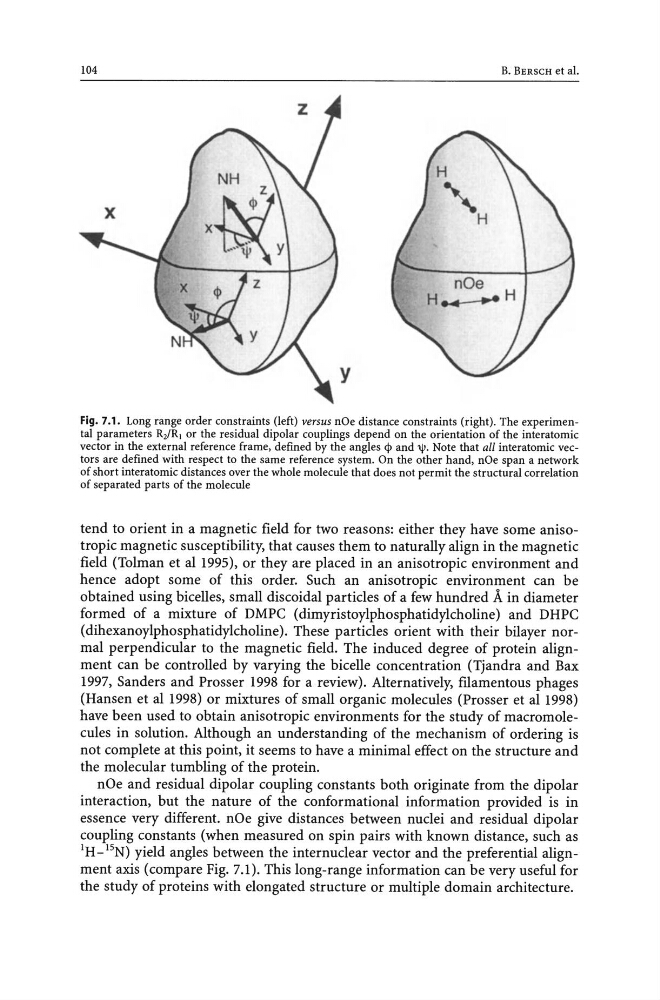
Fig. 7.1. Long range order constraints (left) versus nOe distance constraints (right). The experimental parameters R2/R, or the residual dipolar couplings depend on the orientation of the interatomic
vector in the external reference frame, defined by the angles and ' 1/' . Note that all interatomic vectors are defined with respect to the same reference system. On the other hand, nOe span a network
of short interatomic distances over the whole molecule that does not permit the structural correlation
of separated parts of the molecule
tend to orient in a magnetic field for two reasons: either they have some anisotropic magnetic susceptibility, that causes them to naturally align in the magnetic
field (Tolman et al 1995), or they are placed in an anisotropic environment and
hence adopt some of this order. Such an anisotropic environment can be
obtained using bicelles, small discoidal particles of a few hundred A in diameter
formed of a mixture of DMPC (dimyristoylphosphatidylcholine) and DHPC
(dihexanoylphosphatidylcholine). These particles orient with their bilayer normal perpendicular to the magnetic field. The induced degree of protein alignment can be controlled by varying the bicelle concentration (Tjandra and Bax
1997, Sanders and Prosser 1998 for a review). Alternatively, fIlamentous phages
(Hansen et al 1998) or mixtures of small organic molecules (Prosser et al 1998)
have been used to obtain anisotropic environments for the study of macromolecules in solution. Although an understanding of the mechanism of ordering is
not complete at this point, it seems to have a minimal effect on the structure and
the molecular tumbling of the protein.
nOe and residual dipolar coupling constants both originate from the dipolar
interaction, but the nature of the conformational information provided is in
essence very different. nOe give distances between nuclei and residual dipolar
coupling constants (when measured on spin pairs with known distance, such as
IH_ 15 N) yield angles between the internuclear vector and the preferential alignment axis (compare Fig. 7.1). This long-range information can be very useful for
the study of proteins with elongated structure or multiple domain architecture.
B. BERSCH et aI.
nOe
H .... ~H
Fig. 7.1. Long range order constraints (left) versus nOe distance constraints (right). The experimental parameters R2/R, or the residual dipolar couplings depend on the orientation of the interatomic
vector in the external reference frame, defined by the angles
of short interatomic distances over the whole molecule that does not permit the structural correlation
of separated parts of the molecule
tend to orient in a magnetic field for two reasons: either they have some anisotropic magnetic susceptibility, that causes them to naturally align in the magnetic
field (Tolman et al 1995), or they are placed in an anisotropic environment and
hence adopt some of this order. Such an anisotropic environment can be
obtained using bicelles, small discoidal particles of a few hundred A in diameter
formed of a mixture of DMPC (dimyristoylphosphatidylcholine) and DHPC
(dihexanoylphosphatidylcholine). These particles orient with their bilayer normal perpendicular to the magnetic field. The induced degree of protein alignment can be controlled by varying the bicelle concentration (Tjandra and Bax
1997, Sanders and Prosser 1998 for a review). Alternatively, fIlamentous phages
(Hansen et al 1998) or mixtures of small organic molecules (Prosser et al 1998)
have been used to obtain anisotropic environments for the study of macromolecules in solution. Although an understanding of the mechanism of ordering is
not complete at this point, it seems to have a minimal effect on the structure and
the molecular tumbling of the protein.
nOe and residual dipolar coupling constants both originate from the dipolar
interaction, but the nature of the conformational information provided is in
essence very different. nOe give distances between nuclei and residual dipolar
coupling constants (when measured on spin pairs with known distance, such as
IH_ 15 N) yield angles between the internuclear vector and the preferential alignment axis (compare Fig. 7.1). This long-range information can be very useful for
the study of proteins with elongated structure or multiple domain architecture.