

Some of the general rules for substrate-construction are the same as those for
esterase-substrates (Scheme 2.20), such as the preferred close location of the
chirality center and the necessity of having a hydrogen atom on the carbon atom
bearing the chiral or prochiral center. However, other features are different:
• The acid moiety R
3 of lipase-substrate of type III should be of a straight-chain
nature possessing at least three to four carbon units to ensure a high lipophilicity
of the substrate. Although long-chain fatty acids such as oleates would be
advantageous for a fast reaction rate, they do cause operational problems such
as a high boiling point of the substrate and they tend to form foams and
emulsions during extractive work-up. As a compromise between the two
extremes – short chains for ease of handling and long ones for a high reaction
rate – n-butanoates or n-butyl esters – are often the first choice.
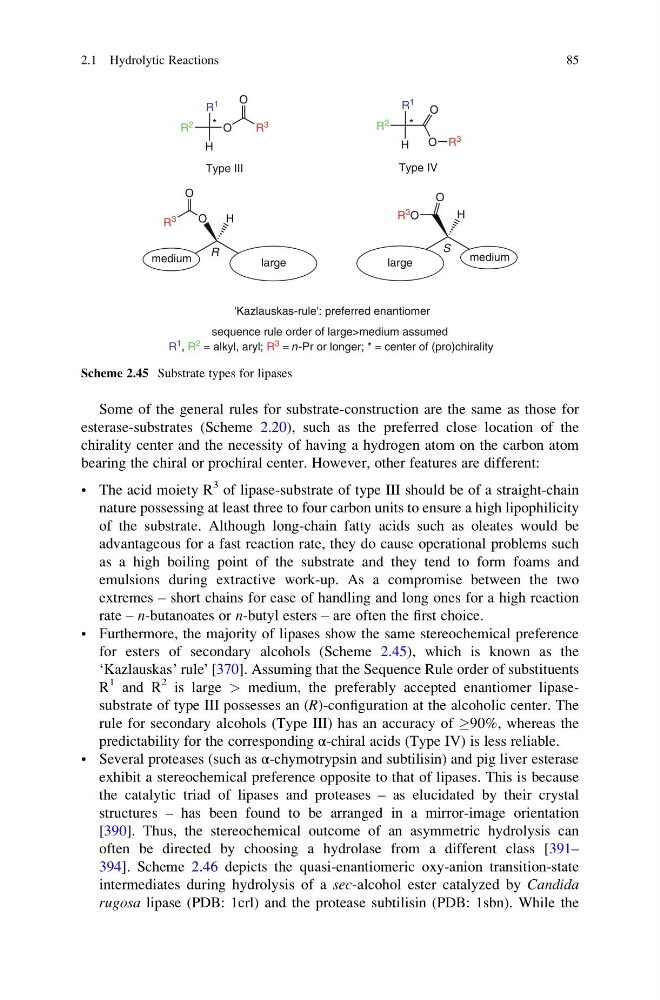
• Furthermore, the majority of lipases show the same stereochemical preference
for esters of secondary alcohols (Scheme 2.45), which is known as the
‘Kazlauskas’ rule’ [370]. Assuming that the Sequence Rule order of substituents
R
1 and R
2 is large > medium, the preferably accepted enantiomer lipasesubstrate of type III possesses an (R)-configuration at the alcoholic center. The
rule for secondary alcohols (Type III) has an accuracy of !90%, whereas the
predictability for the corresponding α-chiral acids (Type IV) is less reliable.
• Several proteases (such as α-chymotrypsin and subtilisin) and pig liver esterase
exhibit a stereochemical preference opposite to that of lipases. This is because
the catalytic triad of lipases and proteases – as elucidated by their crystal
structures – has been found to be arranged in a mirror-image orientation
[390]. Thus, the stereochemical outcome of an asymmetric hydrolysis can
often be directed by choosing a hydrolase from a different class [391–
394]. Scheme 2.46 depicts the quasi-enantiomeric oxy-anion transition-state
intermediates during hydrolysis of a sec-alcohol ester catalyzed by Candida
rugosa lipase (PDB: 1crl) and the protease subtilisin (PDB: 1sbn). While the
R
3
O
O
R
2
H
R
1
O
R
3
O
R
2
H
R
1
O
R
3
H
O
O
R
3
O
H
R 1 , R 2 = alkyl, aryl; R 3 = n-Pr or longer; * = center of (pro)chirality
Type IV
Type III
sequence rule order of large>medium assumed
'Kazlauskas-rule': preferred enantiomer
*
*
medium
large
medium
large
S
R
Scheme 2.45 Substrate types for lipases
2.1 Hydrolytic Reactions
85
esterase-substrates (Scheme 2.20), such as the preferred close location of the
chirality center and the necessity of having a hydrogen atom on the carbon atom
bearing the chiral or prochiral center. However, other features are different:
• The acid moiety R
3 of lipase-substrate of type III should be of a straight-chain
nature possessing at least three to four carbon units to ensure a high lipophilicity
of the substrate. Although long-chain fatty acids such as oleates would be
advantageous for a fast reaction rate, they do cause operational problems such
as a high boiling point of the substrate and they tend to form foams and
emulsions during extractive work-up. As a compromise between the two
extremes – short chains for ease of handling and long ones for a high reaction
rate – n-butanoates or n-butyl esters – are often the first choice.
• Furthermore, the majority of lipases show the same stereochemical preference
for esters of secondary alcohols (Scheme 2.45), which is known as the
‘Kazlauskas’ rule’ [370]. Assuming that the Sequence Rule order of substituents
R
1 and R
2 is large > medium, the preferably accepted enantiomer lipasesubstrate of type III possesses an (R)-configuration at the alcoholic center. The
rule for secondary alcohols (Type III) has an accuracy of !90%, whereas the
predictability for the corresponding α-chiral acids (Type IV) is less reliable.
• Several proteases (such as α-chymotrypsin and subtilisin) and pig liver esterase
exhibit a stereochemical preference opposite to that of lipases. This is because
the catalytic triad of lipases and proteases – as elucidated by their crystal
structures – has been found to be arranged in a mirror-image orientation
[390]. Thus, the stereochemical outcome of an asymmetric hydrolysis can
often be directed by choosing a hydrolase from a different class [391–
394]. Scheme 2.46 depicts the quasi-enantiomeric oxy-anion transition-state
intermediates during hydrolysis of a sec-alcohol ester catalyzed by Candida
rugosa lipase (PDB: 1crl) and the protease subtilisin (PDB: 1sbn). While the
R
3
O
O
R
2
H
R
1
O
R
3
O
R
2
H
R
1
O
R
3
H
O
O
R
3
O
H
R 1 , R 2 = alkyl, aryl; R 3 = n-Pr or longer; * = center of (pro)chirality
Type IV
Type III
sequence rule order of large>medium assumed
'Kazlauskas-rule': preferred enantiomer
*
*
medium
large
medium
large
S
R
Scheme 2.45 Substrate types for lipases
2.1 Hydrolytic Reactions
85