

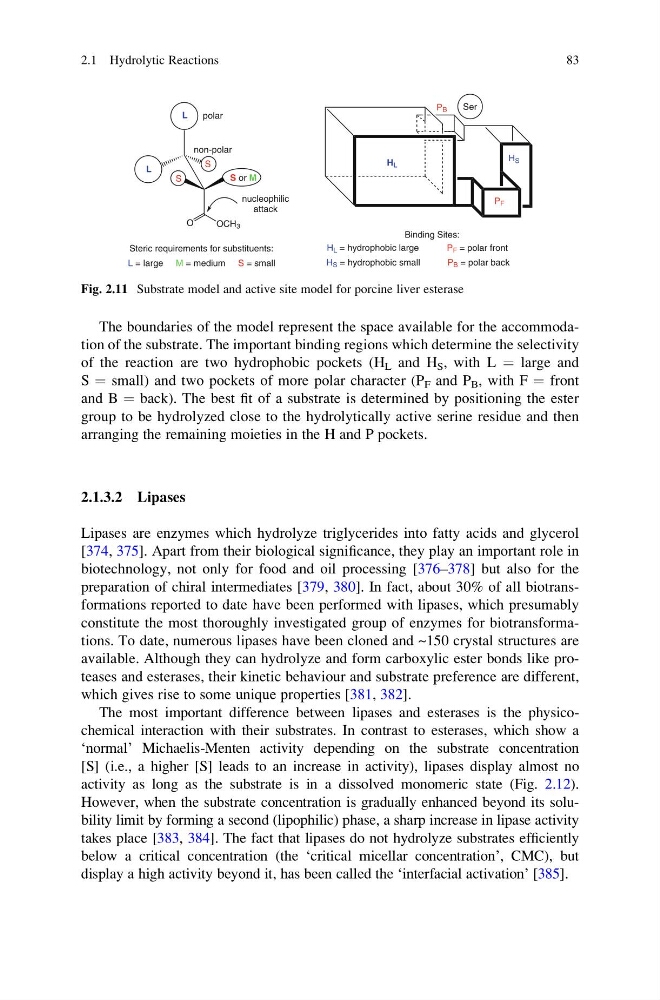
The boundaries of the model represent the space available for the accommodation of the substrate. The important binding regions which determine the selectivity
of the reaction are two hydrophobic pockets (H L and H S , with L ¼ large and
S ¼ small) and two pockets of more polar character (P F and P B , with F ¼ front
and B ¼ back). The best fit of a substrate is determined by positioning the ester
group to be hydrolyzed close to the hydrolytically active serine residue and then
arranging the remaining moieties in the H and P pockets.
2.1.3.2 Lipases
Lipases are enzymes which hydrolyze triglycerides into fatty acids and glycerol
[374, 375]. Apart from their biological significance, they play an important role in
biotechnology, not only for food and oil processing [376–378] but also for the
preparation of chiral intermediates [379, 380]. In fact, about 30% of all biotransformations reported to date have been performed with lipases, which presumably
constitute the most thoroughly investigated group of enzymes for biotransformations. To date, numerous lipases have been cloned and ~150 crystal structures are
available. Although they can hydrolyze and form carboxylic ester bonds like proteases and esterases, their kinetic behaviour and substrate preference are different,
which gives rise to some unique properties [381, 382].
The most important difference between lipases and esterases is the physicochemical interaction with their substrates. In contrast to esterases, which show a
‘normal’ Michaelis-Menten activity depending on the substrate concentration
[S] (i.e., a higher [S] leads to an increase in activity), lipases display almost no
activity as long as the substrate is in a dissolved monomeric state (Fig. 2.12).
However, when the substrate concentration is gradually enhanced beyond its solubility limit by forming a second (lipophilic) phase, a sharp increase in lipase activity
takes place [383, 384]. The fact that lipases do not hydrolyze substrates efficiently
below a critical concentration (the ‘critical micellar concentration’, CMC), but
display a high activity beyond it, has been called the ‘interfacial activation’ [385].
OCH 3
O
nucleophilic
attack
Steric requirements for substituents:
polar
non-polar
L
L
S or M
S
S
H L
Binding Sites:
H S
P F
P B
Ser
H L = hydrophobic large
H S = hydrophobic small
P F = polar front
P B = polar back
L = large M = medium S = small
Fig. 2.11 Substrate model and active site model for porcine liver esterase
2.1 Hydrolytic Reactions
83
of the reaction are two hydrophobic pockets (H L and H S , with L ¼ large and
S ¼ small) and two pockets of more polar character (P F and P B , with F ¼ front
and B ¼ back). The best fit of a substrate is determined by positioning the ester
group to be hydrolyzed close to the hydrolytically active serine residue and then
arranging the remaining moieties in the H and P pockets.
2.1.3.2 Lipases
Lipases are enzymes which hydrolyze triglycerides into fatty acids and glycerol
[374, 375]. Apart from their biological significance, they play an important role in
biotechnology, not only for food and oil processing [376–378] but also for the
preparation of chiral intermediates [379, 380]. In fact, about 30% of all biotransformations reported to date have been performed with lipases, which presumably
constitute the most thoroughly investigated group of enzymes for biotransformations. To date, numerous lipases have been cloned and ~150 crystal structures are
available. Although they can hydrolyze and form carboxylic ester bonds like proteases and esterases, their kinetic behaviour and substrate preference are different,
which gives rise to some unique properties [381, 382].
The most important difference between lipases and esterases is the physicochemical interaction with their substrates. In contrast to esterases, which show a
‘normal’ Michaelis-Menten activity depending on the substrate concentration
[S] (i.e., a higher [S] leads to an increase in activity), lipases display almost no
activity as long as the substrate is in a dissolved monomeric state (Fig. 2.12).
However, when the substrate concentration is gradually enhanced beyond its solubility limit by forming a second (lipophilic) phase, a sharp increase in lipase activity
takes place [383, 384]. The fact that lipases do not hydrolyze substrates efficiently
below a critical concentration (the ‘critical micellar concentration’, CMC), but
display a high activity beyond it, has been called the ‘interfacial activation’ [385].
OCH 3
O
nucleophilic
attack
Steric requirements for substituents:
polar
non-polar
L
L
S or M
S
S
H L
Binding Sites:
H S
P F
P B
Ser
H L = hydrophobic large
H S = hydrophobic small
P F = polar front
P B = polar back
L = large M = medium S = small
Fig. 2.11 Substrate model and active site model for porcine liver esterase
2.1 Hydrolytic Reactions
83