

• The same considerations are applicable to acylates of type II, where short-chain
acetates or propionates are the preferred acyl moieties. Increasing the carbonyl
reactivity of the substrate ester by adding electron-withdrawing substituents
such as halogen or methoxy (leading to α-halo- or α-methoxyacetates) is a
frequently used method to enhance the reaction rate in enzyme-catalyzed ester
hydrolysis [203].
• One limitation in substrate construction is common for both types of substrates: the remaining hydrogen atom at the chiral center must not be
replaced, since α,α,α-trisubstituted carboxylates and esters of tertiary alcohols
are usually too bulky to be accepted by esterases and proteases, although
there are some rare exceptions to this rule [204–207]. This limitation turns
them into potential protective groups for carboxy- and alcoholic functionalities, such as t-butyl esters and pivalates, in case an enzymatic hydrolysis is
not desired. For serine ester hydrolases, the rare ability to hydrolyze bulky
esters was attributed to an atypical Gly-Gly-Gly-X-sequence motif (instead of
the common Gly-X-motif) in the oxyanion cavity located within the active
site, which was found in Candida rugosa and Candida antarctica lipase A
[208–210].
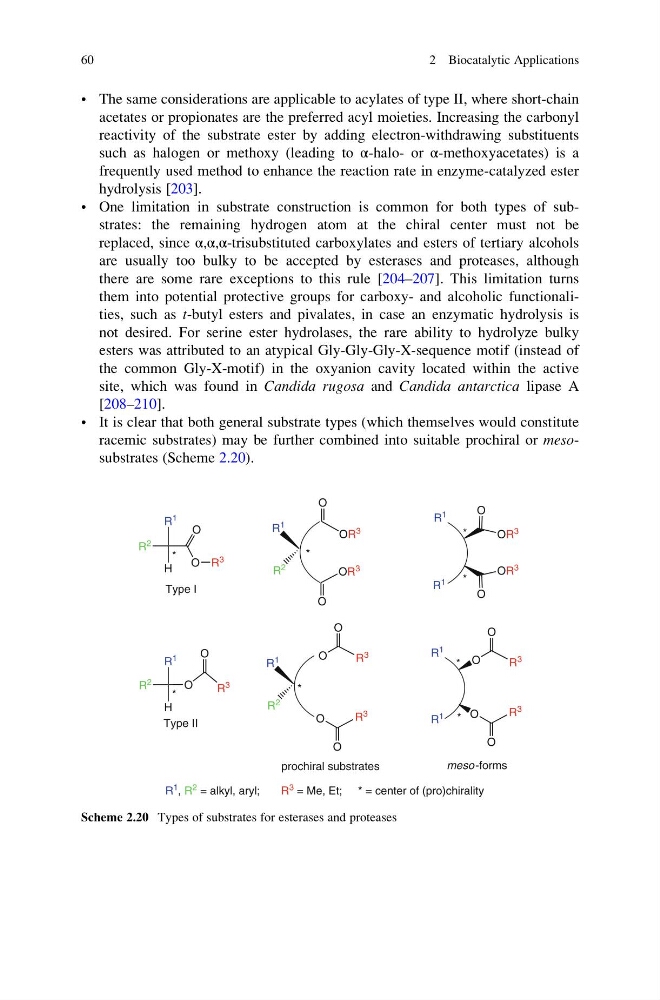
• It is clear that both general substrate types (which themselves would constitute
racemic substrates) may be further combined into suitable prochiral or mesosubstrates (Scheme 2.20).
R
3
O
O
R
2
H
R 1
O
R
3
O
R
2
H
R 1
O
O
R
2
R
1
O
OR
3
O
OR 3
O
O
O
O
O
O
O
O
R
2
R 1
R 1 , R 2 = alkyl, aryl;
R 3 = Me, Et; * = center of (pro)chirality
prochiral substrates
meso -forms
Type II
Type I
*
*
*
*
*
*
*
*
R 1
R
1
R 1
R 1
R
3
R 3
OR
3
OR 3
R
3
R 3
Scheme 2.20 Types of substrates for esterases and proteases
60
2 Biocatalytic Applications
acetates or propionates are the preferred acyl moieties. Increasing the carbonyl
reactivity of the substrate ester by adding electron-withdrawing substituents
such as halogen or methoxy (leading to α-halo- or α-methoxyacetates) is a
frequently used method to enhance the reaction rate in enzyme-catalyzed ester
hydrolysis [203].
• One limitation in substrate construction is common for both types of substrates: the remaining hydrogen atom at the chiral center must not be
replaced, since α,α,α-trisubstituted carboxylates and esters of tertiary alcohols
are usually too bulky to be accepted by esterases and proteases, although
there are some rare exceptions to this rule [204–207]. This limitation turns
them into potential protective groups for carboxy- and alcoholic functionalities, such as t-butyl esters and pivalates, in case an enzymatic hydrolysis is
not desired. For serine ester hydrolases, the rare ability to hydrolyze bulky
esters was attributed to an atypical Gly-Gly-Gly-X-sequence motif (instead of
the common Gly-X-motif) in the oxyanion cavity located within the active
site, which was found in Candida rugosa and Candida antarctica lipase A
[208–210].
• It is clear that both general substrate types (which themselves would constitute
racemic substrates) may be further combined into suitable prochiral or mesosubstrates (Scheme 2.20).
R
3
O
O
R
2
H
R 1
O
R
3
O
R
2
H
R 1
O
O
R
2
R
1
O
OR
3
O
OR 3
O
O
O
O
O
O
O
O
R
2
R 1
R 1 , R 2 = alkyl, aryl;
R 3 = Me, Et; * = center of (pro)chirality
prochiral substrates
meso -forms
Type II
Type I
*
*
*
*
*
*
*
*
R 1
R
1
R 1
R 1
R
3
R 3
OR
3
OR 3
R
3
R 3
Scheme 2.20 Types of substrates for esterases and proteases
60
2 Biocatalytic Applications