

Repeated Resolution In order to avoid the loss of half of the material in kinetic
resolution, it has been a common practice to racemize the unwanted enantiomer
after separation from the desired product and to subject it again to kinetic resolution
in a subsequent cycle, until virtually all of the racemic material has been converted
into a single stereoisomeric product. For obvious reasons, this laborious procedure
is not justified for laboratory-scale reactions, but it is a viable option for resolutions
on an industrial scale, in particular for continuously operated processes, where the
re-racemized material is simply fed back into the subsequent batch of the resolution
process. At first sight, repeated resolution appears less than ideal and it certainly
lacks synthetic elegance, bearing in mind that an infinite number of cycles are
theoretically required to transform all of the racemic starting material into a single
stereoisomer. Upon closer examination, though, re-racemization holds certain
merits: a simple calculation shows that although only 50% of the desired enantiomer is obtained after a single cycle, the overall (theoretical) yield increases to ~94%
after only four cycles [69].
In practice, however, deracemization via repeated resolution is often plagued by
low overall yields due to the harsh reaction conditions required for (chemical)
racemization [70]. In view of the mild reaction conditions displayed by enzymes,
racemases of EC-class 5 are increasingly being employed [71, 72].
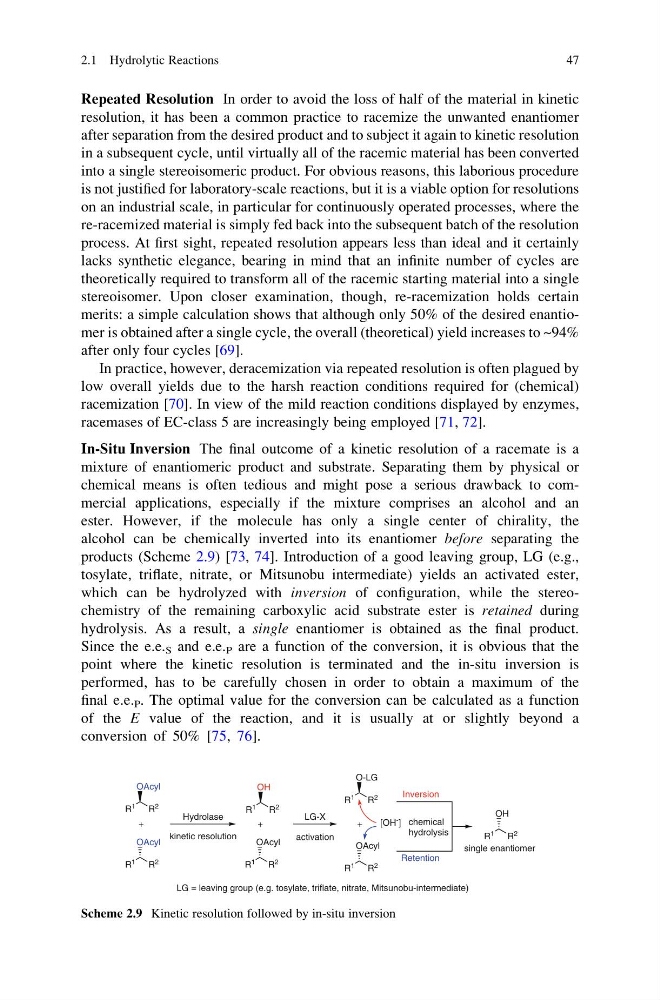
In-Situ Inversion The final outcome of a kinetic resolution of a racemate is a
mixture of enantiomeric product and substrate. Separating them by physical or
chemical means is often tedious and might pose a serious drawback to commercial applications, especially if the mixture comprises an alcohol and an
ester. However, if the molecule has only a single center of chirality, the
alcohol can be chemically inverted into its enantiomer before separating the
products (Scheme 2.9) [73, 74]. Introduction of a good leaving group, LG (e.g.,
tosylate, triflate, nitrate, or Mitsunobu intermediate) yields an activated ester,
which can be hydrolyzed with inversion of configuration, while the stereochemistry of the remaining carboxylic acid substrate ester is retained during
hydrolysis. As a result, a single enantiomer is obtained as the final product.
Since the e.e. S and e.e. P are a function of the conversion, it is obvious that the
point where the kinetic resolution is terminated and the in-situ inversion is
performed, has to be carefully chosen in order to obtain a maximum of the
final e.e. P . The optimal value for the conversion can be calculated as a function
of the E value of the reaction, and it is usually at or slightly beyond a
conversion of 50% [75, 76].
OAcyl
R 2
R 1
OAcyl
R 2
R 1
OH
R
2
R
1
OAcyl
R 2
R 1
O-LG
R 2
R 1
OAcyl
R
2
R
1
OH
R
2
R
1
single enantiomer
chemical
hydrolysis
activation
kinetic resolution
Hydrolase
LG-X
LG = leaving group (e.g. tosylate, triflate, nitrate, Mitsunobu-intermediate)
Inversion
Retention
[OH
- ]
+
+
+
Scheme 2.9 Kinetic resolution followed by in-situ inversion
2.1 Hydrolytic Reactions
47
resolution, it has been a common practice to racemize the unwanted enantiomer
after separation from the desired product and to subject it again to kinetic resolution
in a subsequent cycle, until virtually all of the racemic material has been converted
into a single stereoisomeric product. For obvious reasons, this laborious procedure
is not justified for laboratory-scale reactions, but it is a viable option for resolutions
on an industrial scale, in particular for continuously operated processes, where the
re-racemized material is simply fed back into the subsequent batch of the resolution
process. At first sight, repeated resolution appears less than ideal and it certainly
lacks synthetic elegance, bearing in mind that an infinite number of cycles are
theoretically required to transform all of the racemic starting material into a single
stereoisomer. Upon closer examination, though, re-racemization holds certain
merits: a simple calculation shows that although only 50% of the desired enantiomer is obtained after a single cycle, the overall (theoretical) yield increases to ~94%
after only four cycles [69].
In practice, however, deracemization via repeated resolution is often plagued by
low overall yields due to the harsh reaction conditions required for (chemical)
racemization [70]. In view of the mild reaction conditions displayed by enzymes,
racemases of EC-class 5 are increasingly being employed [71, 72].
In-Situ Inversion The final outcome of a kinetic resolution of a racemate is a
mixture of enantiomeric product and substrate. Separating them by physical or
chemical means is often tedious and might pose a serious drawback to commercial applications, especially if the mixture comprises an alcohol and an
ester. However, if the molecule has only a single center of chirality, the
alcohol can be chemically inverted into its enantiomer before separating the
products (Scheme 2.9) [73, 74]. Introduction of a good leaving group, LG (e.g.,
tosylate, triflate, nitrate, or Mitsunobu intermediate) yields an activated ester,
which can be hydrolyzed with inversion of configuration, while the stereochemistry of the remaining carboxylic acid substrate ester is retained during
hydrolysis. As a result, a single enantiomer is obtained as the final product.
Since the e.e. S and e.e. P are a function of the conversion, it is obvious that the
point where the kinetic resolution is terminated and the in-situ inversion is
performed, has to be carefully chosen in order to obtain a maximum of the
final e.e. P . The optimal value for the conversion can be calculated as a function
of the E value of the reaction, and it is usually at or slightly beyond a
conversion of 50% [75, 76].
OAcyl
R 2
R 1
OAcyl
R 2
R 1
OH
R
2
R
1
OAcyl
R 2
R 1
O-LG
R 2
R 1
OAcyl
R
2
R
1
OH
R
2
R
1
single enantiomer
chemical
hydrolysis
activation
kinetic resolution
Hydrolase
LG-X
LG = leaving group (e.g. tosylate, triflate, nitrate, Mitsunobu-intermediate)
Inversion
Retention
[OH
- ]
+
+
+
Scheme 2.9 Kinetic resolution followed by in-situ inversion
2.1 Hydrolytic Reactions
47