

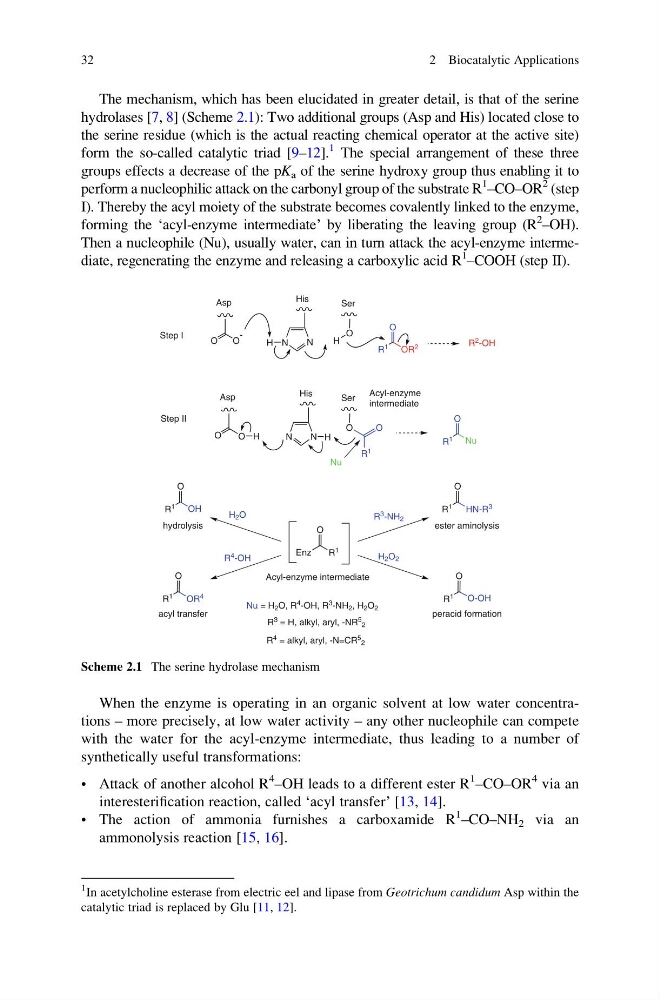
The mechanism, which has been elucidated in greater detail, is that of the serine
hydrolases [7, 8] (Scheme 2.1): Two additional groups (Asp and His) located close to
the serine residue (which is the actual reacting chemical operator at the active site)
form the so-called catalytic triad [9–12].
1 The special arrangement of these three
groups effects a decrease of the pK a of the serine hydroxy group thus enabling it to
perform a nucleophilic attack on the carbonyl group of the substrate R
1
–CO–OR
2 (step
I). Thereby the acyl moiety of the substrate becomes covalently linked to the enzyme,
forming the ‘acyl-enzyme intermediate’ by liberating the leaving group (R
2
–OH).
Then a nucleophile (Nu), usually water, can in turn attack the acyl-enzyme intermediate, regenerating the enzyme and releasing a carboxylic acid R
1
–COOH (step II).
When the enzyme is operating in an organic solvent at low water concentrations – more precisely, at low water activity – any other nucleophile can compete
with the water for the acyl-enzyme intermediate, thus leading to a number of
synthetically useful transformations:
• Attack of another alcohol R
4 –OH leads to a different ester R
1 –CO–OR
4 via an
interesterification reaction, called ‘acyl transfer’ [13, 14].
• The action of ammonia furnishes a carboxamide R
1 –CO–NH 2 via an
ammonolysis reaction [15, 16].
O
Nu
R
1
H
O
O
H
N
N
O
R 1
O
H
O
H
N
N
O
O
OR
2
O
R
1
Acyl-enzyme
intermediate
Nu
Step II
Step I
-
R
2
-OH
Asp
His
Ser
Ser
His
Asp
O
HN-R
3
R
1
O
O-OH
R
1
O
OH
R
1
O
OR
4
R
1
R 1
O
Enz
R
3 = H, alkyl, aryl, -NR
5
2
R 4 = alkyl, aryl, -N=CR 5
2
Nu = H 2 O, R
4
-OH, R
3 -NH 2 , H 2 O 2
Acyl-enzyme intermediate
hydrolysis
acyl transfer
ester aminolysis
peracid formation
H 2 O
H 2 O 2
R
4
-OH
R
3
-NH 2
Scheme 2.1 The serine hydrolase mechanism
1 In acetylcholine esterase from electric eel and lipase from Geotrichum candidum Asp within the
catalytic triad is replaced by Glu [11, 12].
32
2 Biocatalytic Applications
hydrolases [7, 8] (Scheme 2.1): Two additional groups (Asp and His) located close to
the serine residue (which is the actual reacting chemical operator at the active site)
form the so-called catalytic triad [9–12].
1 The special arrangement of these three
groups effects a decrease of the pK a of the serine hydroxy group thus enabling it to
perform a nucleophilic attack on the carbonyl group of the substrate R
1
–CO–OR
2 (step
I). Thereby the acyl moiety of the substrate becomes covalently linked to the enzyme,
forming the ‘acyl-enzyme intermediate’ by liberating the leaving group (R
2
–OH).
Then a nucleophile (Nu), usually water, can in turn attack the acyl-enzyme intermediate, regenerating the enzyme and releasing a carboxylic acid R
1
–COOH (step II).
When the enzyme is operating in an organic solvent at low water concentrations – more precisely, at low water activity – any other nucleophile can compete
with the water for the acyl-enzyme intermediate, thus leading to a number of
synthetically useful transformations:
• Attack of another alcohol R
4 –OH leads to a different ester R
1 –CO–OR
4 via an
interesterification reaction, called ‘acyl transfer’ [13, 14].
• The action of ammonia furnishes a carboxamide R
1 –CO–NH 2 via an
ammonolysis reaction [15, 16].
O
Nu
R
1
H
O
O
H
N
N
O
R 1
O
H
O
H
N
N
O
O
OR
2
O
R
1
Acyl-enzyme
intermediate
Nu
Step II
Step I
-
R
2
-OH
Asp
His
Ser
Ser
His
Asp
O
HN-R
3
R
1
O
O-OH
R
1
O
OH
R
1
O
OR
4
R
1
R 1
O
Enz
R
3 = H, alkyl, aryl, -NR
5
2
R 4 = alkyl, aryl, -N=CR 5
2
Nu = H 2 O, R
4
-OH, R
3 -NH 2 , H 2 O 2
Acyl-enzyme intermediate
hydrolysis
acyl transfer
ester aminolysis
peracid formation
H 2 O
H 2 O 2
R
4
-OH
R
3
-NH 2
Scheme 2.1 The serine hydrolase mechanism
1 In acetylcholine esterase from electric eel and lipase from Geotrichum candidum Asp within the
catalytic triad is replaced by Glu [11, 12].
32
2 Biocatalytic Applications