

The asymmetric hydrolysis of epoxides offers a valuable method for the synthesis of nonracemic epoxides and vic-diols on a multigram-scale. The enzymatic
hydrolysis of nitriles to amides or carboxylic acids often does not proceed with high
enantioselectivity, but it offers a mild alternative to the harsh reaction conditions
required using traditional methodology. As a consequence, nitrile-hydrolysing
enzymes have outcompeted chemical catalysts on industrial scale.
The chemo- and regio-selective synthesis of phosphate esters used as flavorenhancers, active pharmaceutical ingredients and as high-energy metabolites
required for pathway engineering is now possible using cheap inorganic pyrophosphate circumventing the need of ATP.
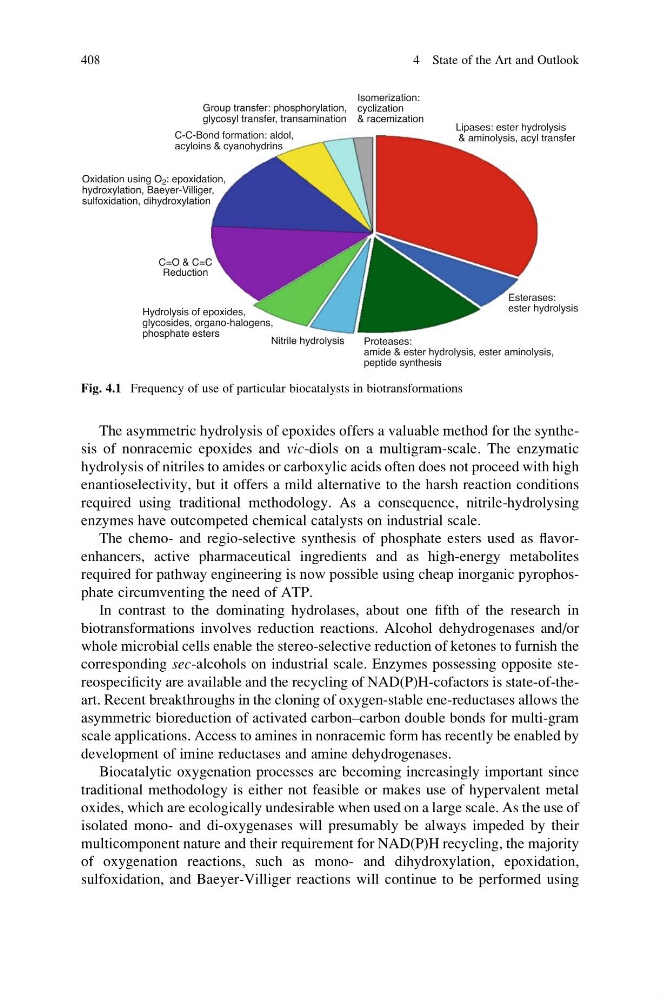
In contrast to the dominating hydrolases, about one fifth of the research in
biotransformations involves reduction reactions. Alcohol dehydrogenases and/or
whole microbial cells enable the stereo-selective reduction of ketones to furnish the
corresponding sec-alcohols on industrial scale. Enzymes possessing opposite stereospecificity are available and the recycling of NAD(P)H-cofactors is state-of-theart. Recent breakthroughs in the cloning of oxygen-stable ene-reductases allows the
asymmetric bioreduction of activated carbon–carbon double bonds for multi-gram
scale applications. Access to amines in nonracemic form has recently be enabled by
development of imine reductases and amine dehydrogenases.
Biocatalytic oxygenation processes are becoming increasingly important since
traditional methodology is either not feasible or makes use of hypervalent metal
oxides, which are ecologically undesirable when used on a large scale. As the use of
isolated mono- and di-oxygenases will presumably be always impeded by their
multicomponent nature and their requirement for NAD(P)H recycling, the majority
of oxygenation reactions, such as mono- and dihydroxylation, epoxidation,
sulfoxidation, and Baeyer-Villiger reactions will continue to be performed using
Fig. 4.1 Frequency of use of particular biocatalysts in biotransformations
408
4 State of the Art and Outlook
hydrolysis of nitriles to amides or carboxylic acids often does not proceed with high
enantioselectivity, but it offers a mild alternative to the harsh reaction conditions
required using traditional methodology. As a consequence, nitrile-hydrolysing
enzymes have outcompeted chemical catalysts on industrial scale.
The chemo- and regio-selective synthesis of phosphate esters used as flavorenhancers, active pharmaceutical ingredients and as high-energy metabolites
required for pathway engineering is now possible using cheap inorganic pyrophosphate circumventing the need of ATP.
In contrast to the dominating hydrolases, about one fifth of the research in
biotransformations involves reduction reactions. Alcohol dehydrogenases and/or
whole microbial cells enable the stereo-selective reduction of ketones to furnish the
corresponding sec-alcohols on industrial scale. Enzymes possessing opposite stereospecificity are available and the recycling of NAD(P)H-cofactors is state-of-theart. Recent breakthroughs in the cloning of oxygen-stable ene-reductases allows the
asymmetric bioreduction of activated carbon–carbon double bonds for multi-gram
scale applications. Access to amines in nonracemic form has recently be enabled by
development of imine reductases and amine dehydrogenases.
Biocatalytic oxygenation processes are becoming increasingly important since
traditional methodology is either not feasible or makes use of hypervalent metal
oxides, which are ecologically undesirable when used on a large scale. As the use of
isolated mono- and di-oxygenases will presumably be always impeded by their
multicomponent nature and their requirement for NAD(P)H recycling, the majority
of oxygenation reactions, such as mono- and dihydroxylation, epoxidation,
sulfoxidation, and Baeyer-Villiger reactions will continue to be performed using
Fig. 4.1 Frequency of use of particular biocatalysts in biotransformations
408
4 State of the Art and Outlook