

‘catalophor’, serves as template for a search in protein crystal structures. The hit
structures are analyzed and the active site is redesigned to maximize its affinity for
the transition state and its conformational stability. The obtained (variant) proteins
are then screened for activity.
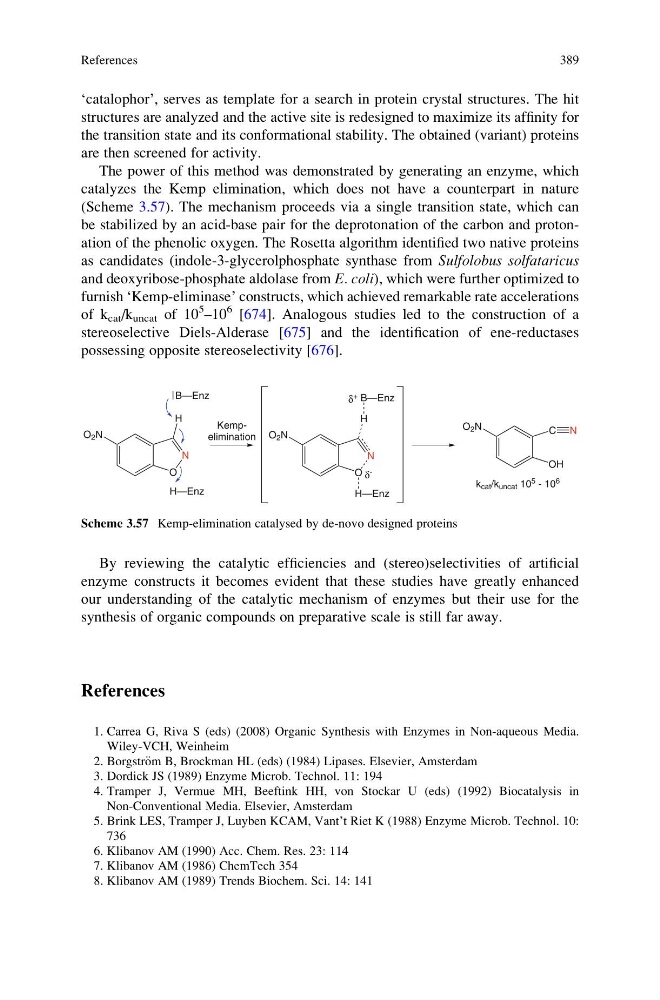
The power of this method was demonstrated by generating an enzyme, which
catalyzes the Kemp elimination, which does not have a counterpart in nature
(Scheme 3.57). The mechanism proceeds via a single transition state, which can
be stabilized by an acid-base pair for the deprotonation of the carbon and protonation of the phenolic oxygen. The Rosetta algorithm identified two native proteins
as candidates (indole-3-glycerolphosphate synthase from Sulfolobus solfataricus
and deoxyribose-phosphate aldolase from E. coli), which were further optimized to
furnish ‘Kemp-eliminase’ constructs, which achieved remarkable rate accelerations
of k cat /k uncat of 10
5 –10
6 [674]. Analogous studies led to the construction of a
stereoselective Diels-Alderase [675] and the identification of ene-reductases
possessing opposite stereoselectivity [676].
By reviewing the catalytic efficiencies and (stereo)selectivities of artificial
enzyme constructs it becomes evident that these studies have greatly enhanced
our understanding of the catalytic mechanism of enzymes but their use for the
synthesis of organic compounds on preparative scale is still far away.
References
1. Carrea G, Riva S (eds) (2008) Organic Synthesis with Enzymes in Non-aqueous Media.
Wiley-VCH, Weinheim
2. Borgstr€ om B, Brockman HL (eds) (1984) Lipases. Elsevier, Amsterdam
3. Dordick JS (1989) Enzyme Microb. Technol. 11: 194
4. Tramper J, Vermue MH, Beeftink HH, von Stockar U (eds) (1992) Biocatalysis in
Non-Conventional Media. Elsevier, Amsterdam
5. Brink LES, Tramper J, Luyben KCAM, Vant’t Riet K (1988) Enzyme Microb. Technol. 10:
736
6. Klibanov AM (1990) Acc. Chem. Res. 23: 114
7. Klibanov AM (1986) ChemTech 354
8. Klibanov AM (1989) Trends Biochem. Sci. 14: 141
O 2 N
O
N
H
B—Enz
H—Enz
δ +
δ
-
O 2 N
O
N
H
B—Enz
H—Enz
O 2 N
OH
C N
k cat /k uncat 10
5 - 10
6
Kempelimination
Scheme 3.57 Kemp-elimination catalysed by de-novo designed proteins
References
389
structures are analyzed and the active site is redesigned to maximize its affinity for
the transition state and its conformational stability. The obtained (variant) proteins
are then screened for activity.
The power of this method was demonstrated by generating an enzyme, which
catalyzes the Kemp elimination, which does not have a counterpart in nature
(Scheme 3.57). The mechanism proceeds via a single transition state, which can
be stabilized by an acid-base pair for the deprotonation of the carbon and protonation of the phenolic oxygen. The Rosetta algorithm identified two native proteins
as candidates (indole-3-glycerolphosphate synthase from Sulfolobus solfataricus
and deoxyribose-phosphate aldolase from E. coli), which were further optimized to
furnish ‘Kemp-eliminase’ constructs, which achieved remarkable rate accelerations
of k cat /k uncat of 10
5 –10
6 [674]. Analogous studies led to the construction of a
stereoselective Diels-Alderase [675] and the identification of ene-reductases
possessing opposite stereoselectivity [676].
By reviewing the catalytic efficiencies and (stereo)selectivities of artificial
enzyme constructs it becomes evident that these studies have greatly enhanced
our understanding of the catalytic mechanism of enzymes but their use for the
synthesis of organic compounds on preparative scale is still far away.
References
1. Carrea G, Riva S (eds) (2008) Organic Synthesis with Enzymes in Non-aqueous Media.
Wiley-VCH, Weinheim
2. Borgstr€ om B, Brockman HL (eds) (1984) Lipases. Elsevier, Amsterdam
3. Dordick JS (1989) Enzyme Microb. Technol. 11: 194
4. Tramper J, Vermue MH, Beeftink HH, von Stockar U (eds) (1992) Biocatalysis in
Non-Conventional Media. Elsevier, Amsterdam
5. Brink LES, Tramper J, Luyben KCAM, Vant’t Riet K (1988) Enzyme Microb. Technol. 10:
736
6. Klibanov AM (1990) Acc. Chem. Res. 23: 114
7. Klibanov AM (1986) ChemTech 354
8. Klibanov AM (1989) Trends Biochem. Sci. 14: 141
O 2 N
O
N
H
B—Enz
H—Enz
δ +
δ
-
O 2 N
O
N
H
B—Enz
H—Enz
O 2 N
OH
C N
k cat /k uncat 10
5 - 10
6
Kempelimination
Scheme 3.57 Kemp-elimination catalysed by de-novo designed proteins
References
389