

with association constants of 10
4
–10
14 M
À1
, in other words, binding is extremely
strong. As with enzymes, binding occurs by Van der Waals (London), hydrophobic,
electrostatic and hydrogen-bonding interactions.
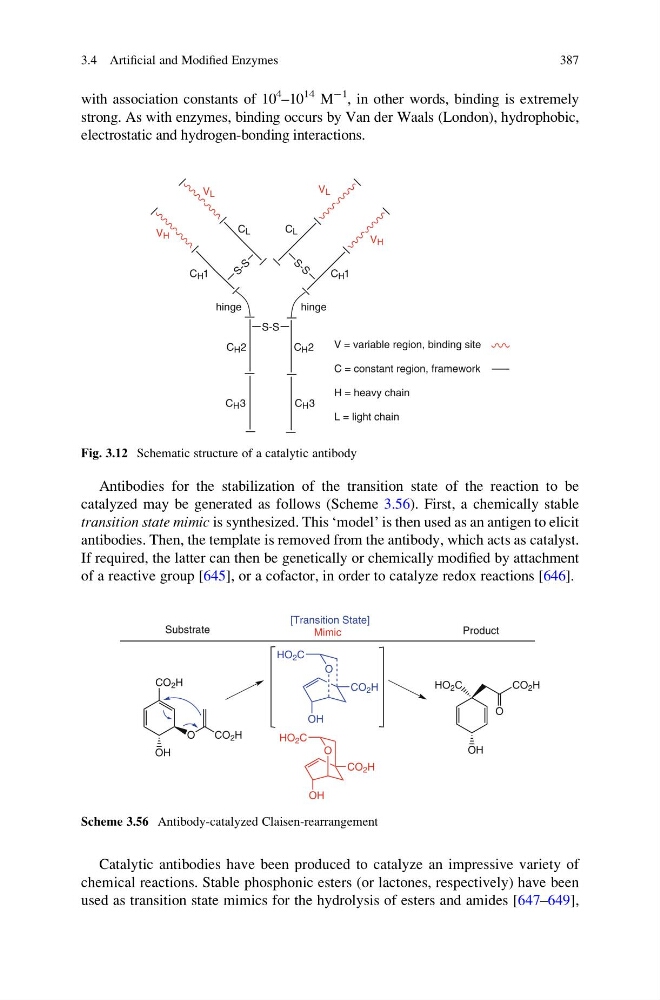
Antibodies for the stabilization of the transition state of the reaction to be
catalyzed may be generated as follows (Scheme 3.56). First, a chemically stable
transition state mimic is synthesized. This ‘model’ is then used as an antigen to elicit
antibodies. Then, the template is removed from the antibody, which acts as catalyst.
If required, the latter can then be genetically or chemically modified by attachment
of a reactive group [645], or a cofactor, in order to catalyze redox reactions [646].
Catalytic antibodies have been produced to catalyze an impressive variety of
chemical reactions. Stable phosphonic esters (or lactones, respectively) have been
used as transition state mimics for the hydrolysis of esters and amides [647–649],
OH
CO 2 H
CO 2 H
O
O
CO 2 H
HO 2 C
OH
HO 2 C
CO 2 H
OH
O
HO 2 C
CO 2 H
OH
O
Substrate
[Transition State]
Product
Mimic
Scheme 3.56 Antibody-catalyzed Claisen-rearrangement
S-S
V = variable region, binding site
C = constant region, framework
H = heavy chain
L = light chain
hinge
hinge
C L
C L
V L
V L
C H 3
C H 3
C H 2
C H 2
C H
C
1
H 1
V H
V H
S - S
S - S
Fig. 3.12 Schematic structure of a catalytic antibody
3.4 Artificial and Modified Enzymes
387
4
–10
14 M
À1
, in other words, binding is extremely
strong. As with enzymes, binding occurs by Van der Waals (London), hydrophobic,
electrostatic and hydrogen-bonding interactions.
Antibodies for the stabilization of the transition state of the reaction to be
catalyzed may be generated as follows (Scheme 3.56). First, a chemically stable
transition state mimic is synthesized. This ‘model’ is then used as an antigen to elicit
antibodies. Then, the template is removed from the antibody, which acts as catalyst.
If required, the latter can then be genetically or chemically modified by attachment
of a reactive group [645], or a cofactor, in order to catalyze redox reactions [646].
Catalytic antibodies have been produced to catalyze an impressive variety of
chemical reactions. Stable phosphonic esters (or lactones, respectively) have been
used as transition state mimics for the hydrolysis of esters and amides [647–649],
OH
CO 2 H
CO 2 H
O
O
CO 2 H
HO 2 C
OH
HO 2 C
CO 2 H
OH
O
HO 2 C
CO 2 H
OH
O
Substrate
[Transition State]
Product
Mimic
Scheme 3.56 Antibody-catalyzed Claisen-rearrangement
S-S
V = variable region, binding site
C = constant region, framework
H = heavy chain
L = light chain
hinge
hinge
C L
C L
V L
V L
C H 3
C H 3
C H 2
C H 2
C H
C
1
H 1
V H
V H
S - S
S - S
Fig. 3.12 Schematic structure of a catalytic antibody
3.4 Artificial and Modified Enzymes
387