

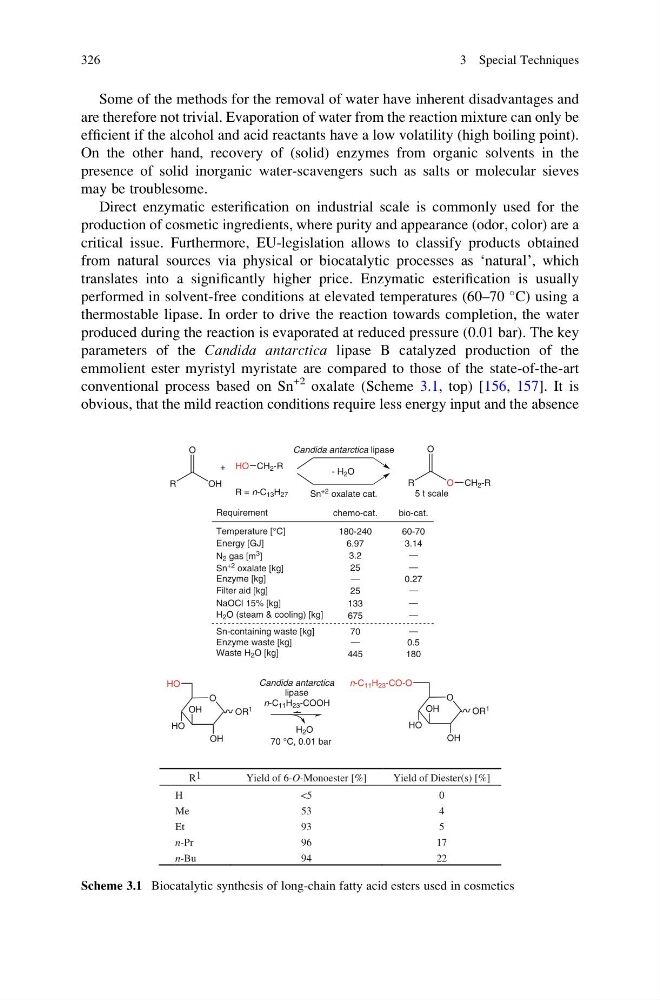
Some of the methods for the removal of water have inherent disadvantages and
are therefore not trivial. Evaporation of water from the reaction mixture can only be
efficient if the alcohol and acid reactants have a low volatility (high boiling point).
On the other hand, recovery of (solid) enzymes from organic solvents in the
presence of solid inorganic water-scavengers such as salts or molecular sieves
may be troublesome.
Direct enzymatic esterification on industrial scale is commonly used for the
production of cosmetic ingredients, where purity and appearance (odor, color) are a
critical issue. Furthermore, EU-legislation allows to classify products obtained
from natural sources via physical or biocatalytic processes as ‘natural’, which
translates into a significantly higher price. Enzymatic esterification is usually
performed in solvent-free conditions at elevated temperatures (60–70
C) using a
thermostable lipase. In order to drive the reaction towards completion, the water
produced during the reaction is evaporated at reduced pressure (0.01 bar). The key
parameters of the Candida antarctica lipase B catalyzed production of the
emmolient ester myristyl myristate are compared to those of the state-of-the-art
conventional process based on Sn
+2 oxalate (Scheme 3.1, top) [156, 157]. It is
obvious, that the mild reaction conditions require less energy input and the absence
OR 1
n-C 11 H 23 -CO-O
HO
OH
OH
O
OR
1
HO
HO
OH
OH
O
lipase
Candida antarctica
70 °C, 0.01 bar
n-C 11 H 23 -COOH
R
OH
O
HO CH 2 -R
+
R
O
O
CH 2 -R
R = n-C 13 H 27
Candida antarctica lipase
H 2 O
- H 2 O
Sn +2 oxalate cat.
chemo-cat.
bio-cat.
Requirement
Energy [GJ]
6.97
3.14
N 2 gas [m
3 ]
3.2
—
Sn +2 oxalate [kg]
5 t scale
25
—
Enzyme [kg]
—
0.27
Filter aid [kg]
25
—
NaOCl 15% [kg]
133
—
H 2 O (steam & cooling) [kg]
675
—
Sn-containing waste [kg]
70
—
Enzyme waste [kg]
—
0.5
Waste H 2 O [kg]
445
180
Temperature [°C]
180-240
60-70
R 1
Yield of 6-O-Monoester [%]
Yield of Diester(s) [%]
H
< 5
0
Me
53
4
Et
93
5
n-Pr
96
17
n-Bu
94
22
Scheme 3.1 Biocatalytic synthesis of long-chain fatty acid esters used in cosmetics
326
3 Special Techniques
are therefore not trivial. Evaporation of water from the reaction mixture can only be
efficient if the alcohol and acid reactants have a low volatility (high boiling point).
On the other hand, recovery of (solid) enzymes from organic solvents in the
presence of solid inorganic water-scavengers such as salts or molecular sieves
may be troublesome.
Direct enzymatic esterification on industrial scale is commonly used for the
production of cosmetic ingredients, where purity and appearance (odor, color) are a
critical issue. Furthermore, EU-legislation allows to classify products obtained
from natural sources via physical or biocatalytic processes as ‘natural’, which
translates into a significantly higher price. Enzymatic esterification is usually
performed in solvent-free conditions at elevated temperatures (60–70
C) using a
thermostable lipase. In order to drive the reaction towards completion, the water
produced during the reaction is evaporated at reduced pressure (0.01 bar). The key
parameters of the Candida antarctica lipase B catalyzed production of the
emmolient ester myristyl myristate are compared to those of the state-of-the-art
conventional process based on Sn
+2 oxalate (Scheme 3.1, top) [156, 157]. It is
obvious, that the mild reaction conditions require less energy input and the absence
OR 1
n-C 11 H 23 -CO-O
HO
OH
OH
O
OR
1
HO
HO
OH
OH
O
lipase
Candida antarctica
70 °C, 0.01 bar
n-C 11 H 23 -COOH
R
OH
O
HO CH 2 -R
+
R
O
O
CH 2 -R
R = n-C 13 H 27
Candida antarctica lipase
H 2 O
- H 2 O
Sn +2 oxalate cat.
chemo-cat.
bio-cat.
Requirement
Energy [GJ]
6.97
3.14
N 2 gas [m
3 ]
3.2
—
Sn +2 oxalate [kg]
5 t scale
25
—
Enzyme [kg]
—
0.27
Filter aid [kg]
25
—
NaOCl 15% [kg]
133
—
H 2 O (steam & cooling) [kg]
675
—
Sn-containing waste [kg]
70
—
Enzyme waste [kg]
—
0.5
Waste H 2 O [kg]
445
180
Temperature [°C]
180-240
60-70
R 1
Yield of 6-O-Monoester [%]
Yield of Diester(s) [%]
H
< 5
0
Me
53
4
Et
93
5
n-Pr
96
17
n-Bu
94
22
Scheme 3.1 Biocatalytic synthesis of long-chain fatty acid esters used in cosmetics
326
3 Special Techniques