

enzymes remain catalytically active in water-miscible organic solvents with an
extremely low water content; these cases are limited to unusually stable enzymes
such as subtilisin and some lipases, e.g., from Candida antarctica [49–51]. Watermiscible organic solvents have also been successfully used to decrease the freezing
temperature of aqueous systems when biocatalytic reactions were conducted at temperatures below 0
C (‘cryoenzymology’) [52–55].
Enzyme Dissolved in a Biphasic Aqueous-Organic Solution
Reaction systems consisting of two discrete macroscopic phases, namely the
aqueous phase containing the dissolved enzyme, and a second phase of a nonpolar
organic solvent (preferably lipophilic and of high molecular weight) such as
(chlorinated) hydrocarbons, aromatics or ethers, may be advantageous to achieve
a spatial separation of the biocatalyst from the organic phase [56–58]. Thus, the
biocatalyst is in a favorable aqueous environment and not in direct contact with the
organic solvent, where most of the substrate/product is located. Therefore, the
limited concentrations of organic material in the aqueous phase may circumvent
inhibition phenomena. Furthermore, the removal of product from the enzyme
surface drives the reaction towards completion. Due to the fact that in such biphasic
systems the enzymatic reaction proceeds only in the aqueous phase, a sufficient
mass transfer of the reactant(s) to and product(s) from the catalyst and between the
two phases is necessary [59]. It is obvious that shaking or stirring represents a
crucial parameter in such systems.
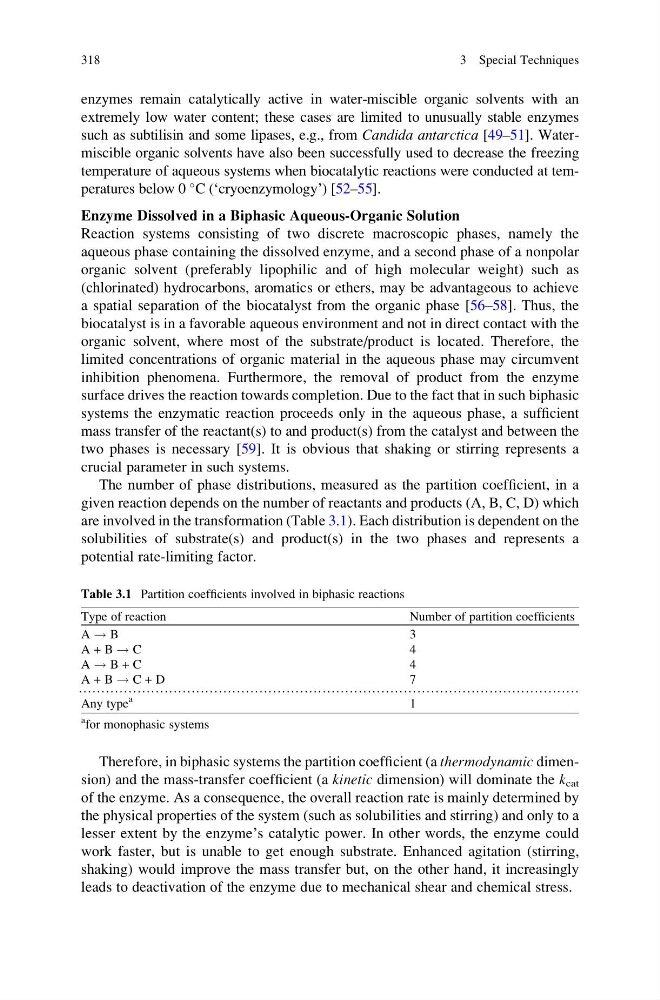
The number of phase distributions, measured as the partition coefficient, in a
given reaction depends on the number of reactants and products (A, B, C, D) which
are involved in the transformation (Table 3.1). Each distribution is dependent on the
solubilities of substrate(s) and product(s) in the two phases and represents a
potential rate-limiting factor.
Therefore, in biphasic systems the partition coefficient (a thermodynamic dimension) and the mass-transfer coefficient (a kinetic dimension) will dominate the k cat
of the enzyme. As a consequence, the overall reaction rate is mainly determined by
the physical properties of the system (such as solubilities and stirring) and only to a
lesser extent by the enzyme’s catalytic power. In other words, the enzyme could
work faster, but is unable to get enough substrate. Enhanced agitation (stirring,
shaking) would improve the mass transfer but, on the other hand, it increasingly
leads to deactivation of the enzyme due to mechanical shear and chemical stress.
. . . . . . . . . . . . . . . . . . . . . . . . . . . . . . . . . . . . . . . . . . . . . . . . . . . . . . . . . . . . . . . . . . . . . . . . . . . . . . . . . . . . . . . . . . . . . . . . . . . . . . . . . . . . . . .
Table 3.1 Partition coefficients involved in biphasic reactions
Type of reaction
Number of partition coefficients
A ! B
3
A + B ! C
4
A ! B + C
4
A + B ! C + D
7
Any type
a
1
a
for monophasic systems
318
3 Special Techniques
extremely low water content; these cases are limited to unusually stable enzymes
such as subtilisin and some lipases, e.g., from Candida antarctica [49–51]. Watermiscible organic solvents have also been successfully used to decrease the freezing
temperature of aqueous systems when biocatalytic reactions were conducted at temperatures below 0
C (‘cryoenzymology’) [52–55].
Enzyme Dissolved in a Biphasic Aqueous-Organic Solution
Reaction systems consisting of two discrete macroscopic phases, namely the
aqueous phase containing the dissolved enzyme, and a second phase of a nonpolar
organic solvent (preferably lipophilic and of high molecular weight) such as
(chlorinated) hydrocarbons, aromatics or ethers, may be advantageous to achieve
a spatial separation of the biocatalyst from the organic phase [56–58]. Thus, the
biocatalyst is in a favorable aqueous environment and not in direct contact with the
organic solvent, where most of the substrate/product is located. Therefore, the
limited concentrations of organic material in the aqueous phase may circumvent
inhibition phenomena. Furthermore, the removal of product from the enzyme
surface drives the reaction towards completion. Due to the fact that in such biphasic
systems the enzymatic reaction proceeds only in the aqueous phase, a sufficient
mass transfer of the reactant(s) to and product(s) from the catalyst and between the
two phases is necessary [59]. It is obvious that shaking or stirring represents a
crucial parameter in such systems.
The number of phase distributions, measured as the partition coefficient, in a
given reaction depends on the number of reactants and products (A, B, C, D) which
are involved in the transformation (Table 3.1). Each distribution is dependent on the
solubilities of substrate(s) and product(s) in the two phases and represents a
potential rate-limiting factor.
Therefore, in biphasic systems the partition coefficient (a thermodynamic dimension) and the mass-transfer coefficient (a kinetic dimension) will dominate the k cat
of the enzyme. As a consequence, the overall reaction rate is mainly determined by
the physical properties of the system (such as solubilities and stirring) and only to a
lesser extent by the enzyme’s catalytic power. In other words, the enzyme could
work faster, but is unable to get enough substrate. Enhanced agitation (stirring,
shaking) would improve the mass transfer but, on the other hand, it increasingly
leads to deactivation of the enzyme due to mechanical shear and chemical stress.
. . . . . . . . . . . . . . . . . . . . . . . . . . . . . . . . . . . . . . . . . . . . . . . . . . . . . . . . . . . . . . . . . . . . . . . . . . . . . . . . . . . . . . . . . . . . . . . . . . . . . . . . . . . . . . .
Table 3.1 Partition coefficients involved in biphasic reactions
Type of reaction
Number of partition coefficients
A ! B
3
A + B ! C
4
A ! B + C
4
A + B ! C + D
7
Any type
a
1
a
for monophasic systems
318
3 Special Techniques