

One particular warning should be given concerning catalytic activities which are
measured in several different systems:
According to the SI system, catalytic activity is defined by the “katal”
(1 kat ¼ 1 mol s
À1 of substrate transformed). Since its magnitude is far too big for
practical application, it has not been widely accepted. The transformation of one mole
of an organic compound within one second resembles an industrial-scale reaction and
is thus not suited to describe enzyme kinetics. As a consequence, a more appropriate
standard – The ‘International Unit’ (1 I.U. ¼ 1 μmol of substrate transformed per
min) – has been defined. Unfortunately, other units such as nmol/min or nmol/h are
also common, mainly to make the numbers of low catalytic activity look bigger. After
all, it should be kept in mind that the activities using nonnatural substrates are often
significantly below the values which were determined for natural substrates. As a rule
of thumb, enzymes from the primary metabolism typically display k cat values of
~100 s
À1 because they are highly evolved and hence specific for a given substrate. On
the other hand, proteins from the secondary metabolism show a broad substrate
tolerance and are about one order of magnitude slower.
A comparison of the activity of different enzyme preparations is only possible if
the assay procedure is performed exactly in the same way. Since most enzyme
suppliers use their own experimental setup, an estimation of the cost/activity ratio
of biocatalysts from various commercial sources is seldom possible by using
published data, unless activity data were determined independently.
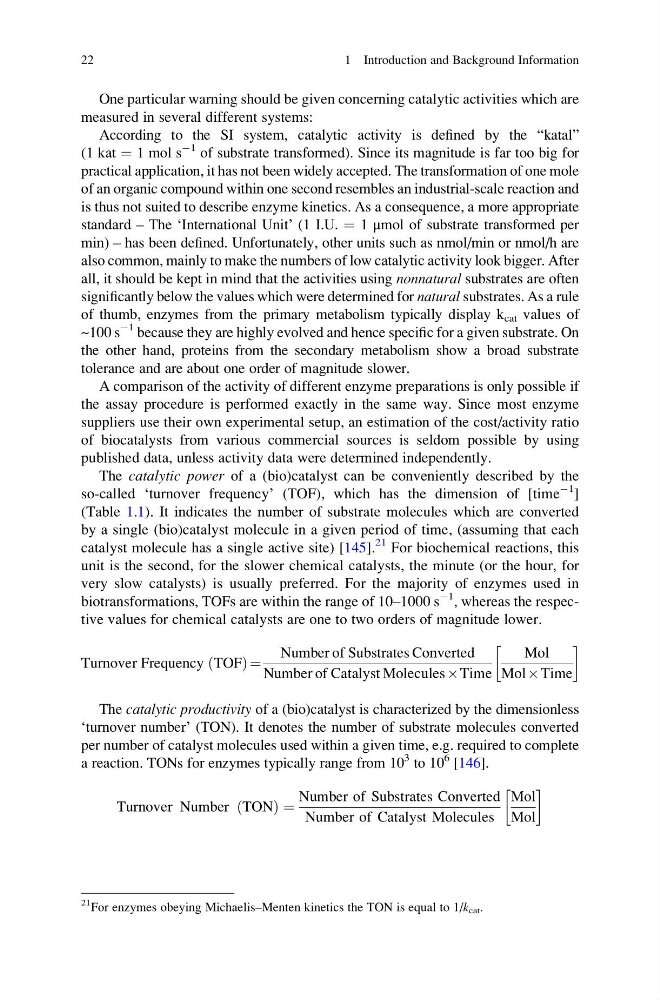
The catalytic power of a (bio)catalyst can be conveniently described by the
so-called ‘turnover frequency’ (TOF), which has the dimension of [time
À1 ]
(Table 1.1). It indicates the number of substrate molecules which are converted
by a single (bio)catalyst molecule in a given period of time, (assuming that each
catalyst molecule has a single active site) [145].
21 For biochemical reactions, this
unit is the second, for the slower chemical catalysts, the minute (or the hour, for
very slow catalysts) is usually preferred. For the majority of enzymes used in
biotransformations, TOFs are within the range of 10–1000 s
À1 , whereas the respective values for chemical catalysts are one to two orders of magnitude lower.
Turnover Frequency TOF
ð
Þ¼
Number of Substrates Converted
Number of Catalyst Molecules  Time
Mol
Mol  Time
The catalytic productivity of a (bio)catalyst is characterized by the dimensionless
‘turnover number’ (TON). It denotes the number of substrate molecules converted
per number of catalyst molecules used within a given time, e.g. required to complete
a reaction. TONs for enzymes typically range from 10
3 to 10
6 [146].
Turnover Number TON
ð
Þ¼
Number of Substrates Converted
Number of Catalyst Molecules
Mol
Mol
21 For enzymes obeying Michaelis–Menten kinetics the TON is equal to 1/k cat .
22
1 Introduction and Background Information
measured in several different systems:
According to the SI system, catalytic activity is defined by the “katal”
(1 kat ¼ 1 mol s
À1 of substrate transformed). Since its magnitude is far too big for
practical application, it has not been widely accepted. The transformation of one mole
of an organic compound within one second resembles an industrial-scale reaction and
is thus not suited to describe enzyme kinetics. As a consequence, a more appropriate
standard – The ‘International Unit’ (1 I.U. ¼ 1 μmol of substrate transformed per
min) – has been defined. Unfortunately, other units such as nmol/min or nmol/h are
also common, mainly to make the numbers of low catalytic activity look bigger. After
all, it should be kept in mind that the activities using nonnatural substrates are often
significantly below the values which were determined for natural substrates. As a rule
of thumb, enzymes from the primary metabolism typically display k cat values of
~100 s
À1 because they are highly evolved and hence specific for a given substrate. On
the other hand, proteins from the secondary metabolism show a broad substrate
tolerance and are about one order of magnitude slower.
A comparison of the activity of different enzyme preparations is only possible if
the assay procedure is performed exactly in the same way. Since most enzyme
suppliers use their own experimental setup, an estimation of the cost/activity ratio
of biocatalysts from various commercial sources is seldom possible by using
published data, unless activity data were determined independently.
The catalytic power of a (bio)catalyst can be conveniently described by the
so-called ‘turnover frequency’ (TOF), which has the dimension of [time
À1 ]
(Table 1.1). It indicates the number of substrate molecules which are converted
by a single (bio)catalyst molecule in a given period of time, (assuming that each
catalyst molecule has a single active site) [145].
21 For biochemical reactions, this
unit is the second, for the slower chemical catalysts, the minute (or the hour, for
very slow catalysts) is usually preferred. For the majority of enzymes used in
biotransformations, TOFs are within the range of 10–1000 s
À1 , whereas the respective values for chemical catalysts are one to two orders of magnitude lower.
Turnover Frequency TOF
ð
Þ¼
Number of Substrates Converted
Number of Catalyst Molecules  Time
Mol
Mol  Time
The catalytic productivity of a (bio)catalyst is characterized by the dimensionless
‘turnover number’ (TON). It denotes the number of substrate molecules converted
per number of catalyst molecules used within a given time, e.g. required to complete
a reaction. TONs for enzymes typically range from 10
3 to 10
6 [146].
Turnover Number TON
ð
Þ¼
Number of Substrates Converted
Number of Catalyst Molecules
Mol
Mol
21 For enzymes obeying Michaelis–Menten kinetics the TON is equal to 1/k cat .
22
1 Introduction and Background Information