

The hydrolytic instability of α-bromoacids in aqueous solvent systems and the
limited solubility of long-chain analogs can be overcome by using organic solvents
[2034]. Thus, long-chain α-haloacids (which were not accepted as substrates in
water) were successfully transformed with good specificity in presence of toluene,
acetone or DMSO.
Halohydrin Dehalogenases
The biodegradation of halohydrins proceeds through a two-step mechanism involving epoxide-formation catalysed by halohydrin dehalogenases [EC 4.5.1.X, formally lyases],
60 followed by epoxide hydrolase-mediated formation of vic-diols
(Sect. 2.1.5), which are oxidatively degraded. A number of organisms possessing
halohydrin dehalogenase and epoxide hydrolase activity, respectively, were found
among bacteria (Flavo- [2035, 2036], Corynebacteria [2037], Arthrobacter erithrii
[2038, 2039], Pseudomonas sp. [2040]), fungi (Caldariomyces fumago), and algae
(Laurencia pacifica).
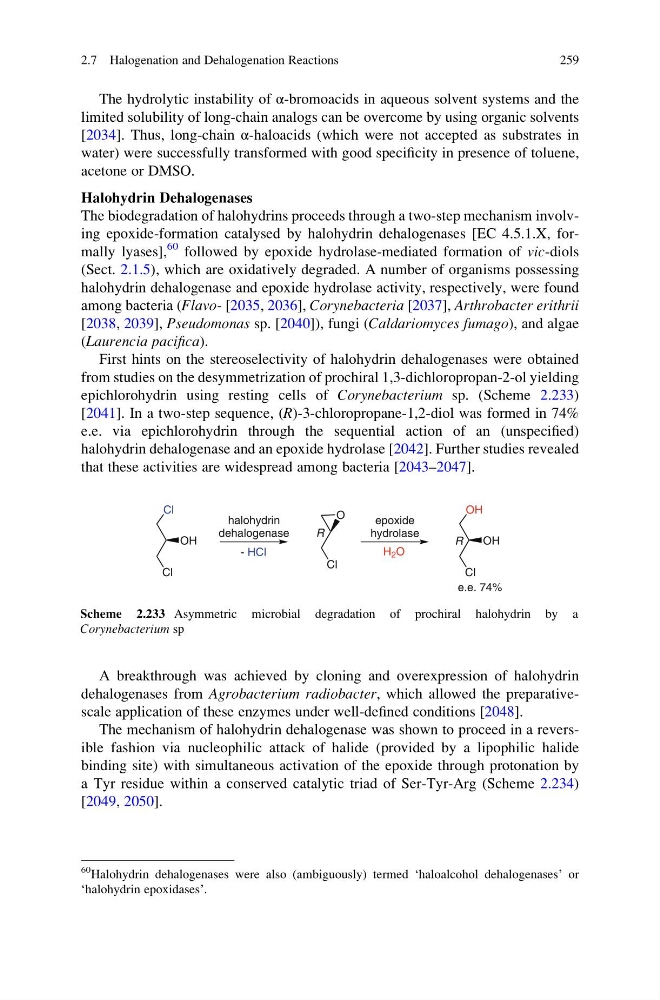
First hints on the stereoselectivity of halohydrin dehalogenases were obtained
from studies on the desymmetrization of prochiral 1,3-dichloropropan-2-ol yielding
epichlorohydrin using resting cells of Corynebacterium sp. (Scheme 2.233)
[2041]. In a two-step sequence, (R)-3-chloropropane-1,2-diol was formed in 74%
e.e. via epichlorohydrin through the sequential action of an (unspecified)
halohydrin dehalogenase and an epoxide hydrolase [2042]. Further studies revealed
that these activities are widespread among bacteria [2043–2047].
A breakthrough was achieved by cloning and overexpression of halohydrin
dehalogenases from Agrobacterium radiobacter, which allowed the preparativescale application of these enzymes under well-defined conditions [2048].
The mechanism of halohydrin dehalogenase was shown to proceed in a reversible fashion via nucleophilic attack of halide (provided by a lipophilic halide
binding site) with simultaneous activation of the epoxide through protonation by
a Tyr residue within a conserved catalytic triad of Ser-Tyr-Arg (Scheme 2.234)
[2049, 2050].
O
Cl
OH
Cl
Cl
OH
Cl
OH
e.e. 74%
halohydrin
dehalogenase
epoxide
hydrolase
H 2 O
R
R
- HCl
Scheme 2.233 Asymmetric microbial degradation of prochiral halohydrin by a
Corynebacterium sp
60 Halohydrin dehalogenases were also (ambiguously) termed ‘haloalcohol dehalogenases’ or
‘halohydrin epoxidases’.
2.7 Halogenation and Dehalogenation Reactions
259
limited solubility of long-chain analogs can be overcome by using organic solvents
[2034]. Thus, long-chain α-haloacids (which were not accepted as substrates in
water) were successfully transformed with good specificity in presence of toluene,
acetone or DMSO.
Halohydrin Dehalogenases
The biodegradation of halohydrins proceeds through a two-step mechanism involving epoxide-formation catalysed by halohydrin dehalogenases [EC 4.5.1.X, formally lyases],
60 followed by epoxide hydrolase-mediated formation of vic-diols
(Sect. 2.1.5), which are oxidatively degraded. A number of organisms possessing
halohydrin dehalogenase and epoxide hydrolase activity, respectively, were found
among bacteria (Flavo- [2035, 2036], Corynebacteria [2037], Arthrobacter erithrii
[2038, 2039], Pseudomonas sp. [2040]), fungi (Caldariomyces fumago), and algae
(Laurencia pacifica).
First hints on the stereoselectivity of halohydrin dehalogenases were obtained
from studies on the desymmetrization of prochiral 1,3-dichloropropan-2-ol yielding
epichlorohydrin using resting cells of Corynebacterium sp. (Scheme 2.233)
[2041]. In a two-step sequence, (R)-3-chloropropane-1,2-diol was formed in 74%
e.e. via epichlorohydrin through the sequential action of an (unspecified)
halohydrin dehalogenase and an epoxide hydrolase [2042]. Further studies revealed
that these activities are widespread among bacteria [2043–2047].
A breakthrough was achieved by cloning and overexpression of halohydrin
dehalogenases from Agrobacterium radiobacter, which allowed the preparativescale application of these enzymes under well-defined conditions [2048].
The mechanism of halohydrin dehalogenase was shown to proceed in a reversible fashion via nucleophilic attack of halide (provided by a lipophilic halide
binding site) with simultaneous activation of the epoxide through protonation by
a Tyr residue within a conserved catalytic triad of Ser-Tyr-Arg (Scheme 2.234)
[2049, 2050].
O
Cl
OH
Cl
Cl
OH
Cl
OH
e.e. 74%
halohydrin
dehalogenase
epoxide
hydrolase
H 2 O
R
R
- HCl
Scheme 2.233 Asymmetric microbial degradation of prochiral halohydrin by a
Corynebacterium sp
60 Halohydrin dehalogenases were also (ambiguously) termed ‘haloalcohol dehalogenases’ or
‘halohydrin epoxidases’.
2.7 Halogenation and Dehalogenation Reactions
259