

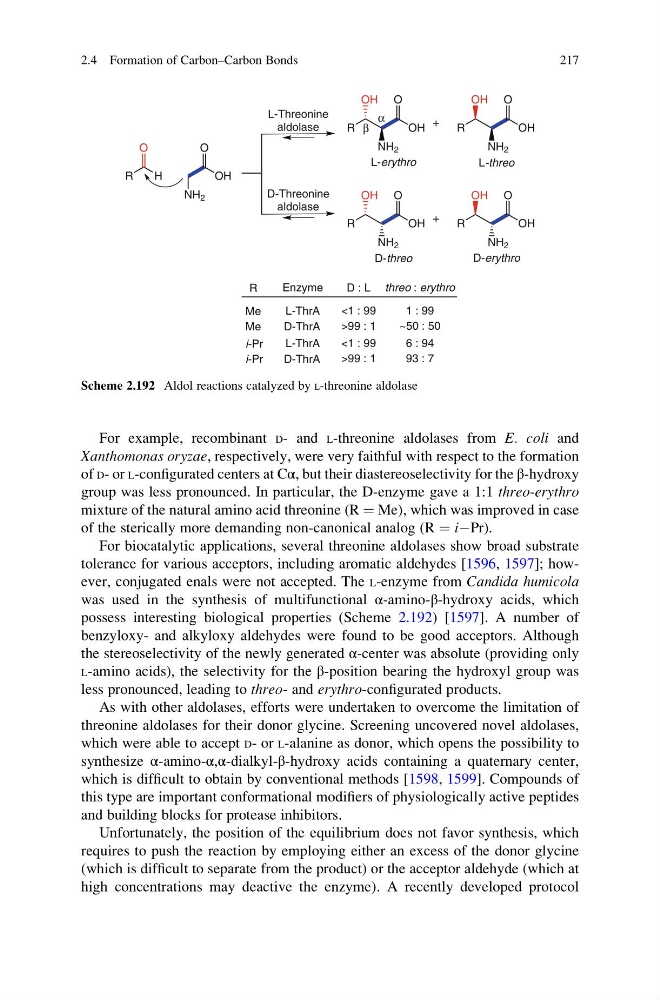
For example, recombinant D- and L-threonine aldolases from E. coli and
Xanthomonas oryzae, respectively, were very faithful with respect to the formation
of D- or L-configurated centers at Cα, but their diastereoselectivity for the β-hydroxy
group was less pronounced. In particular, the D-enzyme gave a 1:1 threo-erythro
mixture of the natural amino acid threonine (R ¼ Me), which was improved in case
of the sterically more demanding non-canonical analog (R ¼ iÀPr).
For biocatalytic applications, several threonine aldolases show broad substrate
tolerance for various acceptors, including aromatic aldehydes [1596, 1597]; however, conjugated enals were not accepted. The L-enzyme from Candida humicola
was used in the synthesis of multifunctional α-amino-β-hydroxy acids, which
possess interesting biological properties (Scheme 2.192) [1597]. A number of
benzyloxy- and alkyloxy aldehydes were found to be good acceptors. Although
the stereoselectivity of the newly generated α-center was absolute (providing only
L-amino acids), the selectivity for the β-position bearing the hydroxyl group was
less pronounced, leading to threo- and erythro-configurated products.
As with other aldolases, efforts were undertaken to overcome the limitation of
threonine aldolases for their donor glycine. Screening uncovered novel aldolases,
which were able to accept D- or L-alanine as donor, which opens the possibility to
synthesize α-amino-α,α-dialkyl-β-hydroxy acids containing a quaternary center,
which is difficult to obtain by conventional methods [1598, 1599]. Compounds of
this type are important conformational modifiers of physiologically active peptides
and building blocks for protease inhibitors.
Unfortunately, the position of the equilibrium does not favor synthesis, which
requires to push the reaction by employing either an excess of the donor glycine
(which is difficult to separate from the product) or the acceptor aldehyde (which at
high concentrations may deactive the enzyme). A recently developed protocol
NH 2
O
OH
NH 2
OH O
OH
R
NH 2
OH O
OH
R
O
H
R
β
α
L-threo
L-erythro
L-Threonine
aldolase
+
D-Threonine
aldolase
NH 2
OH O
OH
R
NH 2
OH O
OH
R
D-erythro
D-threo
+
R
Enzyme
D : L threo : erythro
Me
Me
L-ThrA
D-ThrA
<1 : 99
1 : 99
>99 : 1
~50 : 50
i-Pr
i-Pr
L-ThrA
D-ThrA
<1 : 99
6 : 94
>99 : 1
93 : 7
Scheme 2.192 Aldol reactions catalyzed by L-threonine aldolase
2.4 Formation of Carbon–Carbon Bonds
217
Xanthomonas oryzae, respectively, were very faithful with respect to the formation
of D- or L-configurated centers at Cα, but their diastereoselectivity for the β-hydroxy
group was less pronounced. In particular, the D-enzyme gave a 1:1 threo-erythro
mixture of the natural amino acid threonine (R ¼ Me), which was improved in case
of the sterically more demanding non-canonical analog (R ¼ iÀPr).
For biocatalytic applications, several threonine aldolases show broad substrate
tolerance for various acceptors, including aromatic aldehydes [1596, 1597]; however, conjugated enals were not accepted. The L-enzyme from Candida humicola
was used in the synthesis of multifunctional α-amino-β-hydroxy acids, which
possess interesting biological properties (Scheme 2.192) [1597]. A number of
benzyloxy- and alkyloxy aldehydes were found to be good acceptors. Although
the stereoselectivity of the newly generated α-center was absolute (providing only
L-amino acids), the selectivity for the β-position bearing the hydroxyl group was
less pronounced, leading to threo- and erythro-configurated products.
As with other aldolases, efforts were undertaken to overcome the limitation of
threonine aldolases for their donor glycine. Screening uncovered novel aldolases,
which were able to accept D- or L-alanine as donor, which opens the possibility to
synthesize α-amino-α,α-dialkyl-β-hydroxy acids containing a quaternary center,
which is difficult to obtain by conventional methods [1598, 1599]. Compounds of
this type are important conformational modifiers of physiologically active peptides
and building blocks for protease inhibitors.
Unfortunately, the position of the equilibrium does not favor synthesis, which
requires to push the reaction by employing either an excess of the donor glycine
(which is difficult to separate from the product) or the acceptor aldehyde (which at
high concentrations may deactive the enzyme). A recently developed protocol
NH 2
O
OH
NH 2
OH O
OH
R
NH 2
OH O
OH
R
O
H
R
β
α
L-threo
L-erythro
L-Threonine
aldolase
+
D-Threonine
aldolase
NH 2
OH O
OH
R
NH 2
OH O
OH
R
D-erythro
D-threo
+
R
Enzyme
D : L threo : erythro
Me
Me
L-ThrA
D-ThrA
<1 : 99
1 : 99
>99 : 1
~50 : 50
i-Pr
i-Pr
L-ThrA
D-ThrA
<1 : 99
6 : 94
>99 : 1
93 : 7
Scheme 2.192 Aldol reactions catalyzed by L-threonine aldolase
2.4 Formation of Carbon–Carbon Bonds
217