

The following methods have been used to avoid the (often tedious) separation of
diastereomeric products [546].
• Efficient kinetic resolution of α-hydroxyaldehydes can be achieved by inserting
a negative charge (such as phosphate or carboxylate) at a distance of four to five
atoms from the aldehydic center in order to enhance the binding of the acceptor
substrate [1548].
• In some cases, a diastereoselective aldol reaction can be accomplished in a
kinetically controlled process via kinetic resolution of the racemic
α-substituted aldehyde. Thus, if the reaction is stopped before it reaches equilibrium, a single diastereomer is predominantly formed. However, as mentioned
above, the selectivities of aldolases for such kinetic resolutions involving recognition of the (remote) chirality on the α-carbon atom of the aldehyde are
usually low.
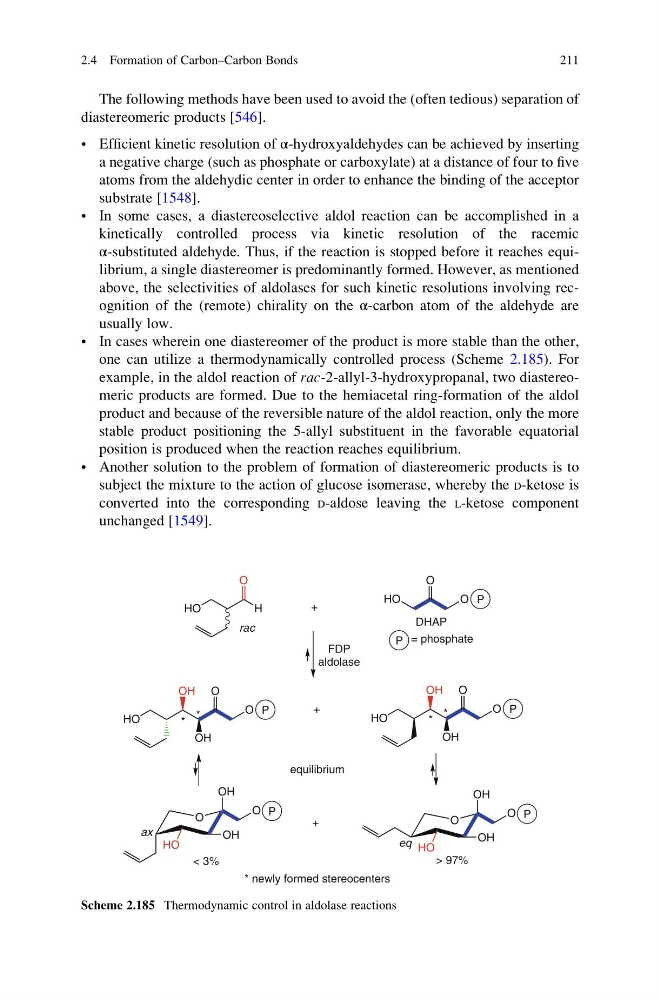
• In cases wherein one diastereomer of the product is more stable than the other,
one can utilize a thermodynamically controlled process (Scheme 2.185). For
example, in the aldol reaction of rac-2-allyl-3-hydroxypropanal, two diastereomeric products are formed. Due to the hemiacetal ring-formation of the aldol
product and because of the reversible nature of the aldol reaction, only the more
stable product positioning the 5-allyl substituent in the favorable equatorial
position is produced when the reaction reaches equilibrium.
• Another solution to the problem of formation of diastereomeric products is to
subject the mixture to the action of glucose isomerase, whereby the D-ketose is
converted into the corresponding D-aldose leaving the L-ketose component
unchanged [1549].
O
H
HO
HO
OH
O
OH
O
HO
OH
O
OH
O
O
O
HO
O
OH
OH
O
HO
O
OH
OH
O
HO
* newly formed stereocenters
*
*
eq
ax
rac
+
< 3%
> 97%
+
FDP
aldolase
+
DHAP
= phosphate
*
*
equilibrium
P
P
P
P
P
P
Scheme 2.185 Thermodynamic control in aldolase reactions
2.4 Formation of Carbon–Carbon Bonds
211
diastereomeric products [546].
• Efficient kinetic resolution of α-hydroxyaldehydes can be achieved by inserting
a negative charge (such as phosphate or carboxylate) at a distance of four to five
atoms from the aldehydic center in order to enhance the binding of the acceptor
substrate [1548].
• In some cases, a diastereoselective aldol reaction can be accomplished in a
kinetically controlled process via kinetic resolution of the racemic
α-substituted aldehyde. Thus, if the reaction is stopped before it reaches equilibrium, a single diastereomer is predominantly formed. However, as mentioned
above, the selectivities of aldolases for such kinetic resolutions involving recognition of the (remote) chirality on the α-carbon atom of the aldehyde are
usually low.
• In cases wherein one diastereomer of the product is more stable than the other,
one can utilize a thermodynamically controlled process (Scheme 2.185). For
example, in the aldol reaction of rac-2-allyl-3-hydroxypropanal, two diastereomeric products are formed. Due to the hemiacetal ring-formation of the aldol
product and because of the reversible nature of the aldol reaction, only the more
stable product positioning the 5-allyl substituent in the favorable equatorial
position is produced when the reaction reaches equilibrium.
• Another solution to the problem of formation of diastereomeric products is to
subject the mixture to the action of glucose isomerase, whereby the D-ketose is
converted into the corresponding D-aldose leaving the L-ketose component
unchanged [1549].
O
H
HO
HO
OH
O
OH
O
HO
OH
O
OH
O
O
O
HO
O
OH
OH
O
HO
O
OH
OH
O
HO
* newly formed stereocenters
*
*
eq
ax
rac
+
< 3%
> 97%
+
FDP
aldolase
+
DHAP
= phosphate
*
*
equilibrium
P
P
P
P
P
P
Scheme 2.185 Thermodynamic control in aldolase reactions
2.4 Formation of Carbon–Carbon Bonds
211